Showing posts with label ARRL Field Day. Show all posts

Thursday, June 22, 2023

ARRL Field Day 2023: Past Hudson Division Site Participation


Back in 2020, we saw the full effect of what COVID did to ARRL Field Day site participation. The total number of participants shrank, but the number of actual "on air" participants increased greatly.

Everyone who organizes an ARRL Field Day operation and who submits logs back to the ARRL collects an attendance sheet and is how site participation is measured. Participants can be those who operate over the air or just come to help with setting up the event or socializing.  

In 2023, those who participated from home the past few years hopefully rejoin us out in the field in the true spirit of what makes field day a real field day.

A few years ago Hudson Valley Digital Network (HVDN) decided to take the publicly available ARRL Field Day data and continue running some analytics about the event, just like we do with global Digital Voice Repeaters.  If interested in past related articles, please use the our search function in upper right of page.

For 2023, the COVID impacts should be not great and site participation should rebound in a big way. 

Weather conditions in some parts of the United States may impact site participation this year, but most who organize ARRL Field Day sites know how to plan around the weather to pull off a great 24 hour preparedness event. Are you ready?

This will also be the first year that HVDN officially participates in ARRL Field Day using our N2HVD callsign. More details on where and what we are doing along with the UNDR Group is listed on its blog page along with details on the search and rescue inspired radio direction finding challenge.

Local ARRL Field Day Participation

Here in what is known as the ARRL Hudson Division and overall site participation has seen an increase in site participation compared to the event wide average.  This is a great trend to see considering that overall attendance across the event has declined over the past 13 years.


Here is a view comparing average site attendance by each of the three sections within Hudson Division. 

Based on the data below, the Northern New Jersey Section with few exceptions has had the smallest average site participation whereas the Eastern New York Section has continued to show higher turnout from those looking to participate in ARRL Field Day.   

Within New York City/Long Island has shown some issues and could be due to people moving out of the area, such as a number of Hudson Valley Digital Network (HVDN) members who decided to move north for better access to public spaces or lower cost of living.


Accept This Challenge Now!

It does not matter if you stay at home and operate as a 1D or 1E station,  plan to join a few friends as part of a small B or C class operation  or be part of a club operation within A class or at an emergency operations center as F class, the point is get out there and enjoy ARRL Field Day this year and keep our local division growing. 

The part two of this article will cover how did Hudson Division do this year in terms of site participation after the event. There may also be a part three later this year when we have full event details to compare against national averages.

Here is the official ARRL Field Day Station Locator map with public sites listed. Based on Hudson Division Sections, a listing of Class A participants is below as of the time of this article a few days before the 2023 event for those organizing "A" class field day sites. The full dataset used to create the above charts is available here.


New York City & Long Island

  1. K2GSG - Garden School Amateur Radio Club
  2. NW2C - NorthEast Wireless Radio Club
  3. KC2RC - Kings County Radio Club
  4. K2VN - Nassau Amateur Radio Club
  5. W2VL - Long Island Mobile Amateur Radio Club
  6. W2GSB - Great South Bay Amateur Radio Club
  7. W2LRC - Larkfield Amateur Radio Club
  8. W2DQ - Suffolk County Radio Club
  9. W2RC - Radio Central Amateur Radio Club & Order of Boiled Owls
  10. W2AMC - Peconic Amateur Radio Club
  11. K2EC - Bonac Amateur Radio Club

Eastern New York

  1. N2SF - Westchester Emergency Communications Association
  2. W2NYW - Peekskill Cortlandt Amateur Radio Association
  3. K2PUT - Putnam Emergency Amateur Radio League
  4. W2HO - Orange County Amateur Radio Club
  5. K2QS - The QSY Society
  6. N2HVD - HVDN & UNDR Group - Taconic - Hereford MUA
  7. N2LL - Overlook Mountain Amateur Radio Club - Ferncliff Forest
  8. K2OMD - Overlook Mountain Amateur Radio Club  - Norrie Park (Not listed on map)
  9. W2EGB - East Greenbush Amateur Radio Association
  10. K2CT/NY2U - Albany Amateur Radio Association & Troy Amateur Radio Association
  11. W2IR/K2AE - Broughton Memorial Field Day Group
  12. K2DLL - Saratoga County Amateur Radio Association
  13. W2F - Eastern Fulmont/Mohawk Valley
  14. WA2ZWM - Schoharie County Amateur Radio Association
  15. W2WCR - Warren County Radio Club

Northern New Jersey

  1. W2NPT - Fairlawn Amateur Radio Club
  2. N2FLO - Franklin Lakes Office of Emergency Management
  3. W2EF - West Essex Amateur Radio Club
  4. W2YD - Morris Radio Club/Hanover Township Office of Emergency Management
  5. WS2R - Splitrock Amateur Radio Association
  6. W2LV - Sussex County Amateur Radio Club
  7. N2XJ - New Providence Amateur Radio Club
  8. K2ZV - Carteret Volunteers Amateur Radio Club
  9. NJ2SP - South Plainfield Amateur Radio Club
  10. W2CRA - Cherryville Repeater Association 

Wednesday, January 19, 2022

Class C: Benefits for ARRL Field Day


ARRL Field Day takes place the last full weekend of June and sometimes runs into challenges with other events such as graduations.

Large club run Class A operations become challenging to put together when key club members can not dedicate the right time to planning or participating in a proper field day event.

Often times, the logistics of setting up tents, renting portable toilets, figuring out how to feed people and deciding how to power all the radio and additional equipment for 24 hours becomes complicated.

All this extra equipment also takes up a lot of room and not every club has a storage unit or trailer to contain all of this stuff.  

Many clubs depend on members to bring certain things like chairs, tables, grills, and many other items to help distribute the annoyances. 

But, what happens when some members in a club get too old or lose interest in field day?  

If they were responsible for bringing certain items year over year, the club now has a tough decision to make.  Buying items with club funds sometimes is problematic if finance is an issue.  

New or younger members in a club may have items, but do not want to commit to being at a field day site for the entire time to ensure those items do not get damaged or misplaced.

What is the solution to field day if large Class A club oriented operation is a growing concern?

Lets talk about Class C Mobile operation!

Directly from the ARRL Field Day rules, the definition of Class C is as follows:


This seems pretty clear.  Most people have a car, but not everyone has a stationary camper.  Getting your gear to a field day site is easy and you can find more places to set up for some or all of the event. 

If you wish to try field day and camping, class C operation offers a good combination to try if you are able and willing.

What if you have a few friends who also like to camp and have a car,  you can all go separately to the same campground and operate independent from each other.  

Or, maybe you all like amateur radio but not the club oriented issues that arise with complicated politics.  How can you operate field day?   Class C might be with a look.

Class C operation for field day offers many benefits and it seems that there is some data to back this up.

Review:  What is this chart?

New York State (ARRL Sections NLI, ENY, NNY, WNY) - By Class with CAGR


June in New York is a great time to be outside or go for a drive! 

The above chart shows at various points in time over the last 12 years how each class of station participated in ARRL Field Day.   

Past Reading

Looking at Class C data using CAGR from 2010 to 2021 (12 Years),  there is a clear growth and has gotten even stronger more recently when just measuring CAGR between 2016 to 2021 (6 Years)

Even during and after COVID, the growth is still there.  While the 2019 to 2021 COVID era did decrease Class C growth slightly,  it was still very strong considering that most stations (not participants) stayed home and operated in Class D style.

Is Class C the new Class A?

Solar cycles do impact when people show interest in amateur radio if they are focused on HF spectrum communications. As we enter Cycle 25, it is hard to say if we will see Class A operations increase again or if we will see other classes decrease.

Operating as Class C offers a lot of flexibility, so lets explore some scenarios to give you some ideas.

Scenario X - Bob the quadplexer man

Our fictitious friendly amateur named Bob has a device called a quadplexer which allows one multiband antenna to be connected to up to four different radios, each using a different band such as 15m, 20m, 40m and 80m or maybe 10m, 15m, 20m, 40m. 

When a quadplexer is combined with an end fed wire antenna or trapped dipole, there is no risk of interference with your friends who also wish to be part of field day at the same time as you.

Add in the appropriate feedline, jumper cables and a portable mast kit,  it is really easy to deploy a class 4C  station or four separate 1C stations. and every one can stay in personal vehicles if needed, but all attached to the same common antenna system.

Alternatively, if you create a club, this is very easy to move from Class C to a Class 4A station

Everyone like's what Bob offers with this setup which only cost him less than $800 USD for everything.  All of Bob's friends buy the same setup for next year, just incase if Bob is not available.


Is Class C popular?

The growth is there, but there is no volume.  Have you looked at your logs to see how many Class C stations you worked during ARRL Field Day in the past?  Lets use some data to see where the Class C stations tend to be based on FCC Callsign Area analysis.


2,203:  That is it over 12 years

42,788 total stations have been part of ARRL Field Day over the last 12 years.   This means that only 5.14% of all stations were Class C.  That would make them pretty rare to log during the event.

Chances are that you more than likely made contact with a "four-land" or "nine-land" station that was operating some form of Class C operation if you look at the above data.

If you only ever thought your options were to stay home (Class D),  be part of a club (Class A) or go out on foot (Class B) or visit your county EOC (Class F),  hopefully Class C may appeal to you as an alternative to Class E (at home alternative power)

Tuesday, January 18, 2022

Blips that Bleep: CAGR & ARRL Field Day Analysis

Lets talk about compound annual growth rates (CAGR) which is used to figure out the growth of something over a certain period of time.  The equation for that calculation is:


The benefit of using CAGR is that it smooths out anomalies to not be distracted by the so called "blips" in data.  

Using CAGR is not the best way to determine trends nor is it the best methodology for different forms of  forecasting.

However, showing how to use CAGR for data that an amateur radio person may understand is the goal here through the ARRL Field Day analysis lens.

Yes, I just did use the word "blip" in a somewhat scientific way. Here is what I mean in  real life context.

Blip: Using data we understand?

The ARRL Field Day event is an annual exercise where groups or individuals who have amateur radio licenses see who can make the most radio contacts in a 24 hour period in the last weekend of June. 

For over 80 years, this event sponsored by the ARRL has been taking place and as its name implies, has a strong focus on field operation compared to just sitting at home.  

This event gamifies a level of preparedness in a very social way which also teaches different readiness skills.  Overall, it is a lot of fun.

Until COVID, it was always encouraged to get outside or use emergency power or temporary antenna to help see how effective everyone could be in less than optimal conditions for ARRL Field Day. 


But, because social gathering during a pandemic and involving higher "health/age risk" populations is not a good idea, some temporary rule changes for how field day operates have been made in 2021 and 2022.

There are different classifications of participants.  The "D" class stands for a home participant doing nothing different than normal.  The "A" classification is for fully off grid powered and temporary antenna based club stations. 

There are other classifications such as B, C, E and F as well with specific definitions which covers everything from single portable operators to those involved in a county emergency command center locations.

Different classes for the masses?

The number of transmitters capable of being on the air at the same time is appended to the station class. For example, a 1D is a single operator at home using one transmitter at a time.  

Another example would be the 4A which would be a club operating totally temporary from some location other than home and using four transmitters at any time.    The 1B1B class is a pair of operators each using a different radio and/or antenna.

Rule adjustments due to COVID basically permit at home stations (Class D) to aggregate scores up to Class A clubs if they would like in order to show support. 

But, this is not reflected in the total stations participating which is why looking at station classes is a good way to look at this event.

-----

A copy of the ARRL Field Day 2021 rules can be found here: https://contests.arrl.org/ContestRules/Field-Day-Rules.pdf 

-----

We need charts: Lets look at some interesting data now thanks to the HVDN ARRL Field Day Tracker tool. 


The above table shows the top 20 station classifications in ARRL Field Day in 2019, 2020 and 2021. Each column shows the total number of stations categorized in each of those classifications. This does not show participants, but the actual station classifications. 

Blip Blip: 3 Year Data Analysis 

Looking at only 3 years of data covering 2019, 2020 and 2021 we see some interesting data, but it is not really possible to call these a trend.  Why?  It is because of the BLIP in 2020.

Do you see the huge BLIP in the table above?  If you missed it, have a look at the Class D data in 2020 and 2021.

Before COVID,  it was really rare to make contact with a 1D and 1E station during the event, if we look just at 2019 pre-COVID results.  Using CAGR in this small data set does not tell the whole truth, especially when factoring in the 2020 "blip" year.

With about 2,926 stations, which is different than total participants, taking part of the event in 2019,  it almost appears that the COVID years show huge growth in total stations.  


However, looking at the data, its clear that those who stayed home as 1D stations did nothing different than turn on the radio and do anything differently than normal operation. 

The "E" class trend which is home based, but emergency power based stations is surprising how much it grew in 2020 but shrank in 2021.  However, this is still well above average normalcy based on a 12 year long data set available. 

Overall, it is really hard to analyze these 3 years against each other to discover the true health of amateur radio via the lens of ARRL Field Day.

More Data: Lets look at the 10+ year CAGR trends instead 

To really understand these trends about who is operating during field day or how, we really need a wider data set, so lets looks at 2010 to 2019 separately for now.


In the above chart, its pretty clear to see that Class A stations have been declining before COVID was even known about.  

The Class D stations have been slowly rising.  The Class B family of operators has also been increasing. What does this tell us from 2010 to 2019 data?

  • Amateur radio clubs (Class A) are starting to decline in how they approach Field Day.
  • At home stations (Class D) grow with many reasons such as health, safety and age contributing .
  • The B class 1-2 person portable running battery increases.
  • The emergency power at home Class E stations are increasing.

The 12 year bigger picture about ARRL Field Day

Data tends to scare people, especially if it provides fact versus opinion. 

Looking at just the numbers for 12 years of total ARRL Field Day Data, it is hard to find trends unless you analyze data as your profession.


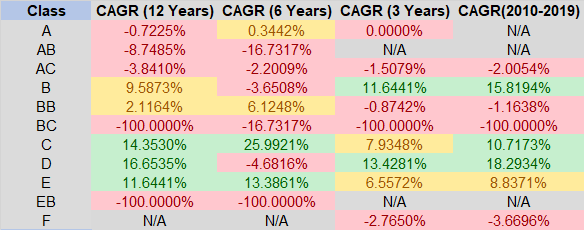
Getting back to using Compound Annual Growth Rates, we can show trends either over a span of 3 years (2019 to 2021), 6 years (2016 to 2021) or the full 12 years (2010 to 2021).  We can also look just at 2010 to 2019.  

If we color code the CAGR values to show red as below zero percent, yellow as between zero to ten percent and green as greater than ten percent, here is what that looks like.  

The below charts are for all field day data and not just for specific regions. It is a complete view of the overall event.

Reading the below charts
  • Red = Less than 0%
  • Yellow = 0.001% to 9.999%
  • Green = More than 10.000%


The below three charts (C1, C2, C3) isolate by color this table to allow for more focused analysis.

 
Lets talk about the "Red" Cells

Values that you see as -100.00% are no cause for concern.  In some years, there were no stations that operated as those classifications in the growth period, so that data needs to get tossed out. Same with the one cell that lists 0.00% under the Class BC.   Same goes with the EB Class.

This leaves us with something important to talk about  relative mostly to Class A operation. 

No matter how we look at the data and model for growth, it is clear that larger club operations are starting to slowly decline.  

It is not high single or double digit declines yet, but it is worth thinking about as we enter what is hopefully a growth cycle thanks to increasing sun spots in Cycle 25 which we are only just starting to benefit from for HF communications.

The ARRL is already marking Cycle 25 as being important to amateur radio which I agree with completely, so lets hope this is true and we see larger Class A operations increase again. 

Chart C1

Lets talk about the "Yellow" Cells

A great point to highlight is that no matter what time period calculated in the data above, overall we see some type of growth. 

The Class B family of stations really need to be focused on as a positive as well along with continued growth within the Class E stations participating in ARRL Field Day.

Chart C2


Lets talk about the "Green" Cells

While few and far between, since these only include growth over 10%,  given that the event is called "Field Day", it seems slightly wrong to look at this growth as a positive when talking about Class D stations here.  

However, if more Class D can convert to off grid powered Class E stations, that is a move in the right direction. 

If the ARRL can find ways to encourage the use of battery power via large power banks, that could maybe start moving home stations back out into the field.   

Bulky and dangerous gas powered generators might be worth considering being taken out of service to encourage more green technology to be used in the future.   This can prove a very large benefit thanks to the ARRL perhaps leading this green energy change.

Chart C3


Regional Analysis of ARRL Field Day

The HVDN ARRL Field Day Tracker tool was built upon publicly available data available from the ARRL.  Some of the data analysis additions added include an FCC Region and aggregate class tracker.

These additions help illustrate regional differences easily in additional to divisional and sectional differences in data. Without pointing fingers, here is what would be interesting to readers in the Hudson Valley. 

The goal is to interpret this data and see what trends can be determined or any improvements or adjustments be made for how almost everyone may approach field day in the future.

FCC Call Region Two ARRL Field Day - By Class with CAGR 


New York State (ARRL Sections NLI, ENY, NNY, WNY) - By Class with CAGR


ARRL Hudson Division (ARRL Sections ENY, NLI, NNJ) - By Class with CAGR


ARRL ENY Section - By Class with CAGR


Thank you for reading this article. If you would like the source data in an excel workbook, please contact Steve Bossert at K2GOG@yahoo.com


Friday, January 7, 2022

2021: Analyzing ARRL Field Day Finally

With 2021 finally behind us,  the results of the ARRL 2021 Field Day event are available.

Building upon the past HVDN analysis from the public ARRL data sources, lets have a look at how 2021 compared to 2020 plus how the event fared against an average taken from 2010-2019.

There are so many positives that came from ARRL Field Day 2021, so the goal of this article is to present the data  along with fact based comments regarding this data.  There are no secret or hidden agendas as part of this analysis, contrary to what some people might think.

The goal of sharing this data in a visualized format is to help understand trends at the national, regional and sectional basis. Plus, if it matters, how everyone may have improved over years past.

For a quick refresh, here are two past articles to help understand the journey in tracking this data.

Activity Tracker:  Version 2021

The data shows an increase of 8,610 additional participants in 2021 compared to 2020.  For the period of 2010 to 2019, the average annual participation has been 36,800.  

This means that the past two years based on an average comparison against 10 years of historical data, is that we are still below normal levels.  

No surprise, but COVID certainly is the main reason to blame, but there could be some other underlying factors such as age, housing and health worth thinking about.


Data generated from HVDN ARRL Field Day Tracker - Version 21
(Photo Source: HVDN.org)


In 2016, the ARRL started tracking the number of transmitters in use as well as the type of power source used during field day. 

2020 saw a huge increase in the number of transmitters mainly because of how participants were tracked.  Participants were able to stay at home and share scores to roll up to a club if needed. 

This was a big success, but it seems that while participation increased in 2021 compared to 2020 which is a 48.43% positive change, the number of transmitters decreased from 10,977 to 8370 which is a 23.74% decrease.

When looking at the different power sources, there is a 38.77% decrease between 2020 to 2021. 

In order to figure out the changes in how participants got on the air in 2021 for field day,  diving deeper into ARRL section and specific callsigns is needed.  This data is available in our larger data set for those who wish to come to conclusions.

QSO Tracker: Version 2021

For the year 2021, a total of 1,421,785 contacts (QSOs) took place during this 24 hour long event.  While participation did see an increase, the total number of QSO did decrease compared to 2020.  

A total of 1,787,929 were counted in 2020, so this works out to a decrease of 20.47%. 

Compared to the average QSO totals from 2010 to 2019, which is 1,265,399,  the year 2021 still trended above the average by 12.35%. This is a very good thing to see.  However, for comparison sake,  2020 compared to the 10 year average was 41.29%.   


Data generated from HVDN ARRL Field Day Tracker - Version 21
(Photo Source: HVDN.org)

The types of contacts when broken down by voice versus non-voice is an interesting set of data to compare. 

Here are some comparisons:


Data generated from HVDN ARRL Field Day Tracker - Version 21
(Photo Source: HVDN.org)

ARRL FCC Call Sign Regional Participation

The ARRL Field Day provided data does not share this, but is simple to calculate based on the ARRL sections.  

Looking at FCC based regional callsign participation gives us a good snapshot of where amateur radio is especially strong or weak without picking on anyone, be it a local club or ARRL section.

Data generated from HVDN ARRL Field Day Tracker - Version 21
(Photo Source: HVDN.org)

In the above pie chart, it is amazing that there is almost as much participation from Canada as compared the the North Eastern United States in call area one.  

The largest FCC call area since 2010 to 2021 is four. While call area two is the most populous by area, it is unfortunate that participation certainly continues to be curious, so looking at the data year by year is the next level to analyze.

Data generated from HVDN ARRL Field Day Tracker - Version 21
(Photo Source: HVDN.org)


The chart above clearly shows macro trends on where there is likely the most amateur radio activity related to ARRL Field Day participation.  

Considering that New York and New Jersey make up the FCC two call area, there needs to be some evaluation as to why participation continues to decline compared to areas such as one and three which are closest in proximity, which may rule out weather as the sole cause.


ARRL Call District Map, modified by AA7OA
(Photo Source:  Google.com search)


Looking Deeper:   ARRL Sectional or Station Details

Some people recently think that HVDN has some agenda in presenting material like this or the state of other parts in amateur radio that are not presenting to the full potential to help expand this great hobby to a new generation.  HVDN has no such bias in any way.  

Our goal is to present data like this and to help illustrate where things are falling apart so that they can be fixed via alternate approaches locally or maybe elsewhere.  We do not claim to have the answers, but are focused on solving things as long as others wish to be involved.

Get data access for $1/month plus much more

If you are interested in accessing our data compilation, which was sourced directly from the ARRL, we kindly suggest becoming an associate member of HVDN for $12 a year.  

Not only will you be able to access the data,  one of the HVDN members very fluent in excel and pivot tables plus visualizations can help you prepare customized views of this data for you to use in your club or regional presentations about ARRL Field Day and the benefits it brings by being part of this great event.


To access this data, please consider becoming an HVDN associate member by visiting https://hvdn.org/join-hvdn