Showing posts with label Field Day. Show all posts

Thursday, June 22, 2023

ARRL Field Day 2023: Past Hudson Division Site Participation


Back in 2020, we saw the full effect of what COVID did to ARRL Field Day site participation. The total number of participants shrank, but the number of actual "on air" participants increased greatly.

Everyone who organizes an ARRL Field Day operation and who submits logs back to the ARRL collects an attendance sheet and is how site participation is measured. Participants can be those who operate over the air or just come to help with setting up the event or socializing.  

In 2023, those who participated from home the past few years hopefully rejoin us out in the field in the true spirit of what makes field day a real field day.

A few years ago Hudson Valley Digital Network (HVDN) decided to take the publicly available ARRL Field Day data and continue running some analytics about the event, just like we do with global Digital Voice Repeaters.  If interested in past related articles, please use the our search function in upper right of page.

For 2023, the COVID impacts should be not great and site participation should rebound in a big way. 

Weather conditions in some parts of the United States may impact site participation this year, but most who organize ARRL Field Day sites know how to plan around the weather to pull off a great 24 hour preparedness event. Are you ready?

This will also be the first year that HVDN officially participates in ARRL Field Day using our N2HVD callsign. More details on where and what we are doing along with the UNDR Group is listed on its blog page along with details on the search and rescue inspired radio direction finding challenge.

Local ARRL Field Day Participation

Here in what is known as the ARRL Hudson Division and overall site participation has seen an increase in site participation compared to the event wide average.  This is a great trend to see considering that overall attendance across the event has declined over the past 13 years.


Here is a view comparing average site attendance by each of the three sections within Hudson Division. 

Based on the data below, the Northern New Jersey Section with few exceptions has had the smallest average site participation whereas the Eastern New York Section has continued to show higher turnout from those looking to participate in ARRL Field Day.   

Within New York City/Long Island has shown some issues and could be due to people moving out of the area, such as a number of Hudson Valley Digital Network (HVDN) members who decided to move north for better access to public spaces or lower cost of living.


Accept This Challenge Now!

It does not matter if you stay at home and operate as a 1D or 1E station,  plan to join a few friends as part of a small B or C class operation  or be part of a club operation within A class or at an emergency operations center as F class, the point is get out there and enjoy ARRL Field Day this year and keep our local division growing. 

The part two of this article will cover how did Hudson Division do this year in terms of site participation after the event. There may also be a part three later this year when we have full event details to compare against national averages.

Here is the official ARRL Field Day Station Locator map with public sites listed. Based on Hudson Division Sections, a listing of Class A participants is below as of the time of this article a few days before the 2023 event for those organizing "A" class field day sites. The full dataset used to create the above charts is available here.


New York City & Long Island

  1. K2GSG - Garden School Amateur Radio Club
  2. NW2C - NorthEast Wireless Radio Club
  3. KC2RC - Kings County Radio Club
  4. K2VN - Nassau Amateur Radio Club
  5. W2VL - Long Island Mobile Amateur Radio Club
  6. W2GSB - Great South Bay Amateur Radio Club
  7. W2LRC - Larkfield Amateur Radio Club
  8. W2DQ - Suffolk County Radio Club
  9. W2RC - Radio Central Amateur Radio Club & Order of Boiled Owls
  10. W2AMC - Peconic Amateur Radio Club
  11. K2EC - Bonac Amateur Radio Club

Eastern New York

  1. N2SF - Westchester Emergency Communications Association
  2. W2NYW - Peekskill Cortlandt Amateur Radio Association
  3. K2PUT - Putnam Emergency Amateur Radio League
  4. W2HO - Orange County Amateur Radio Club
  5. K2QS - The QSY Society
  6. N2HVD - HVDN & UNDR Group - Taconic - Hereford MUA
  7. N2LL - Overlook Mountain Amateur Radio Club - Ferncliff Forest
  8. K2OMD - Overlook Mountain Amateur Radio Club  - Norrie Park (Not listed on map)
  9. W2EGB - East Greenbush Amateur Radio Association
  10. K2CT/NY2U - Albany Amateur Radio Association & Troy Amateur Radio Association
  11. W2IR/K2AE - Broughton Memorial Field Day Group
  12. K2DLL - Saratoga County Amateur Radio Association
  13. W2F - Eastern Fulmont/Mohawk Valley
  14. WA2ZWM - Schoharie County Amateur Radio Association
  15. W2WCR - Warren County Radio Club

Northern New Jersey

  1. W2NPT - Fairlawn Amateur Radio Club
  2. N2FLO - Franklin Lakes Office of Emergency Management
  3. W2EF - West Essex Amateur Radio Club
  4. W2YD - Morris Radio Club/Hanover Township Office of Emergency Management
  5. WS2R - Splitrock Amateur Radio Association
  6. W2LV - Sussex County Amateur Radio Club
  7. N2XJ - New Providence Amateur Radio Club
  8. K2ZV - Carteret Volunteers Amateur Radio Club
  9. NJ2SP - South Plainfield Amateur Radio Club
  10. W2CRA - Cherryville Repeater Association 

Wednesday, January 19, 2022

Class C: Benefits for ARRL Field Day


ARRL Field Day takes place the last full weekend of June and sometimes runs into challenges with other events such as graduations.

Large club run Class A operations become challenging to put together when key club members can not dedicate the right time to planning or participating in a proper field day event.

Often times, the logistics of setting up tents, renting portable toilets, figuring out how to feed people and deciding how to power all the radio and additional equipment for 24 hours becomes complicated.

All this extra equipment also takes up a lot of room and not every club has a storage unit or trailer to contain all of this stuff.  

Many clubs depend on members to bring certain things like chairs, tables, grills, and many other items to help distribute the annoyances. 

But, what happens when some members in a club get too old or lose interest in field day?  

If they were responsible for bringing certain items year over year, the club now has a tough decision to make.  Buying items with club funds sometimes is problematic if finance is an issue.  

New or younger members in a club may have items, but do not want to commit to being at a field day site for the entire time to ensure those items do not get damaged or misplaced.

What is the solution to field day if large Class A club oriented operation is a growing concern?

Lets talk about Class C Mobile operation!

Directly from the ARRL Field Day rules, the definition of Class C is as follows:


This seems pretty clear.  Most people have a car, but not everyone has a stationary camper.  Getting your gear to a field day site is easy and you can find more places to set up for some or all of the event. 

If you wish to try field day and camping, class C operation offers a good combination to try if you are able and willing.

What if you have a few friends who also like to camp and have a car,  you can all go separately to the same campground and operate independent from each other.  

Or, maybe you all like amateur radio but not the club oriented issues that arise with complicated politics.  How can you operate field day?   Class C might be with a look.

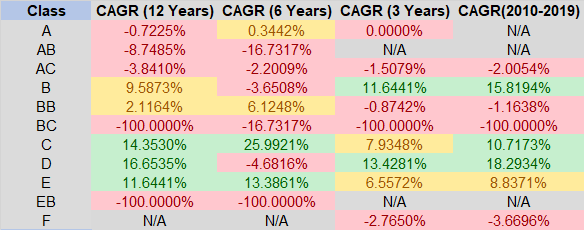
Class C operation for field day offers many benefits and it seems that there is some data to back this up.

Review:  What is this chart?

New York State (ARRL Sections NLI, ENY, NNY, WNY) - By Class with CAGR


June in New York is a great time to be outside or go for a drive! 

The above chart shows at various points in time over the last 12 years how each class of station participated in ARRL Field Day.   

Past Reading

Looking at Class C data using CAGR from 2010 to 2021 (12 Years),  there is a clear growth and has gotten even stronger more recently when just measuring CAGR between 2016 to 2021 (6 Years)

Even during and after COVID, the growth is still there.  While the 2019 to 2021 COVID era did decrease Class C growth slightly,  it was still very strong considering that most stations (not participants) stayed home and operated in Class D style.

Is Class C the new Class A?

Solar cycles do impact when people show interest in amateur radio if they are focused on HF spectrum communications. As we enter Cycle 25, it is hard to say if we will see Class A operations increase again or if we will see other classes decrease.

Operating as Class C offers a lot of flexibility, so lets explore some scenarios to give you some ideas.

Scenario X - Bob the quadplexer man

Our fictitious friendly amateur named Bob has a device called a quadplexer which allows one multiband antenna to be connected to up to four different radios, each using a different band such as 15m, 20m, 40m and 80m or maybe 10m, 15m, 20m, 40m. 

When a quadplexer is combined with an end fed wire antenna or trapped dipole, there is no risk of interference with your friends who also wish to be part of field day at the same time as you.

Add in the appropriate feedline, jumper cables and a portable mast kit,  it is really easy to deploy a class 4C  station or four separate 1C stations. and every one can stay in personal vehicles if needed, but all attached to the same common antenna system.

Alternatively, if you create a club, this is very easy to move from Class C to a Class 4A station

Everyone like's what Bob offers with this setup which only cost him less than $800 USD for everything.  All of Bob's friends buy the same setup for next year, just incase if Bob is not available.


Is Class C popular?

The growth is there, but there is no volume.  Have you looked at your logs to see how many Class C stations you worked during ARRL Field Day in the past?  Lets use some data to see where the Class C stations tend to be based on FCC Callsign Area analysis.


2,203:  That is it over 12 years

42,788 total stations have been part of ARRL Field Day over the last 12 years.   This means that only 5.14% of all stations were Class C.  That would make them pretty rare to log during the event.

Chances are that you more than likely made contact with a "four-land" or "nine-land" station that was operating some form of Class C operation if you look at the above data.

If you only ever thought your options were to stay home (Class D),  be part of a club (Class A) or go out on foot (Class B) or visit your county EOC (Class F),  hopefully Class C may appeal to you as an alternative to Class E (at home alternative power)

Friday, January 7, 2022

2021: Analyzing ARRL Field Day Finally

With 2021 finally behind us,  the results of the ARRL 2021 Field Day event are available.

Building upon the past HVDN analysis from the public ARRL data sources, lets have a look at how 2021 compared to 2020 plus how the event fared against an average taken from 2010-2019.

There are so many positives that came from ARRL Field Day 2021, so the goal of this article is to present the data  along with fact based comments regarding this data.  There are no secret or hidden agendas as part of this analysis, contrary to what some people might think.

The goal of sharing this data in a visualized format is to help understand trends at the national, regional and sectional basis. Plus, if it matters, how everyone may have improved over years past.

For a quick refresh, here are two past articles to help understand the journey in tracking this data.

Activity Tracker:  Version 2021

The data shows an increase of 8,610 additional participants in 2021 compared to 2020.  For the period of 2010 to 2019, the average annual participation has been 36,800.  

This means that the past two years based on an average comparison against 10 years of historical data, is that we are still below normal levels.  

No surprise, but COVID certainly is the main reason to blame, but there could be some other underlying factors such as age, housing and health worth thinking about.


Data generated from HVDN ARRL Field Day Tracker - Version 21
(Photo Source: HVDN.org)


In 2016, the ARRL started tracking the number of transmitters in use as well as the type of power source used during field day. 

2020 saw a huge increase in the number of transmitters mainly because of how participants were tracked.  Participants were able to stay at home and share scores to roll up to a club if needed. 

This was a big success, but it seems that while participation increased in 2021 compared to 2020 which is a 48.43% positive change, the number of transmitters decreased from 10,977 to 8370 which is a 23.74% decrease.

When looking at the different power sources, there is a 38.77% decrease between 2020 to 2021. 

In order to figure out the changes in how participants got on the air in 2021 for field day,  diving deeper into ARRL section and specific callsigns is needed.  This data is available in our larger data set for those who wish to come to conclusions.

QSO Tracker: Version 2021

For the year 2021, a total of 1,421,785 contacts (QSOs) took place during this 24 hour long event.  While participation did see an increase, the total number of QSO did decrease compared to 2020.  

A total of 1,787,929 were counted in 2020, so this works out to a decrease of 20.47%. 

Compared to the average QSO totals from 2010 to 2019, which is 1,265,399,  the year 2021 still trended above the average by 12.35%. This is a very good thing to see.  However, for comparison sake,  2020 compared to the 10 year average was 41.29%.   


Data generated from HVDN ARRL Field Day Tracker - Version 21
(Photo Source: HVDN.org)

The types of contacts when broken down by voice versus non-voice is an interesting set of data to compare. 

Here are some comparisons:


Data generated from HVDN ARRL Field Day Tracker - Version 21
(Photo Source: HVDN.org)

ARRL FCC Call Sign Regional Participation

The ARRL Field Day provided data does not share this, but is simple to calculate based on the ARRL sections.  

Looking at FCC based regional callsign participation gives us a good snapshot of where amateur radio is especially strong or weak without picking on anyone, be it a local club or ARRL section.

Data generated from HVDN ARRL Field Day Tracker - Version 21
(Photo Source: HVDN.org)

In the above pie chart, it is amazing that there is almost as much participation from Canada as compared the the North Eastern United States in call area one.  

The largest FCC call area since 2010 to 2021 is four. While call area two is the most populous by area, it is unfortunate that participation certainly continues to be curious, so looking at the data year by year is the next level to analyze.

Data generated from HVDN ARRL Field Day Tracker - Version 21
(Photo Source: HVDN.org)


The chart above clearly shows macro trends on where there is likely the most amateur radio activity related to ARRL Field Day participation.  

Considering that New York and New Jersey make up the FCC two call area, there needs to be some evaluation as to why participation continues to decline compared to areas such as one and three which are closest in proximity, which may rule out weather as the sole cause.


ARRL Call District Map, modified by AA7OA
(Photo Source:  Google.com search)


Looking Deeper:   ARRL Sectional or Station Details

Some people recently think that HVDN has some agenda in presenting material like this or the state of other parts in amateur radio that are not presenting to the full potential to help expand this great hobby to a new generation.  HVDN has no such bias in any way.  

Our goal is to present data like this and to help illustrate where things are falling apart so that they can be fixed via alternate approaches locally or maybe elsewhere.  We do not claim to have the answers, but are focused on solving things as long as others wish to be involved.

Get data access for $1/month plus much more

If you are interested in accessing our data compilation, which was sourced directly from the ARRL, we kindly suggest becoming an associate member of HVDN for $12 a year.  

Not only will you be able to access the data,  one of the HVDN members very fluent in excel and pivot tables plus visualizations can help you prepare customized views of this data for you to use in your club or regional presentations about ARRL Field Day and the benefits it brings by being part of this great event.


To access this data, please consider becoming an HVDN associate member by visiting https://hvdn.org/join-hvdn


Thursday, October 28, 2021

Recipe for Success: What is RTTY?

Radioteletype or "RTTY" is a digital data mode that allows text to be sent over radio and has been around since the 1930's.   

Before RTTY signals were sent over wireless, teletype was used going back to the mid 1800's which makes this one of the oldest modes of non-spoken communication, just like Morse Code.

Within amateur radio, RTTY is commonly sent on HF bands by using 45.45 baud at 170 Hz shift width along with a mark frequency of 2125.  It is also possible to use RTTY on all other bands such as the popular 2m band and at even greater speed. What does this all mean?  Lets find out.....

RTTY Basics

The term "baud rate" is used to explain how many words per minute can be sent and there are 60 (45.45 baud), 67 (50 baud), 75 (56.25 baud) and 100 (75 baud) options as standard within amateur radio.  

Here is where sending large amounts of data really started thanks to RTTY since even trying to speak more than 60 words a minute may be a challenge for many people.

If you think about how that translates to 1200 baud which is what APRS uses, or the last generation of "dial up internet modems" in the late 1990's which used 56,000 baud and now, all the way to modern broadband which would be too fast to even easily think about, RTTY sounds pretty interesting, right?

Some of the earliest RTTY activity took place just down the Hudson River on Long Island and a brief history is available on the RTTY Wikipedia page.  Lets keep building on our regional history by keeping RTTY alive! 

Here is what a RTTY signal would look like and how the "mark" and "space" are visualized.

Each of the signal peaks are one of opposing tones that help identity bits in the symbols being sent which translate to letters, numbers and special characters.

While there are more efficient modes of "keyboard to keyboard" communication available today, RTTY is not only reliable, but easy to be sent with basic equipment.

We learned with SSTV experimentation during the weekly UNDR Net in September 2021 over the 146.805 MHz repeater operated by the Overlook Mountain Amateur Radio Club, its possible to send images, so now its time to send some text.

RTTY takes up around 250 Hz of receiver bandwidth if your radio is set for 170 Hz shift between the high and low tones. This is more than ok if you plan on sending RTTY over FM since a typical signal is 25 kHz wide, so there is more than enough room to send RTTY over FM.

The year 2021:  Why RTTY?

While RTTY is mainly used during special contests or between just a few friends, its still a mode that is worth keeping in your communications tool box.

A benefit of audio frequency shift key (AFSK) based modes is that they are easy to decode simply by holding a smartphone near your radio speaker. You can even send RTTY by holding the microphone of your radio near the speaker on your smartphone.

Better results can be had with a wired interface like the Easy Digi device for use with most any handheld radio or the Masters Communications Model RA-40. 

Some radios even include a built in decoder for RTTY like the Icom IC-7000, IC-7100 and IC-705. 


As we learned by sending the PD50 SSTV mode which takes about one minute over FM,  this should mean we can send at least 60 words of text or more in the same time using RTTY.  This capability could be very useful in certain situations where accuracy counts and a digital signal is better than speaking.

What if we wanted to share Uncle Grants Field Day Chili recipe over the air?  

According to the below photo courtesy of the ARRL, this recipe page has 313 words and it may actually be quicker sending a recipe like this over RTTY compared to multiple smaller sectional photos sent over PD50 SSTV or one higher resolution photo using the PD290 SSTV which would take almost 5 minutes!


The above recipe can certainly be condensed and reformatted for more "human readable" reception if sent over RTTY.

This will be one of our first tests in sending some interesting information using RTTY in the month of November during the UNDR Net.

If you are interested in joining our experiments, feel free to come up with your own interpretation of the above recipe and lets see who can transmit it the fastest that is human readable on the receiving end. 

Please join us every Tuesday at 8:00 PM Eastern US time in the month of November to listen in or participate with what we are doing each evening with RTTY.

IMPORTANT:   Starting December 6th 2021, UNDR Net will be moving to Monday 8:00 PM 


Monday, July 5, 2021

The Evolution of Logging

In a previous article on Field Day logging, I focused on a networked logging solution using N3FJP ARRL Field Day Contest Log software.  A link to the article was posted on Facebook where a discussion ensued that included mention of other great logging packages. The discussion inspired me to go a little deeper into network logging starting with running the logging packages mentioned on a few virtual machines in my home lab.

This article is targeted for developers, those responsible for the technology behind club logging especially for events like Field Day, and those who are always interested in what is behind the technology curtain.

The Network Logging Landscape

N3FJP follows a client-server model where one of the PC's can do double duty as a server either using Microsoft File Sharing to share its local MDB file or running a TCP server process.

N1MM Logger+ uses a UDP broadcast approach by all participating PCs running N1MM Logger+. The broadcast can be unicast to the local subnet and/or directed to a list of IP addresses on local or reachable networks.

The TR4W logging software (which is Open Source) approach is similar to the N3FJP TCP approach but runs the server as a small separate application.

All applications mentioned make local scheduled backups of the collective logs and document methods of restoring logs in the event of outages. Each of these packages have a strong standalone heritage with networking "bolted on" over time. But in today's world network applications are no longer monolithic instead built as a collection of loosely coupled services to ensure high availability and data integrity.

Service-Oriented Architecture (SOA)

From Wikipedia

"Service-oriented architecture (SOA) is an architectural style that supports service orientation . . . well applied in the field of software design where services are provided to the other components by application components, through a communication protocol over a network. A service is a discrete unit of functionality that can be accessed remotely and acted upon and updated independently. SOA is also intended to be independent of vendors, products and technologies."

After spending some time looking at how networking is done with N3FJP, N1MM, TR4W, and Log4OM I think for networking they all need to adopt a loosely-coupled architecture. This architecture would have the logging applications continue providing standalone capability but any shared and peered services is via a message service bus. Peers may be the same or other logging applications sharing logs for dupe checking log protection. Shared services may be a common database server, chat, or some online log services (discussed further on.) 

Message Queue (aka bus service) enables applications to communicate with each other as peers exchanging information using a standard protocol. The applications themselves can be in different languages implemented on different platforms. Both N1MM and Log4OM do something close to this already but there is no guaranteed delivery given the use of UDP.

In order to provide message queuing and guaranteed delivery, a message broker would need to be part of the queue. Message brokers can validate, store, route, and deliver messages to the appropriate destinations with the message queue processing messages in the exact order in which they were sent and remain in the queue until receipt is confirmed. Separate queues can be created and maintained for service isolation such as logging, chat, and other service queues that trigger uploading logs to online log services.

Online Log Services

The most well known online log service is Log Book of the World (LoTW) run by the ARRL and free to all radio amateurs.

"LoTW’s defining role is to provide confirmation of two-way amateur communications with impeccable reliability and security. LoTW maintains a record of logged and confirmed contacts, and identifies confirmations associated with supported awards. . . While ARRL awards are a priority for support by LoTW, awards offered by other organizations may be supported by Logbook, subject to prioritization by the ARRL Administration and Finance Committee."

The standard formats for importing logs to this and similar service are ADIF and Cabrillo. All the logging applications discussed in this article have the capability to import/export these formats as well as upload to LoTW.

Another popular log service is online scoreboards. Logging applications periodically upload log information in XML format via a HTTP POST method to a website such as Score Distributor,  CQcontest.net, and Contest Online Scoreboard.

Applications and Platforms

Developers like to stay within the safety of their preferred integrated development and the commonly used libraries within it.  For example you may see support for MDB, SQL, SQLlite, databases but not NOSQL because the Microsoft ODBC driver used by Microsoft application developers does not support it. Exception to this are those who are developing for Azure Cosmos DB. Same said for networking. 

Since it is easier for developers to build to breadth than depth you see expansion from one to  a suite of applications with intent of becoming the go-to platform for your Amateur Radio needs.  Ham Radio Deluxe is one of the few Amateur Radio software platform successes out there to date evolving from free applications to a subscription model. Being the platform rather than just an application is similar to commercial enterprise software strategy. Be the platform for all other applications to build on to grow customer base and revenue.

The need to grow revenue through building customer base is the reason why I am pessimistic any Amateur Radio Logging software application that is not Open Source will embrace an SOA model and instead limit such interoperability to named applications. I get it, trying to make a living developing software for the Amateur Radio is far from lucrative and requires more passion for Amateur Radio than expecting to make a livable wage from it. 

Futures

Many licensed amateurs in recent years come from other technology communities where collecting achievements is their motivation. They get their license, don't do anything with it, and move on to some other challenge. Online log services could evolve to "gamification" of existing contests and perhaps introduce new corporate sponsored ones attracting these quiet amateurs who always up for a challenge.

I hesitate to say as much as tracking clicks and eyeballs are monetized on the Internet, tracking Amateur Radio contact statistics could help keep interest in developing/sell ing products to the Amateur Radio market as well further data to be referenced in spectrum protection more readily that just a handful of organizations.

73,

- Joe, NE2Z


Wednesday, June 30, 2021

The Magical Military Tent Pole

Introduction


You've seen them for sale online, at some Hamfests, mentions of their for building antennas, I am talking about military tents poles repurposed and sold as military antenna masts. 

They come in heavy duty fiberglass, smooth-walled and ribbed aluminum. Camouflage netting supports being repurposed and sold as insulator top pieces for a vertical or base. They end up being re-usable building blocks for antenna experimentation.

I started using the heavy duty fiberglass poles a decade ago as end supports for dipoles on top of the Hotel Pennsylvania for HOPE Conferences that would occur every two years there. We would build 12 feet of fiberglass mast for each end and strap the masts to whatever structure that was anchored to the building as possible. 

Each conference they would be up there in the summer heat and winds for three days. The ends would be reinforced with duct tape. In eight years of use we hadn't had any structural failure with them but did started hearing some creaking in their last use.

Low Dipoles atop Hotel Penn in NYC
Low Dipole atop Hotel Penn in NYC. Far mast just behind left corner of building

12 feet strapped to the side of an existing structure might have been secure enough, but what about when it comes to how high can you stack military masts safely in open space using guy rings and ropes?

Use case

Carrying the N2B load during HR3:2021

Is this a mast to serve as end point for a wire antenna, a mast for a beam or vertical, some combination? This adds up to how much load we are balancing at the top. 

Will this installation be a semi-permanent setup at home or will this be part of a portable operation kit? For the latter weight, easy setup/teardown are considerations whether one or more people are involved. 

Let's start with portable operations. and the most precarious setup.

Fiberglass Mast as Center Support for Wire Antennas (Dipole/V/OCF)

Base


Let start with ensuring you are setting up on level ground and what are you using for your base. The Paddle base is what is commonly used for flat surfaces as well as portable locations where you need to leave the least foot print on nature.
Top is Paddle Base
Bottom is Swivel Base(photos goverticalusa.com)

The mast kits used to include Paddle Bases but have since started to include the more expensive swivel stakes. These are good where ground is soft enough to pound them down into the earth.

When it comes to re-purposing or making your own portable base, I have used a plastic Christmas tree stand. 

An item you could re-purpose for a base in a semi-permanent installation is a concrete block used for posts as sold by local home improvement stores. 

They are too heavy for frequent portable operations but
a consideration for infrequent long operations setups like Field Day
at easily accessible locations.

Guy Ropes
11.5 x 8 x 11.5 inch
Concrete Block


For a total mast height of 24 feet, run guy ropes at 12 feet and then again at 20 feet for a mast that is 24 to 28 feet tall given a top load that will support the center of a wire antenna and 2/70cm mobile antenna.

While advise against going higher than 28 feet with fiberglass poles, for a similarly loaded mast that is 32 feet high, run guy ropes at 12 feet and then again at 24 feet. 

To add some life to the fiberglass poles I've wrapped duct tape around the ends since when these poles fail it is often at those points.

Tripod base using six
 fiberglass poles
If you want to run only one set of guy ropes for heights above 20 feet and have six extra fiberglass poles may you want to build a tripod base using a tripod adapter from companies like GoVerticalUSA or fabricating your own if you have the tools and materials. With a tripod added you can run your guy ropes at 24 feet for mast heights up to 32 feet.

Aluminum Pole Use


For this use since there is little weight difference between the fiberglass and aluminum poles, I use fiberglass poles for the legs of the tripod and all but the top two sections of the vertical mast.  

With the top two sections fiberglass this reduces signal pattern impact to the wire antennas. while having a stronger support.

Aluminum Poles as a Portable Vertical


With tent poles being four feet in length, you and up lugging at least six poles for 24 feet to as much as eight for 32 feet. If you go with a tripod base you end up adding six poles to each configuration. Does not make for light carry for portable operation, just acceptable load for long operation setups.

So I got thinking about making an antenna out of the aluminum poles and cut a short section of fiberglass as a base. 

Portable Vertical - Blue taps first aluminum pole, green is counterpoise laying on ground

The diagram above is that idea as a 13 foot vertical. 'B" is a fiberglass section cut down to one and three aluminum poles stacked on top of it. A non-metallic guy ring with ropes is attached between sections '2' and '3' to keep the structure stable. A short wire is connected from the balun to bare aluminum using a metal hose clamp and a twenty foot wire is attached to the other end of the balun laid on the ground as a counterpoise.

While I have made a few FT8 contacts with it on 20 meters using a Yaesu FT-817 with a Z-11 tuner. 

I need to do some more experimentation to see how far I can improve it to be a viable alternative to the performance of windsock verticals. 

Will follow this article up at some point with results.

73,

- Joe, NE2Z

Tuesday, June 22, 2021

Dash Battery Status: Field Day & QRP


The HVDN Notebook blog tries to remain very unbiased and focused on future relevancy around active lifestyles involving amateur radio without enforcing the beliefs or mission statements of certain national level advocacy groups.

It is the authors opinion that we enjoy a pretty great relationship with our local regional leadership when talking about the ARRL since they were more than happy to encourage what we did via our recent Hudson River Radio Relay special event which was led by a non-affiliated club in the ARRL ENY section.

As we get closer to Field Day and the end of COVID, looking back on our data analysis gathered over the last ten years about Field Day, it was a good idea to shift our attention to the status of battery operated field day efforts.

Certainly 2020 and this year are different when it comes to normal field day operations and is why talking about the differences between low power, battery powered and emergency stations is a good idea since many people will be still at home and possibly contributing to club overall standings.

Battery Powered

According to the 41 pages of ARRL Field Day rules for 2021,  in section 4.2 it specifically explains:


This is very clear. If you are a club, such as HVDN who will be operating under N2HVD this year from POTA K-2084 for just a few hours on Saturday June 26th, or a non club portable group of more than two people  in the Hudson Valley from a location only they can get to via backpack and foot power as a group of SOTA enthusiasts

This means that no matter how much battery capacity you have or output capability of our radio, if you wish to claim Class A - Battery status, you need to stay at less than 5 watts output if you will be sharing one callsign. 

Operating at low or QRP power is a way to drive distinction to your club or group compared to being plain old "alpha" class running on some sort of other power system such as carbon fuel based generators.

If we look at the "Bravo" class of setup and its battery powered variant, it is also very clear how they differ for these smaller groups of amateur radio enthusiasts that are not going to represent a club or be more than two people.


No one here at HVDN is complaining, but simply offering an alternative to encourage distinction for your field day activities for this year and the future.

Being safe is paramount since the majority of those involved in amateur radio are those at highest risk of suffering from not being young any longer.    For those who will be 1D from home this year and rolling your scores up to your favorite club, why not try a decentralized QRP field day instead?

Based on the public data shared from the ARRL, it is amazing that more operators do not try legitimate battery power operations in the field or even at home. The data below does not lie, unless the ARRL material is not accurate.


Look at the above chart. The most popular historic way to operate as a true battery powered station, using less than 5 watts is classified as 2AB and 3AB. This shows that HVDN is only part of a small crazy bunch of operators to attempt this likely in 2021.

There are even the 2 person 2B2B plus one transmitter 1EB and B1B classifications out there which have about the same number of crazy adopters.

So whats the point?

The total of entities operating as true battery powered stations is far too low and needs more to join the club compared to the larger "Alpha" cousins with the bubble based 1D's that will help again this year. which do not operate as battery powered.

The point is that there should really be a different classification for QRP power 5 watt stations as well as a separate class for those running from battery, but may wish to use more than 5 watts since radios like the Yaesu FT-891, Xiegu G-90 and a few others are pretty popular these days and are capable to run more than QRP power.

Low Power

Ever speak with a QRP operator about antennae or feedline?  They will have interesting stories about how to optimize the gain from an antenna headed where they want it, find ways to save weight by avoiding certain types of antenna or even feedline and probably be more knowledgeable about patient operating practices or ways to be more efficient in getting as much RF to radiate outward rather then get burnt up as wasteful heat energy.


All this differentiation should be encouraged by the ARRL, but not confused by battery power.  Nothing prevents anyone from dropping down in power to try QRP nor trying to be sustainable from just a battery. 

If you plan to be 1D from home (again) this year, why not challenge yourself by running QRP from home if you can scrounge up a battery to run your radio from before Saturday.

Emergency Stations

There are many first responder or community groups that fall under the "Echo" class of operation for Field Day, but what makes them so different than a battery powered station?  It is possible to run emergency and on battery, but this still means they are limited to only 5 watts.  

If there was a long term emergency situation and the ability to charge batteries was not possible, would more EB stations be a good experiment? Perhaps the E class stations will not use a whole building generator used for many EMCOMM facilities and see what they can do from a battery and only run five watts.

Obligatory Antennae Stuff

Not always can we arrange the perfect antenna system and often the way around that is to transmit more power to make up for a lousy antenna. 

Perhaps trying to optimize antenna as if everyone was using 5 watts would be an interesting experiment, especially since we have so many low signal to noise ratio modes and superior equipment available today capable of receiving weak signals.

Can we try to improve our antennae systems or try modes that reward low signal to noise ratios?

Hopefully the excuses of whatever you are already thinking about can be put aside and more people decide to try something new when it comes to field day.


It is HVDN's belief that that ARRL is taking us in the right direction during the strange times we live in, but they do not always do a good job of articulating the benefits, values and most important awareness things we should all be focusing on. 

Oh, and did you want access to the nice 10 year database in excel that we compiled from the ARRL website?

Feel free to reach out to me at .K2GOG.@yahoo...com (remove the extra dots!!) and I am happy to share a copy with you of the 2010 to 2020 data that was used for the below two articles.

Thanks for reading

Steve K2GOG
Trustee, N2HVD
Co-Founder HVDN
Organizer, HR3

ARRL Field Day: Independent Data Analysis


Saturday, June 19, 2021

A Guide to Field Day Network Logging


Adopting and evolving electronic logging for Field Day can been a slow journey for many clubs given trusting technology with their precious logs. The journey often looks like:

  • Standalone - Clubs standardize on a software package used by all stations. Station logs are collected and compiled into a single log file with some post-processing (manual)
  • Standardized - Clubs standardize on a software package used by all stations. Station logs are collected and compiled into a single log file with some post-processing.
  • Networked - Clubs use network version of their standard software package. Single log file pulled from server with some post-processing.

The key to evolving computer logging solutions is focusing as much on process as you do on the technology. 

When I say process I am speaking to building mature, repeatable processes in implementation and documenting them in sufficient detail that the passing of "tribal knowledge" is not required. This documentation also needs to be updated and tested every year before Field Day.

This article focuses on networked using the N3FJP ARRL Field Day Contest Log software in a wireless network configuration that uses a Raspberry Pi 3 Model B+ as a Windows File Share, Web, and Logging server. 

This Field Day Network logging solution has been in use for six consecutive Field Days by the Orange County Amateur Radio Club with no loss of data.

Network Considerations

Latency is your enemy. The N3FJP ARRL Field Day Contest Log (hereafter referred to as "the software") is sensitive to latency given it's use of Microsoft Access MDB file format for the log file and the "chattiness" of the Microsoft SMB network protocol it uses. 

Plan and test your wireless network coverage. Not all wireless cards in laptops are created equal. Low signals will yield significant packet loss and retries adding to latency. 

This needs to be discussed as part of the site layout planning for stations and antennas. Also be cognizant of any potential sources of interference especially at sites with RF sources not part of your Field Day operation.

Logging will be as good as the slowest laptop connected to the network. As of this posting only laptops running the last release of Windows 7 with 2GB RAM minimum or Windows 10 with 4GB RAM minimum and latest patches should be used as logging clients on the network. 

Guaranteed if someone brings an old Windows XP laptop they had in a closet since last Field Day it will introduce problems for logging with more than a half-dozen laptops. 

Only run services on the network necessary to support logging. Providing Internet access on your wireless network is only asking for trouble. Laptops that have not been updated prior to Field Day will see the Internet connection and look to start updating themselves with no consideration for available bandwidth. 

The wireless network should also be password protected since mobile phones are often set to look for open networks and try to find Internet connectivity through them as costs savings to users in their cell plans.

Network Design

Wireless routers. In following the network considerations mentioned, a stock Linksys WRT54GS wireless router with a pair of 7dBi antennas has served me well for many years as the anchor for a wireless network supporting up to eight logging laptops within a 75 foot radius of the wireless router.

Services. A flat network plan is followed with 192.168.73.0/24 used for the wireless (WPA2 password protected) and wired connections. DHCP services are providing assigning 192.168.73.128-252 to laptops. 

The Field Day server is setup with a static IP address of 192.168.73.100 and is not a client of DHCP services. In the the vein of keeping it simple, name services is not used so the server is always referenced by its IP address.

Pi Server

In using the software, the file share method for networking is proven reliable. Over the years I started with a Raspberry Pi 1 Model B+ and then a Raspberry Pi 2B as a server with a wired connection to the wireless router. The server is configured with a static IP address of 192.168.73.100 and runs two services.

The first service is Samba (Windows File Server.) A club account is created as a standard user and is used as the owner of a password-protected file share that hosts the log file.

The second service is Nginx web server. Why? To provide a self-service kiosk for those who need to setup their laptops for logging, info for operations on site, as well as a repository for registered and open-source software operators may need to setup their station for other modes. Nginx requires little resources and uses simple static web pages.

Lessons from the Field

Oh no... read the message .. then wait
Patience grasshopper. While there has been no loss of data by the servers, there have been issues born from lack of human patience. The software recognizes within a minute if the server is unavailable and will keep retrying until it is back online. 

But instead of waiting users panic, shutting off the software and restarting. When they do that they may
see no error but what has happened is they are disconnected from the network share and the software will start writing to a local MDB file with no warning. 

You end up with a new local file that needs to be added and reconciled with the network log file. when the server goes down, stations should do nothing and wait for the server to come back up and let the software do its thing.

Triage not Helpdesk. I make it abundantly clear that if someone asks me for help in getting their laptop working with the logging software and network that I will be focused on that task at the risk of disrupting other applications. Enough said so end-users know your laptops well.

All-in-one Server/Network. If you are comfortable with Linux and the Raspberry Pi you can reduce component count and have a Raspberry Pi 3 B+ or better do double-duty as server and wireless access point (WAP). 

As a WAP you disable onboard Bluetooth and WiFi and use an external higher-power WiFi device with external antenna. You will need to ensure you have adequate power to the Pi to support the external WiFi device.

Other Bits

Adding Time Services. This would be one more service I would consider adding to the server not just for logging but laptops that are running digital modes that require time synchronization (FT4/8.) 

Time would be sourced from an attached GPS dongle and available via NTP server process. Laptops would need to run a NTP client application to sync time with the server.

I want my Internet. If you insist. Go with a wired network to all laptops who are doing logging duty. Make as much of the network connectivity wired as possible. Internet connectivity should be via the WAN port on the WAP. 

If you doing an All-in-one server approach connect to the Internet via USB to a cell phone that can provide Internet service.

Building a Pi Server. A work-in-progress of how to build your own Field Day Network Pi server is available on GitHub.

73,

- Joe, NE2Z