Showing posts with label amateur radio. Show all posts

Thursday, April 30, 2026

SDR Top 10 Has Fallen: Meet something new....


At the HOPE 16 conference back in August 2025, my presentation focused on the most popular projects based on key search terms such as "SDR", "Software Defined Radio", "Amateur Radio" and "Ham Radio".   

My theory was to look at how many stars were voted on by the GitHub community per project and compare against how long the project has been around in order to create a velocity score, simply by dividing stars by number of days old the project is.  While Git is just one narrow dimensional lens to observe through, it is still a good one since its a great way to capture crowd sourced ranking data.

The idea was that the faster a project could generate the most stars would mean that it captured more interest or maintained that over time and thus, would be very important to pay attention to these projects. So while not perfect, this is the best way to capture interest level from a community of people who generally all have overlapping interests.

Here are the slides, charts and data to back up the presentation if you missed it. I analyzed the top 10 most popular for each search term for a total of 40 projects overall. Below is an example of one of my "velocity" charts enabled by the star history site which can be used for exactly what I needed.


I really wanted to wait a full year before seeing if there were major changes to the top projects, so here is a short update to start May 2026 off since too many exciting things are happening. I will compare again just before HOPE 26 at the New Yorker Hotel now less than 90 days away.

Changes:  SDR

First up, lets look at the "SDR" top 10 from last year and how they compare to now. I bolded out four worth talking about below.

Last year, GQRX which is one of the longest maintained "SDR" projects was the 9th most starred project followed by SDRangel as 10th most popular. Less than a year later, GQRX has dropped to 13th most popular and SDRangel is now 11th most popular. 

In March, SDRangel released version 7.24.0 which now includes Meshtastic functionality,  which is clear evolution from the earlier Chirp Chat function designed to support LoRa based messaging.  This is nice because if you have a HackRF, ADLAM Pluto, Lime SDR or most other transmit capable SDR, you can use it as a mesh device with limited capabilities along with its many (many) other useful features.

Not much of anything has changed in the last year however with GQRX since its intent was always to be a simple and easy to use radio application for those getting started with SDR.

Shadowbroker

What is really amazing are the two new entries to the top ten most starred SDR projects less than a year later from my original analysis.  

Shadowbroker is defined as "Open-source intelligence for the global theater. Track everything from the corporate/private jets of the wealthy, and spy satellites, to seismic events in one unified interface. The knowledge is available to all but rarely aggregated in the open, until now." This project is now the 6th most popular as voted on by the community all time. 

Much of what Shadowbroker offers is functionality built into SDRangel actually, but Shadowbroker is meant to be an OSINT tool where SDRangel is more of a SIGINT tool, with built in OSINT functionality. 

It is amazing how fast Shadowbroker has obtained 5,500 stars since its first release which was only in March 2026.  From Shadowbroker's repository, here is a video showing its capability. 


A blend of true coding plus some level of "AI" vibe coding was used to come up with this and is an amazing achievement that not many are talking about Shadowbroker across the wider interwebs.  Maybe that will change soon. I sure hope so. 

It is really worth explaining why Shadowbroker is unique.  While SDRangel allows the user to show many types of location based signals like aircraft, balloons, boats, spacecraft, amateur radio people and more on a map all at the same time from directly connected SDR's, or those over a network,  SDRangel also allows some of what is received to also feed into other systems.

Shadowbroker is not just about radio signals. Its about complex situational awareness, so this is a really cool project for looking at many types of information. If you ever dreamed about becoming the "guy in the chair" this project helps you get pretty close to that, just like in the movies!.

Ground Station

Having a look at the now 9th most popular repository simply called ground-station, this project began life in October 2025 and has already gained 4,200 stars.  This is also very impressive as it touts being  a full-featured, open-source software solution for satellite tracking and radio communication. 

Designed for amateur radio operators, satellite enthusiasts, and researchers, it provides a comprehensive and easy-to-use platform for monitoring spacecraft, controlling radio equipment, and receiving live radio signals from satellites. This project was built with the help of Claude Code and Codex.


It is clear what this project is and how it was made.  Again, much of this functionality is built in to SDRangel, but can be overwhelming to some users and the new ground station project seems really nicely done.  A full understanding of its functionality can be found on the project page, which is now coming close to its hundredth release yet is still on up to version 0.4.4.  

Typically, when a project hits the v1 milestone, its considered much more mature, so there is certainly a lot more expected to happen with ground station.

Software Defined Radio

Comparing the top 10 from last year until now,  the same are all present with a few changing places in total stars, but otherwise nothing else is unique.  Clearly if you want to experiment with SDR,  its worth searching both ways, but the long form of "software defined radio" is not where things are happening compared to "SDR".

Ham Radio

There is one change in the top ten thanks to a project called HamDashboard which now would rank as 9th most popular and surprisingly helped knock down the LoRaHam project down to the eleventh spot. While the LoRaHam project is managed by the pretty famous Travis Goodspeed, here is a clear example that when a project sees no updates, it often becomes less popular. 

But, the work of Travis on areas like hacking the TYT MD-380 which helped make DMR very popular and his other projects found on his Git repository demonstrate that its worth keeping an eye on anything he is doing.  

HamDashboard by VA3HDL started three years ago, but has seen more work in the last few months. The focus is to provide a simple, browser-based ham radio dashboard that displays images, maps, web pages, and feeds in a configurable grid. It is lightweight, easy to host, and suitable for use on a local computer, Raspberry Pi, or a static host such as GitHub Pages or Cloudflare Pages. 

With projects like HamClock undergoing changes, it seems HamDashboard is becoming more popular and here is the proof to show that.  While very different than what Shadowbroker does, it seems that a need to visualize many data sources is an area that many radio hobbyists are very interested in. 


Amateur Radio

The top ten most "starred" projects found by using the "amateur radio" key term are also almost the same as a year ago.  A few projects changed total rankings, but there is a new number nine present via the APRS D project, which has been around since 2021, but only recently become more popular. 

Many changes within MKISS and AX.25 are starting to rattle thanks to the recent news about certain things being dropped from the Linux kernel but that is out of scope for this update, but still was worth a quick mention.

APRS which has been covered here at length continues to be a misunderstood or narrowly conceptualized area within communications, so its amazing that this project is one of the more popular voted on projects to keep an eye on.  

Pretty much anything related to APRS is worth keeping an eye on actually, so this is a nice place to end this article without diving super deep on this topic.

Summary

It is important to embrace the advances in technology and a great way to do that is to spend some time searching for things on Git.  The value I hope my presentation offers from last year and into this update is to demonstrate theory to fact in order to prove a point on how to track trends and uncover hidden patterns around topical areas worth paying attention to.  

A benefit for those interested in coding is you may find something you can help improve or for those not considered "coders", might find inspiration to leverage artificial intelligence (AI) by way of vibe coding to help create solutions targeted at clear problems, just like Ground Station has done and most likely a few other projects too.

Also worth noting that when it comes to "amateur/ham" radio, there is still not enough excitement in these areas to attract more innovation.  While unfair to compare to "SDR",  this is an area which many in the amateur community should be looking at for what should be next.

Wednesday, August 20, 2025

Presentation Replay: It had a long title.....


Here is the jump to my replay of the "Top Ten: Democratic Open-Source Software Defined Radio and Amateur Radio Applications That Matter Today" presentation on Saturday. 


https://youtu.be/bEatax_cbKA?t=7520

Other related stuff here https://hvdn.org/hope16.html


Monday, July 5, 2021

The Evolution of Logging

In a previous article on Field Day logging, I focused on a networked logging solution using N3FJP ARRL Field Day Contest Log software.  A link to the article was posted on Facebook where a discussion ensued that included mention of other great logging packages. The discussion inspired me to go a little deeper into network logging starting with running the logging packages mentioned on a few virtual machines in my home lab.

This article is targeted for developers, those responsible for the technology behind club logging especially for events like Field Day, and those who are always interested in what is behind the technology curtain.

The Network Logging Landscape

N3FJP follows a client-server model where one of the PC's can do double duty as a server either using Microsoft File Sharing to share its local MDB file or running a TCP server process.

N1MM Logger+ uses a UDP broadcast approach by all participating PCs running N1MM Logger+. The broadcast can be unicast to the local subnet and/or directed to a list of IP addresses on local or reachable networks.

The TR4W logging software (which is Open Source) approach is similar to the N3FJP TCP approach but runs the server as a small separate application.

All applications mentioned make local scheduled backups of the collective logs and document methods of restoring logs in the event of outages. Each of these packages have a strong standalone heritage with networking "bolted on" over time. But in today's world network applications are no longer monolithic instead built as a collection of loosely coupled services to ensure high availability and data integrity.

Service-Oriented Architecture (SOA)

From Wikipedia

"Service-oriented architecture (SOA) is an architectural style that supports service orientation . . . well applied in the field of software design where services are provided to the other components by application components, through a communication protocol over a network. A service is a discrete unit of functionality that can be accessed remotely and acted upon and updated independently. SOA is also intended to be independent of vendors, products and technologies."

After spending some time looking at how networking is done with N3FJP, N1MM, TR4W, and Log4OM I think for networking they all need to adopt a loosely-coupled architecture. This architecture would have the logging applications continue providing standalone capability but any shared and peered services is via a message service bus. Peers may be the same or other logging applications sharing logs for dupe checking log protection. Shared services may be a common database server, chat, or some online log services (discussed further on.) 

Message Queue (aka bus service) enables applications to communicate with each other as peers exchanging information using a standard protocol. The applications themselves can be in different languages implemented on different platforms. Both N1MM and Log4OM do something close to this already but there is no guaranteed delivery given the use of UDP.

In order to provide message queuing and guaranteed delivery, a message broker would need to be part of the queue. Message brokers can validate, store, route, and deliver messages to the appropriate destinations with the message queue processing messages in the exact order in which they were sent and remain in the queue until receipt is confirmed. Separate queues can be created and maintained for service isolation such as logging, chat, and other service queues that trigger uploading logs to online log services.

Online Log Services

The most well known online log service is Log Book of the World (LoTW) run by the ARRL and free to all radio amateurs.

"LoTW’s defining role is to provide confirmation of two-way amateur communications with impeccable reliability and security. LoTW maintains a record of logged and confirmed contacts, and identifies confirmations associated with supported awards. . . While ARRL awards are a priority for support by LoTW, awards offered by other organizations may be supported by Logbook, subject to prioritization by the ARRL Administration and Finance Committee."

The standard formats for importing logs to this and similar service are ADIF and Cabrillo. All the logging applications discussed in this article have the capability to import/export these formats as well as upload to LoTW.

Another popular log service is online scoreboards. Logging applications periodically upload log information in XML format via a HTTP POST method to a website such as Score Distributor,  CQcontest.net, and Contest Online Scoreboard.

Applications and Platforms

Developers like to stay within the safety of their preferred integrated development and the commonly used libraries within it.  For example you may see support for MDB, SQL, SQLlite, databases but not NOSQL because the Microsoft ODBC driver used by Microsoft application developers does not support it. Exception to this are those who are developing for Azure Cosmos DB. Same said for networking. 

Since it is easier for developers to build to breadth than depth you see expansion from one to  a suite of applications with intent of becoming the go-to platform for your Amateur Radio needs.  Ham Radio Deluxe is one of the few Amateur Radio software platform successes out there to date evolving from free applications to a subscription model. Being the platform rather than just an application is similar to commercial enterprise software strategy. Be the platform for all other applications to build on to grow customer base and revenue.

The need to grow revenue through building customer base is the reason why I am pessimistic any Amateur Radio Logging software application that is not Open Source will embrace an SOA model and instead limit such interoperability to named applications. I get it, trying to make a living developing software for the Amateur Radio is far from lucrative and requires more passion for Amateur Radio than expecting to make a livable wage from it. 

Futures

Many licensed amateurs in recent years come from other technology communities where collecting achievements is their motivation. They get their license, don't do anything with it, and move on to some other challenge. Online log services could evolve to "gamification" of existing contests and perhaps introduce new corporate sponsored ones attracting these quiet amateurs who always up for a challenge.

I hesitate to say as much as tracking clicks and eyeballs are monetized on the Internet, tracking Amateur Radio contact statistics could help keep interest in developing/sell ing products to the Amateur Radio market as well further data to be referenced in spectrum protection more readily that just a handful of organizations.

73,

- Joe, NE2Z


Saturday, November 30, 2019

Kit Building: Behind the Green LED


While one can enjoy a great sense of accomplishment coding an application and see it work, it can be even more exciting when success manifests itself as interaction with the physical environment. Such is the attraction in working with microcontrollers and breadboarding simple sensors to work with.

But people often get intimidated in taking the hardware experimentation further once a soldering iron is required. Let me get you past this with the first piece of advice; Never hold the hot end of a soldering iron. You are now past the most intimidating part when it comes to soldering. Congratulations!

While you may have a great hardware build idea as a goal, it can quickly overwhelm you in what resources and skills are required to complete it. That is why you should build your experience and skills in short sprints that deliver “quick wins” building your sense of accomplishment and confidence along the way. No better way to start than with kit building. But how do you get started?

We start with a basic set of tools and a kit that can be built in a single evening.


Basic Tools


Soldering Station


Starting with the most expensive tool , invest in a soldering station. Two good solder stations (in no particular order) are the Hakko FX888D and the Weller WE1010NA. Both are available for just under $100 USD and will serve you well for a long time.

Weller WE1010NA
They both have adjustable temperature controls to accommodate components that may be heat sensitive or if you need to use other solder types from standard to lead-free to silver solder. Both solder station models have solder iron stands with sponge inserts (that need to be moist – not wet) for cleaning your soldering iron tip. The Hakko includes a brass sponge (dry) that you can also clean the tip with but you may prematurely wear the tip.


Solder and Solder Removal


Tin Lead Rosin-core Standard 60/40
For solder, four ounce spools of Rosin-core standard 60/40 are available for $10 USD. Be aware that most solder contains lead. Lead solder has a high melting point meaning less heat is required with the cooling time lower decreasing the risk of bad solder joints.

When you accidentally solder the wrong part into the wrong hole a desoldering pump aka “solder sucker” is your friend. You simply reset the solder sucker vacuum by pressing the plunger, heat the lead you just soldered, put the solder sucker tip near the solder joint, and hit the button to suck the solder.
Solder Sucker and Wick

Hitting the plunger again not only resets the tool, but also spits out the solder you previously sucked. So be sure to keep the solder sucker clear.

Solder wick is small flat spool of braided copper that is also used to remove solder. You heat the end of the the solder wick on the solder join and you will see the solder leach into the braid. Once the solder is removed you snip off the piece of braid saturated with solder. Collin Cunningham of Colin’s Lab has produced two good videos on soldering and desoldering.


Circuit Board Holder


Aven 17010 Circuit Board Holder
With solder in one hand and the soldering iron in the other, you need an extra pair of hands to hold the circuit board steady at a comfortable height and angle for you to solder the components to the board. You will need a three-dimensional vise securely mounted to your bench with either a weighted or vacuum base. Companies like Aven and Panavise produce a range of products and features depending on how much you want to spend from $12 USD and up.


Magnifier

Flip-Type Head Magnifier

Even with perfect eyesight there will be times that you will need help seeing the leads on the smallest components. Because you only have so many hands, best to go with a head magnifier with a light built-in. There are different styles of head magnifiers to choose from but I have always found myself going back to the headband style which flips back and forth like a welder’s helmet for under $10 USD.

Start with that style and then experiment with some of others to find what is most comfortable for you.


Cutters,Pliers, and Strippers

Hakko CMP-170 Micro Cutter

Now that I can solder and see what I am doing, what about those excess leads I need to cutoff after I have soldered? Dollar store cutters are not going to cut it (pun intended.) Because we are dealing with small components we need diagonal cutters with better precision. This includes micro needle nose pliers and wire strippers. These tools can be found at a sufficient level of quality for $10 USD each from Hakko.


Multimeter

Crenova MS8233D Multimeter

Even if electronics knowledge is only elementary as you get into kit building, having a multimeter will help you verify a resistor value if the markings can’t be read, that last solder connection you made is good and there is continuity further up the circuit. Also help you check if your kit is getting power. You want a multimeter that is digital, autoranging, measures voltage – current - resistance, built in fuse, auto-off, backlit, and includes a stand. Sounds like a lot of features but these can be found standard for a $20 USD multimeter. A Crenova MS8233D or similar is good choice.

Now that we have our tools, what do we build?


Your First Build


As I said, before chasing the big idea you have you should build experience, skills, and confidence. Achieve that feeling of accomplishment by positioning yourself for “quick wins.” Low cost kits that can be built in a single evening are a great choice. In fact order two if they are cheap enough. Start with kits that use only through-hole components. Only consider kits that include SMT if they are already soldered to the board.

Example Simple Kit

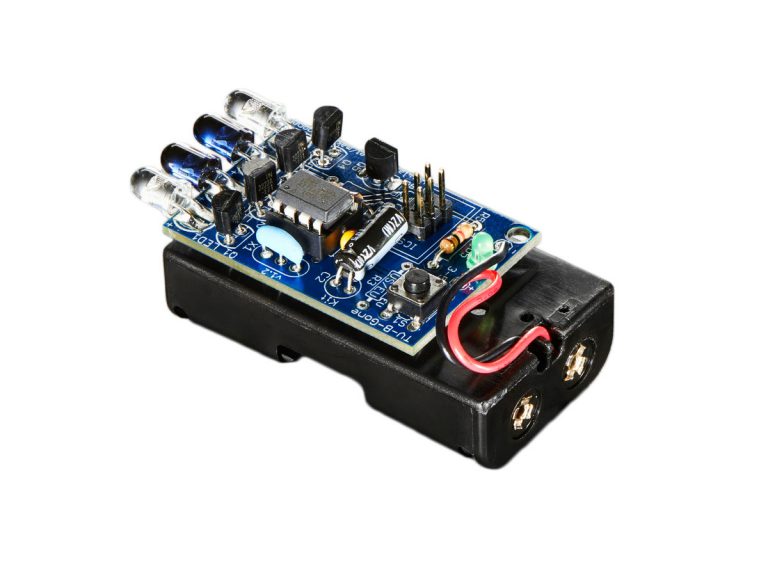
TV-B-Gone Kit

A first kit I’ve recommended to friends is the TV-B-Gone Kit. Not only is it a kit that can be completed in an evening, but that sense of accomplishment is rewarded with the power to shut off most any TV within 100 feet. BuhhWAHAHA.

Whether you choose the TV-B-Gone or some other kit, be sure to read all the documentation included first before unpacking any parts. Sometimes kits may point you to a web site rather than include printed material. Again, RTFM and if the docs are available as PDF, download and print.

Preparation


My home office desk may not be clear, but my workbench is before I begin any project. That includes removing any dust and debris. So be sure to:
  • Have documentation open
  • Board mounted in the vise
  • Moist sponge ready
  • Soldering Station turned on and set for around 650F
  • A coil of solder unspooled
  • Solder sucker set with solder wick available


Assembly


A well documented kit should have you work in assembly sprints and provide an explanation of the circuit or components as you progress. If a kit does not provide a guide as to what to assemble first go from small non-polarized parts, to parts with polarity, and then larger parts.
Parts identified and sorted
  • Resistors
  • Inductors
  • Ceramic Capacitors
  • Crystals
  • Jumpers
  • Diodes
  • IC Sockets
  • Electrolytic Capacitors
  • Transistors
  • Bridge Rectifiers
  • Jacks
  • Variable Capacitors/Resistors
After you have soldered a grouping or category of parts, double-check that the parts are in their correct position and, the solder joints look good. That is when you clip the excess leads, not before.

If your kit requires external connections such as power or audio ensure any cables and connectors you need to add that are not included with the kit are wired with correct polarity. Use the continuity setting on your multimeter to test for this. How do you do this ? Here is an example video on how to use the Crenova MS8233D multimeter.


Next Time


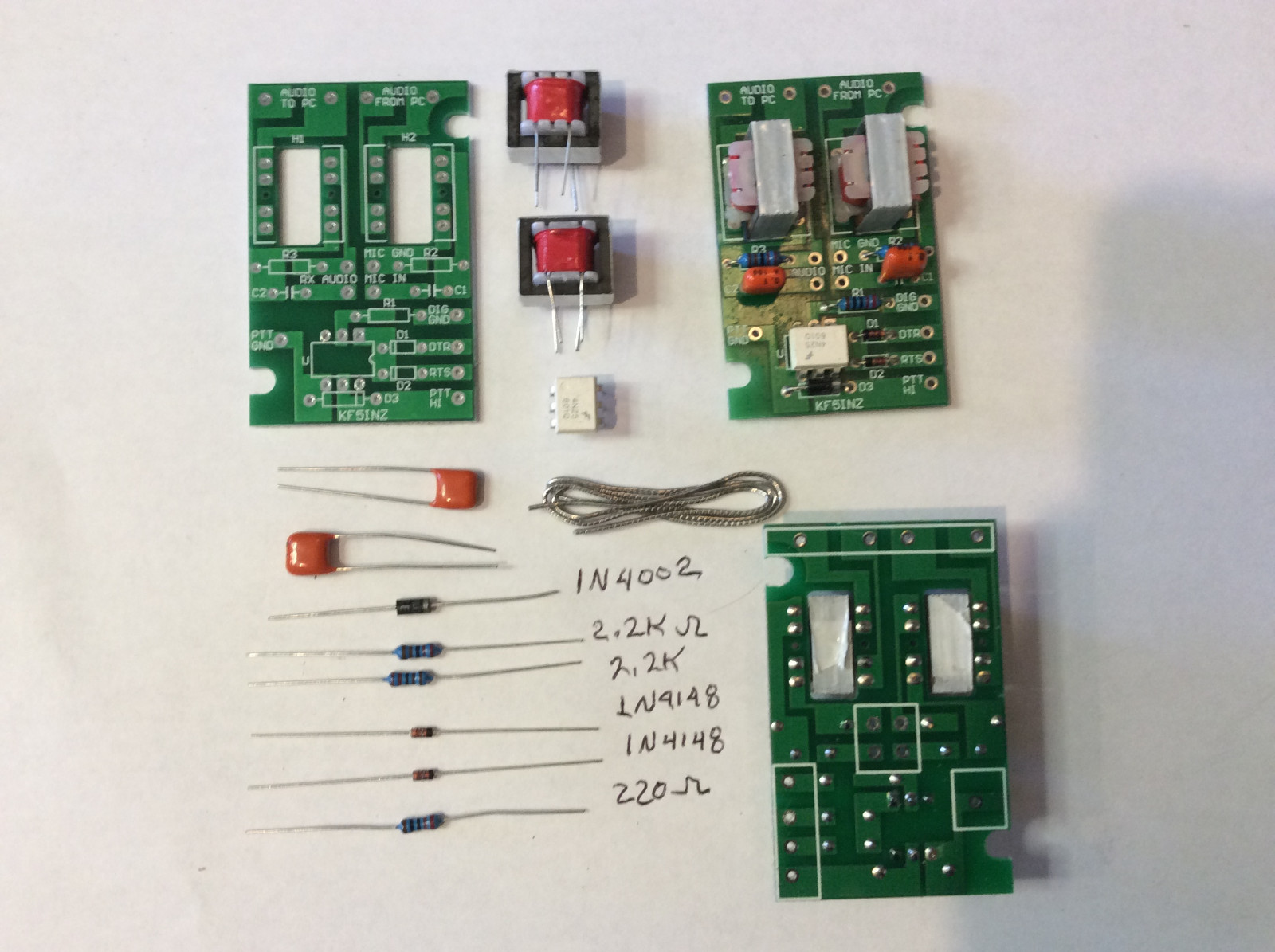
Easy Digi Interface Kit
So you’ve completed your first kit and if it was the TV B Gone you are either bored with turning off TV’s or got caught shutting off all the TVs at the local sports bar. What next?

Since I often find myself interfacing radios with computers for Digital Mode use I order a few Easy Digi Sound Card Interface by KF5INZ from Cliffordwareham via eBay.

In the next article I will go into building this interface and some uses with Baofeng radios as an example. I'll touch upon some other RF kits as we lean in towards microcontroller and RPi integration.

In the next article I will go into building this interface and some uses with Baofeng radios as an example. I'll touch upon some other RF kits as we lean in towards microcontroller and RPi integration.

73,

- Joe, NE2Z