Showing posts with label DTMF. Show all posts

Sunday, August 1, 2021

What the heck is APRStt?

APRStt

What is this article about?

APRS stands for automatic packet reporting system and "tt" stands for "touch tone".  Most "radio hobbyist" people have heard of these two acronyms before, but not used together.  The goal here is to explain simply how APRStt works.

APRStt is not APRS

APRS typically uses analog 1200 baud AX.25 communications that in its most simplistic form, is not very different than how modern internet works. There are headers, body, routing and other message portions that help identify, deliver, acknowledge and add value to a sent or received message.

APRStt by comparison is only made possible by some infrastructure that can decode a string of touch tones known as DTMF. Dual tone multi frequency is the same as found in telephone communications for more than 50 years.  

When you press the appropriate button, your radio sends a combination of two tones below at the same time, such as the "5" key would generate both 770 Hz and 1336 Hz.

aprstt

When a radio user transmits the appropriate tones, the receiving infrastructure can decode these tones and convert them to useful information such as location and status reporting that can appear on a computer screen or certain radio equipment. That essentially is how APRStt functions.

Most any radio with a keypad will include DTMF functionality and thus offers a unique capability for control or reporting via APRStt if you have the necessary receiving infrastructure from even the most inexpensive of radio, like the popular Baofeng UV5R. 

Use Case #1 for APRStt: Remember the game "Battleship"?

One great example to help explain APRStt is the classic game of "Battleship" where players ask the opposition if they have a ship located in a letter and number sequence grid, such as "B5" or "FOXTROT 9". Since this is a known location on the game grid, its easy to confirm location and score either a hit or a miss.

APRStt can work the same way.  If you transmitted a DTMF string such as *13316248302228#, that would translate to the callsign N2HVD along with maidenhead grid square of FN31.   The maidenhead system is used just like GPS coordinates, but offers a more general location in a 70 by 100 mile box.

Today, there is a satellite called PSAT2 that offers the ability for a ground user to transmit a formatted DTMF sequence on 145.980 MHz and if that message is received by the satellite as it passes overhead, the ground user will hear a computer voice acknowledgement on 145.825 MHz to confirm the contact  exchange.

To dive into the super details on how *13316248302228#  is calculated, you can read more at:  http://aprs.org/psat2.html 
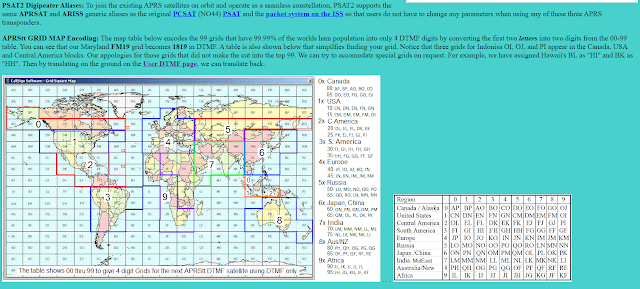
aprstt

Use Case #2 for APRStt: Supporting a local event

Being able to share location information like this can be applied to many real world applications such as for finding people at a special event like a large festival or even a race where not everyone will have an expensive APRS radio, but does have a DTMF capable radio.  

Here is an example by the inventor of APRS, Bob Bruninga WB4APR as deployed at the Dayton Hamvention in 2010.

aprstt

Making APRStt work for a marathon or other race?

Rather than thinking in terms of a location grid, another way to use APRStt is to set predefined locations long a race route which matches GPS locations.  

When a user transmits a number sequence, the infrastructure can receive a DTMF string which may identify a race mile marker, athlete status, health condition and unique "bib" number.  Here is an example as set up for the upcoming United States Military Academy triathlon. 

aprstt


Once the ten digit DTMF sequence is received and decoded, the infrastructure can transmit back a computer voice to let the support staff know the message was received, but the infrastructure can also translate this to be shared over the APRS network and appear on a map in real time. 

APRStt, aprs touch tone,  aprs dtmf, usma, usma triathlon

How to make your own APRStt infrastructure?

In a follow up article, we will detail how to combine a radio with a computer interface along with the appropriate software to create your own APRStt infrastructure for your own local area or special event.

Please follow the N2WU.com blog for more on the technicals behind this with a special focus on the software and tips on ensuring a fully functional system via lessons learned by the 2021 USMA Triathlon which is taking place on August 15th 2021.

APRStt

Thursday, June 20, 2019

Mr. President: Dialing for satellites?

beige box hacker ham radio maker

Ah, the ubiquitous DTMF keypad still has some relevance as a modern communications tool in the age of voice assistants, location technology and digital communications. Lets find out if that is true.....

What is DTMF?


When you press the buttons on a telephone or most radio keypads, a connection is made that generates two tones at the same time. A “Row” tone and a “Column” tone. These two tones identify the key you pressed to any equipment you are controlling. If the keypad is on your phone, the telephone “Central Office” equipment knows what numbers you are dialing by these tones, and will switch your call accordingly.

If you are using a DTMF keypad to remotely control equipment, the tones can identify what unit you want to control, as well as which unique function you want it to perform.


DTMF tones

How do you dial satellites with DTMF Mr. President?

Not all amateur radio satellites focus on providing voice, packet, location or image sharing. A few have incorporated APRStt which makes for novel quick communication of both user call sign and location using one nice short string of DTMF codes.

DTMF satellite ham radio


Any one who has watched or conducted amateur satellite activity may be familiar with the grid square or maidenhead location system.   Using only two capital letters, two numbers and two lower case letters can the geographic position with accuracy of 7.5 miles.

While that may not seem too accurate, its good enough for quick general location exchange.  Simply speaking into a radio that you are located in FN31 or FN31bw is far easier than saying 38°53'52.6"N 77°02'11.4"W or even 38.897933, -77.036500.

Using APRStt, you can simply press *13315246402164# which works out to K2GOG located in FN31bw.   The time it takes to send 16 characters is less time than it took to read this last sentence.

For those interested in data satellite communications, but do not own a radio capable of the popular AX.25 based 1200 baud APRS functionality like the Kenwood TH-D72, TH-D74 and the newish Lanch HG-UV98 to be reviewed on HVDN later this summer, this may be an interesting communication method to experiment with.  Courtesy of Bob Wood, WA7MXZ, here is a nice calculator to compute your own APRStt sentence.


Harris Falcon2 satellite radio military green

Any amateur radio with a DTMF keypad from the lowly $25 BaoFeng radios, to more current mainstream radios like the Yaesu FT-70R and about 300+ other models to the super cool looking military "knock off" variants of the PRC-152 found on E-Bay would work just the same for APRStt since they can all send DTMF.

But how to decode APRStt?

DTMF is hard by ear to determine the DTMF code sent, so the soon to launched PSAT2 includes a  DTMF to voice transponder which will read back via computer generate voice a fully formed APRStt sentence it receives.  There are also many other very interesting things that PSAT2 will also permit such as:

  • PSK31 10m band up-link/UHF FM down-link
  • SSTV camera with UHF down-link in the same pass-band as PSK31 signals
  • DTMF Grid Square up-link and Voice/APRS down-link for Grid position reporting
  • DTMF Text messaging (APRStt).
  • APRS text messages up and Voice down.
  • Conventional APRS digipeater 
Some may choose to experiment with an SDR tuned to the appropriate PSAT2 frequencies and decode APRStt with suitable software or maybe even use an Arduino based simple DTMF decoder since not many amateur radios can decode DTMF easily. 

what is on the PSAT2 satellite?


The radios that can and often include other uses for DTMF multi tone decoders and could be programmed ahead of time to un-mute when a known APRStt is heard, but that sounds frustrating.  Maybe someone will "hack" a TYT MD-380 or other to show DTMF since it is capable at multi tone decode?  Hmmm.....

PSAT2 details please?


AMSAT APRS PSAT2 ParkinsonSat2  HVDN STEM

Once this interesting cube-sat reaches orbit and is provisioned for operations after the June 23rd or 24 or 24th 2019 launch window, we will be able to track the satellite and hopefully learn if 28.120 MHz is the actual 10m frequency to be used for the PSK31 transponder up-link or not.

PSAT2 is sure to be an exciting satellite and we wish it success and to help continue to make ham radio great again!

Related Reading