Showing posts with label MD-UV380. Show all posts

Thursday, January 21, 2021

Planting Digital Voice Seeds with TFSN & HVDN


The Farmacy Seeds Network invited Steve Bossert K2GOG back to its YouTube channel for a discussion about digital voice radio.  CJ KD2IIN asked great questions during the interview to keep it moving along. 

Highlights include:
  • What is the most popular amateur digital voice mode today?
  • What should you invest in when thinking about digital voice?
  • What are common DMR specific terms you need to know?
  • How to program your DMR radio with just the basics?

Friday, November 2, 2018

Review: Retevis RT-51 Basic PoC Network Radio

A network radio or PTT Over Cellular (PoC) device changes the way traditional two way radio users think about reliable unlicensed and local/non-local communications.
"Network radios use existing cellular infrastructure just like your smartphone in order to communicate both near and far"
The most basic PoC radio such as the Retevis RT-51 reviewed later in this article has better coverage compared to a smartphone that uses the same network due to antenna placement and configuration.

This creates unique applications and disruptions for those interested in communication equipment not seen since the days of Nextel and its iDEN technology that created the first wide scale PTT/cellular service concept back in the 1990's.

Overview:  Competitive Landscape

To set a baseline comparison, lets first compare competing unlicensed FRS and MURS radio services in the United States along with two non-critical licensed radio services known as GMRS and Amateur Radio.

Our goal with this article and review is to inform non-critical communications users about the benefits of network radio solutions.

Comparing the physical characteristics of one vendors traditional
analog/digital VHF/UHF radio (RT-3) and its basic network radio (PoC) offering (RT-51)

Licensed versus Unlicensed Radio

In the United States, there are specific frequencies that can be used with no license.  Most of these are designed for consumer use and occasional business use of a non-critical nature. 

Family Radio Service (FRS) and Multi Use Radio Service (MURS) offer different benefits to its users looking either for local or mid range communication. 

FRS uses 14 channels in the 462 and 467 MHz range with a maximum power output of  500mW and no ability to use external antennas.  No more than $60 USD for a pair of basic FRS radio often needs to be spent and the most professional quality FRS radios with other features like weather broadcast reception often sell for less than $150/pair. Average realistic communication range is less than 2 miles.

Example FRS radio made by Retevis. FRS in the United States or PMR and other
 similar services in other countries offer clear local unlicensed voice communication

MURS in comparison to FRS has only 5 channels with up to 2 watts of transmitter power and the ability to use external antennas for greater range.  There are some business users who still use these channels that at one point were called "green dot", "blue dot", "red dot", etc itinerant channels before MURS was an official service in the United States less than 10 years ago.

For a dedicated MURS only radio, pricing would be $150 to $400 for a pair of them. Average realistic communication range is about the same as FRS, but will tend work for greater distances in unobstructed residential environments or more reliably outdoors.

A MURS radio tends to be more expensive compared to FRS radios and there are fewer consumer grade options available for purchase which keeps MURS as a "best kept secret" for reliable mid range unlicensed communications.

Motorola offers its model RDM2020 and RDM2025 as
MURS only radios available for consumer purchase

With either the FRS or MURS service, communications is often limited to less than 3-5 miles.  There is no legal way to increase the range of these services with repeaters. General Mobile Radio Service (GMRS) does however offer this capability however for extended communication range.

Important: There are very few "legal" radios that combine both the VHF MURS and UHF FRS/GMRS functions into one radio.  There are many capable radios to do this however.

GMRS is unique as a licensed service that shares a few overlapping channels with FRS for some level of licensed/unlicensed interoperability.

Basic combinations of GMRS and FRS radios can usually be purchased for less than $100/pair and the advanced repeater capable radios selling for not much more.

Standard FRS radios are advertised as 14 channel models and the FRS/GMRS versions are 22 channel, not including the input frequencies for repeater GMRS operation.


Business users such as property management companies, construction, maintenance and other non-critical communication users have little choice but to turn to specifically licensed frequencies should they require greater coverage range or privacy. 

Pricing for licensing varies along with equipment maintenance and compliance costs. A general overview of licensing costs can be found here.
GMRS is typically not the best for business use because other unlicensed users may interfere with important business communications.
Citizens Band (CB) at 27MHz is mentioned only in passing within this overview of unlicensed radio services due to different characteristics too dissimilar in operation and equipment compared to FRS, MURS, GMRS and amateur radio.

Amateur radio is a licensed non-commercial communications tool that offers the benefit of all the characteristic benefits of different frequencies and spectrum plus the ability for larger antennas and higher power.
A basic amateur license in the United States is known as the Technician Class and permits the use on any frequency for any type of communication above 28.3 MHz and limited data only communication below. 
Gaining a license to become an amateur radio operator is very easy and there are very affordable radios that can be used on part or all of the most common spectrum in use with its 700,000 users in the United States.


Selection of modern amateur radios that offer different combinations of spectrum and communication modes.
MSRP range from $150 to $500 for those pictured.

Amateur radio also offers true "radio to radio" capability, communication through repeaters for extended range when using inexpensive hand held radios and also decentralized networks such as Brandmeister for a mix of local and global communication capability, like that offered by a  network radio.

This is without mentioning long range HF 1.8 to 30 MHz communication which most people associate with amateur radio which often leaves out the VHF and UHF offerings including 144-148 MHz, 220-225 MHz, 420-450 MHz and even 1.2 GHz!

Here is a comparison chart between the different services and spectrum the services covered in the article can be found.


Retevis RT-51 Network Radio Review

The Retevis RT-51 is very well built and feels like its capable to stand up to daily use in bad weather.

The manufacturer lists its IP67 rating for moisture and dust resistance as part of its features which also include loud volume, easy to push buttons and a simple menu system to access key features.

A full color display shows the incoming caller name to help identify who is speaking.  Time, date, battery life and network signal strength also appear and is easy to read in most lighting conditions.

The RT-51 can also announce various operational parameters for the visually impaired in situations where looking at the display is not possible.

The Retevis RT-51 and the TYT IP-350 are identical radios.
The major difference with Retevis is more responsive
customer service and possibly warranty support.

Operation of the radio is very easy with a power and volume function built in to one of the top mount controls.
The knob between the volume and antenna allows the user to select between different groups, explained later in this review.
At a price of less than $150 each, the Retevis RT-51 is unique in that it is a high quality product for a moderate price similar to that of its line of equipment marketed towards amateur and commercial radio users, such as its VHF and UHF only radios along with dual band versions.

Retevis offers the least expensive and basic network radio (PoC). 
Competing and more complex network radios  can cost more than $500 each.

Many manufacturers today offer digital communication capability such as DMR which has been adopted as the replacement for aging analog only radios. Benefits of DMR include user identification, location tracking, flexible group or private calling and management of users through special programming and console software.

RT-51 Experience: Out Of The Box

It is not possible to buy one, two, five or one hundred  of these radios and use them without first having two critical items.

Critical Item #1:   Each radio requires an inexpensive cellular prepaid or post paid data plan that will work on compatible mobile networks such as AT&T and T-Mobile.

A SIM card will need to be installed in each radio so it can work. No "radio to radio" calling feature is possible without a network based data plan with the Retevis RT-51. The spectrum that the Retevis uses is licensed to the mobile carrier networks such as those found at 800 and 900 MHz plus  1.7 GHz, 1.8 GHz 2.1 GHz and 2.6 GHz. There is no 2.4 GHz Wi-Fi of 2.3 GHz amateur spectrum accessible in the RT-51's ZTE 3630 4G LTE modem

The great news is that even with the least expensive $7.99/month plan on offer from FreedomPOP which offers 2 GB per month, the radio will likely only use 25% of that bandwidth even with heavy use. For users looking for many radios, it could be possible to pay even less per month per radio on a data plan.

No matter where a user is the radio will work just as long as there is network coverage available. This translates to 95% or better percent reliability in most any area that network operators cover.  This is a major benefit of a network radio compared to traditional radio. Plus, there is no need to invest in infrastructure, such as a repeater.

Underside of RT-51 showing the
removable door and SIM card slot

Critical Item #2
:

Once the radio has a data plan and SIM card - the radio needs to communicate to a server that routes communication between users.


Retevis offers two different options to make operation of the RT-51 easy.  For $10 a year, Retevis can host the PTT Smart Dispatch software on a US based server.

All that needs to be done is share the user ID for each user with Retevis and let them know how to set up groups for your users.

Easy menu navigation allows selection of
Group, Member, Friend, Recording, GPS, Setup

Each user can contact each other by "private call" or all users assigned to specific groups.  This "hands off" option is best for users who do not need to track user locations from a central dashboard.
  • Group:  Allows a user to contact any member that is assigned to the listed group
  • Member:  Real time list of online users are shown and user can contact other members through a private call
  • Friend:  Server and Local "Friends" can be selected to contact that are managed through the PTT Smart Dispatch software. 
  • Records:  Shows a listing of incoming and outgoing calls specific to the users radio.  Playback of missed calls is possible.
  • GPS:  Will show the location coordinates of the users radio based on GPS satellite reception.
  • Setup:  Provides control of PTT sound, back-light control, audio guide and a few other functions
A second option allows Retevis to sell a license to the Smart PTT Dispatch software for the user to install on a server they currently have.  This option lets the user manage all radios, group settings and view real time maps for all radios.  Pricing is negotiated with Retevis on this option directly.


While this may sound complicated, this approach creates a lot of very interesting capability, including the ability to manage radios on a private LTE networks which are growing in popularity in fields such as mining, agriculture and others.

Feedback on the RT-51

This may sound sort of funny, but Retevis should have included Wi-Fi in this product or at-least offered another version that included it. 

Had Wi-Fi been included, it would have allowed users an option for limited range "radio to radio" communication or to use the radio without the Smart PTT Dispatch software.  It would have also offered an option for brand loyalty and later upgrade capability dependent on user requirements such as in places where there is not good mobile network coverage, but good in building Wi-Fi connection.
Other "Network Radios" offer Wi-Fi  or even low power UHF as standard, so why not Retevis? 
There are reasons that the battery is slightly different than those in use by its popular VHF/UHF radios both in physical dimension and voltage, but it may have created more brand loyalty and interoperability to have used the same battery.


From a hardware perspective, there is not much else that should have been changed to keep this product at a moderate price point. Headset accessories are plentiful and uses the common Kenwood 2-pin configuration.

Key Comments

  • Battery life is excellent and only has shorter use time based on the GPS being on all the time, but can be shut off.  5 days with the radio powered on in standby mode was great and about 2 days with moderate use was common even with GPS on.
  • Direct competition for Retevis will likely come from Inrico and Peak PTT, but Retevis comes out ahead on price point.
  • Both competitors seem to have a more mature approach towards the software and dispatch management that are required for all network radios to work.

While a negative comment against Retevis, they may be able to innovate by investing in the Smart PTT Management Platform software development. 

In comparison,  Inrico has done well by integrating with the Zello and IRN PTT applications that are well known for providing "walkie talkie" like functionality on smartphones.

Peak PTT may be lesser known and will likely be the closest competitor to Retevis. The United States based competitor seems to offer better radio management software and features, but are more expensive than the RT-51.

RT-51 Final Verdict - Wearing Different Hats


  • The "Pretend Local Small Business Owner Hat" - The RT-51 is interesting for a business looking for reliable communication and not interested in maintaining any equipment aside from paying a monthly bill.  
  • The "Pretend Larger Business User Hat" - The RT-51 with its location tracking capability and ability to host the Smart PTT Platform locally will give control to the business owner with minimal infrastructure to maintain, especially if they already operate a computer server for other business functions.
  • The "Amateur Radio" Hat - The RT-51 will not be of interest to the amateur radio community without taking the radio apart to make it do something it is not intended for.
  • The "Communication Hacker" Hat - The RT-51 may be very interesting since this radio is nothing more than a cellular modem with various I/O capability. 
  • The "Concerned Family/Church Leader" Hat - The RT-51 monthly fee may be hard to handle, but a prepay data plan could be great peace of mind for for this solution over other unlicensed services when it is needed.  Group trips, community support and other non-commercial activity are great application examples for the RT-51.
  • The "Business Strategist Perspective Provider" Hat - The RT-51 is a great piece of hardware but will likely not do well from a sales perspective unless distributors and integration specialists are made aware of it.  The lack of polished software management and lack of known APIs will also prevent serious interest in this product since many will want full control of the hosted Smart PTT Platform rather than having it run somewhere unknown "in the cloud" since it can impact user privacy due to the embedded GPS capability. 
In Closing....

As an unlicensed communication tool, the RT-51 is a great idea, however paying a monthly fee to a mobile operator along with a very low annual server host or dedicated software license purchase outright that is hard to get clear pricing from the vendor, may create more business for the competition. 

Friendly Suggestion

Retevis has a great opportunity but really needs to look at where the real revenue and value is to its users as part of its sales and marketing strategy.

Biography on the author

Steve Bossert currently works for a Hong Kong based research & technology advisory firm. His role is to manage and grow the business visibility in North America for the unique capabilities of his company. Prior to this opportunity, he has worked for other well known strategic consultant firms over the past 15 years.  His expertise includes strategy for multinational semiconductor, mobile wireless, infrastructure and diverse emerging technology companies. 

Before graduating university and while in high school, Steve became a licensed amateur radio operator. Steve has the ability to blend his natural technology curiosity and business acumen to provide unique perspectives for both his professional and hobby interests.  Steve currently resides in New York with his wife Jennifer.


Monday, August 13, 2018

60 Days with the TYT MD-UV380

On May 31st and June 5th of 2018, HVDN released a two part internal tear-down of the new TYT MD-380 dual band DMR radio.

The TYT MD-UV380 was released in May 2018 and will only get better with time. 


Since there were still many quirks and curiosities in the actual operation of the radio still be explored, starting a review from the inside out seemed a better way to go about determining if the "UV380" was a keeper or not and avoid getting frustrated by any potential lack of polish on the user interface of the radio.

If you missed those articles, here are the links to check them out:

Far too many new amateur radio products have been rushed to market over the past few years due to the growing complexity of them, but have later been fixed and transformed into much better user experiences.

Some of these of rushed products include the Icom IC-7100, Yaesu FT-991, TYT MD-2017, Icom IC-7300, Baofeng DR-5R and Ailunce HD1 to name just a few.

ham radio firmware upgrades


As of August 10th, much has been learned directly and from other early adopters of the TYT MD- UV380. Here is a more "operational" review of this latest mid tier digital voice radio.

Please note that this review is of the GPS enabled version only.

Firmware and Programming Software Review

The firmware shipped with the MD-UV380 was S15.021 and quickly upgraded to S16.06, but then downgraded to S16.05. The reason for the backwards downgrade by Steve K2GOG was because at the time the programming software seemed to work better with 16.05. 

As of the time of this article, there is a version 17.xxx firmware that has been shipped from TYT vendors for the non-GPS version, but this is not to be found on the TYT or any vendor website.

The Radioddity GD-77 has also started to see new firmware loaded from the factory, but not to be found on the manufacturer website. If this is a trend, it is worrisome for users looking to upgrade or downgrade radios.

The current most up to date "official" radio programming software or CPS as of the date of this article is 1.07. There has been a version 1.08 and 1.09 floating around some user groups, but seems to "sort of work" and it not being recognized as official.

For those with the MD-UV380 GPS version, its suggested to actually use the CPS and FW for the MD-UV390 which is slightly larger and offers water resistance capability.

MD-UV380 Suggestions

As of August 10th 2018, I would suggest using S16.05 as the firmware and CPS 1.05 as the programming software as they seem to have the least issues for the MD-UV380 with GPS.

MD-UV380 Improvements Since Official Release

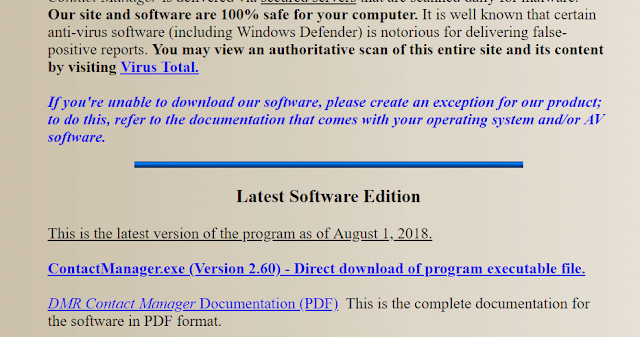
#1) Probably the greatest improvement since the release of the radio is Tom N0GSG's popular contact manager software being able to support the TYT MD-UV380.  This freeware with suggested donation allows easier moving of programmed channels and contacts into a more usable order compared to when programming the TYT MD-UV380 with the manufacturer supplied programming software.

TYT MD-UV380 software contact manager
N0GSG's popular "Contact Manager" software
as of August 1st 2018 supports the TYT MD-UV380

#2) Another improvement since the TYT MD-UV380 was released is better handling of loading in the user contact database to the radio. This is helpful in order to show call-sign, name and location information for each DMR user instead of either trying to memorize the 7 digit ID's for everyone or loading them one at a time.

The AmateurRadio.digital website is the best place to get the current version of the user database for the TYT MD-UV380.  As of the date of this article, the user database has 105,212 registered users and all of them fit within the UV380's memory. It is believed however that once the user database exceed 120,000 contacts, the radio will ignore all users over the maximum number the radio can hold.  Users not stored in the database will show up as "unknown". 

After you create a user database file from the AmateurRadio.digital, such as this sample created for the date of this article, there are a few things to be mindful of:

#3) The TYT MD-UV380 uses the same format for contacts as the TYT MD-2017.  Code plugs can also be directly imported which is nice.  If you have an older mono band MD-380, you can first open that code plug in the MD-2017 CPS of choice, save it and then load it into the MD-UV380.

#4) Before loading contacts, save your code plug often. The CPS may crash sometimes and not save recent changes.

#5) When loading contacts into the TYT MD-UV380 via the CPS, after using the "import button" you need to wait for the "Import Succ" message to appear before then writing the database to your radio

Make sure after importing the database you get
 the "Import Succ!" message before writing to the radio

#7) On your MD-UV380, you will need to enable CSV database for the contacts to appear. You  do not need to have Microsoft Excel to do this contrary to what some people say.  If you do want to edit the contact file, you can use freely available OpenOffice

#8) Almost everything can be programmed without a computer, but requires a certain order to do it. First you need to create a channel and create a zone.  You then need to assign the channel to a zone in order to use it.

#9)  Its possible to enable a VFO mode in the CPS, but its not 100% clear how to access this mode if you reassign any of the buttons on your radio.

#10) If you program a side button for "monitor" you can see frequency and channel info which is nice

There is a lot more to say about this radio and the only thing it seems to miss out on is better "keypad" dialing of talk groups like what MDtoolz does for the MD-380 series or even the Anytone D868 and BTECH 6X2.

Share your observations and tips here if you want or in your favorite Facebook group.


Saturday, July 7, 2018

Look Up! 2 Different Amateur Location Technolologies

Flying in a hot air balloon was a first for Steve K2GOG and proved a great opportunity to test out location positioning using both low power APRS as well as DMR GPS with two different pieces of equipment:


A Kenwood TH-D74 was also taken along for the ride too as a backup in case the PicoAPRS had an issue, but it performed flawlessly.

Instead, the APRS enabled Kenwood radio would serve as a voice only radio to make local contacts on the ground using analog FM. The TYT MD-UV380 was used to make digital voice contacts on the ground and over the internet.

Early morning and early evening is the best time for hot air balloon flights due to
 more predictable wind patterns and thermal conditions

The hot air balloon Steve was a passenger on was the 2nd to launch early Saturday morning from the Dutchess County Fairgrounds of New York as part of Balloon Fest 2018 sponsored by the Dutchess County Chamber of Commerce and area businesses and organizations.


Those looking to taking a balloon ride were asked to arrive at 5:00 AM and launches would happen on a first come first serve basis.  Steve was fortunate to have arrived early and was the third passenger for the second to launch balloon.

There were maybe seven or eight other balloons still getting ready for launch after the "Autumn Above" balloon he was on took to the air, piloted by Scott Griswold of Above All Balloon Rides.

Most balloons were inflated in under five minutes


After what seemed like an ahead of schedule launch just past 6:00 AM, the first set of trees was cleared as the balloon made western ascent which would last about 45 minutes before landing in a  near by field. The maximum altitude turned out to be a somewhat disappointing 260 feet.

During the entire ride, Steve shared his position over two modern location enabled applications for amateur  radio in real time to show that "ham radio" is not just old retired engineers in a basement sending Morse code late at night who enjoy this hobby also.

Propane powered heaters are used to inflate the balloon and control ascent. 
Vents let out hot air to provide descent of the balloon


APRS

Automated Positioning Reporting System or APRS for short has been around for over 20 years since its invention by Bob Bruninga WB4APR and today uses a common frequency of 144.39 MHz in the United States for users to share short text messages, automated weather reports and location data.

Across the United States are countless amateur radio operators who operate digipeaters that repeat received signals from local users to increase the range of these signals in order to reach a wider audience.  There are also iGateways that take these APRS signals and share them across the internet for anyone to view on websites such as aprs.fi

Balloons & APRS

Steve K2GOG utilized a PicoAPRS device to share his location on 144.39 MHz and his signal was picked up by a number of local area digipeaters and iGateways. This particular radio has a function called smart beaconing which allows more frequent transmissions based on speed and altitude. Steve had also set his radio to include the "-11" prefix which is to recognize it as an  aircraft based use of APRS.

This is also known as an SSID and there are many numerical values to identify different types of users. For the balloon trip, Steve operated as N2HVD-11 which is the official call sign of the Hudson Valley Digital Network Club along with the appropriate SSID suffix of 11.

Its normal for balloons to not go much higher than trees.
A few were hit along the way of the flight


The PicoAPRS radio was also set up to only send signals to the closest receivers instead of its normal configuration which is for ground based use.

Because the balloon was going to be above ground at an unknown altitude during the flight, it was appropriate to do this because it would provide less congestion on the frequency since the higher a signal is - the further it would travel.

Since the US only has one APRS frequency, it needs to be shared with many users so this setup while less robust or redundant it was more courteous as a best practice of amateur radio.

N2HVD-11 was used for APRS reporting with picoAPRS
 radio.


Balloons & DMR GPS

Using a digital voice radio such as the DMR based TYT MD-UV380 is a bit different compared to the data only APRS enabled PicoAPRS device or a voice and data APRS radio like the Kenwood TH-D74.  There is no common frequency for sharing location data for DMR yet but there is a common talk group which is 310999 in the United States that can be used for this type of application.

 A talk group is like a "virtual frequency" in that as long as your radio attempts to share location data on this talk group, it will find its way to where it needs to go regardless of frequency. A talk group can get congested just like a single frequency such as the 144.39 MHz frequency for APRS though, but is not subject to as many collisions with other users so could be more efficient for more users.

The TYT MD-UV380 was set up to share its location with a portable digital hotspot operating on 427.505 MHz. The frequency chosen is one of many being explored for part of a uniform channel plan for users of DMR to bring some standard operating practices to this emerging mode of operation.

Since there were no repeaters in the area that permit the use of sending data only transmissions or nearby hotspots on the ground set up within range of the balloons flight path, the hot spot device was connected to the internet over a smart phone enabled Wi-Fi access point.

Here is a basic block diagram of how the signal from Steve's TYT MD-UV380 made its way to the aprs.fi website to see his location.

Simple flow chart of how GPS and DMR work together 


Compared to APRS which is more mature with its network of digipeaters and iGateways, sharing location data from a DMR radio may not seem as mature, but in many ways, its much more advanced.

In the above block diagram, starting at right (TYT MD-UV380), the GPS location data is encoded along with transmissions sent over talk group 310999 on 427.505 MHz. This is then received along with time slot, color code and user ID information to identify the transmission or "payload" at the hot spot device.

Note D represents that data is only able to flow one way towards the network, but it is possible to receive location information on the radio but is outside the scope of this article.

Not all balloon pilots were as experienced as ours, so some were following us.

Once the UHF 427.505 MHz signal is received on the hotspot device which translates an actual amateur radio transmission to get it ready to make its way to the internet, first the data is transformed from the hotspot to Wi-Fi which is how the hotspot and Samsung smart phone communicate.  Communication of data between the smartphone and hotspot as noted by Note C are two way in nature to ensure security and integrity of the signal.

The smartphone then communicates over spectrum that is licensed by the mobile operator network thanks to local cellular towers per note B.  It is after the data communication leaves the local cellular network does it make its way to the internet as shown by note A.


K2GOG-11 was used for GPS DMR location reporting. 


Sharing location data over a DMR radio is not yet as advanced like APRS since there is no smart beaconing function.  Location "breadcrumbs" are only shared at a preset interval or each time the user transmits manually.

Comparing DMR GPS & APRS

As illustrated in the screen captures of the flight path above using two different methods of location tracking, there is much that can be done with amateur radio today.

While APRS is a very robust tool, it only allows the user to send data over one uniform frequency.  DMR on the other hand with its advanced routing could allow simultaneous voice and data transmissions on the same frequency.  This is done by using one of the two time slots with different talk groups as covered in a few past HVDN articles on GPSAPRS and DMR you can find in the word cloud on the HVDN Notebook.

A few more balloons were waiting to take off after we returned to the Dutchess County Fairgrounds

Since APRS has laid a solid ground work for spectrum management, coordination, applications and integrations of various technology since its inception, DMR is a fertile field for additional development for location sharing enabled applications.

Here is the raw packet data for both stations during the flight:
 Visualized Data


After landing, we were treated to a champagne toast at 7:00 AM. Plus, we each got a
keepsake plastic cup.  Basically, its now a $250 cup with a free balloon flight!


Tuesday, June 5, 2018

Teardown & Comparison: TYT MD-UV380 Part 2

Last week saw HVDN post a partial tear-down and comparison of the newly released dual band TYT MD-UV380. And, it seems to have gotten a lot of attention too!


The follow up article that you are about to read goes into more detail "under the hood" on the MD-UV380 compared to the MD-380G mono band version.  There is also some further explanation of features found in the user interface along with some other discoveries that may catch your eye in the RF portion.

FCC Type Acceptance

The FCC ID for the MD-UV380 is "POD-DMRUV" and as of June 4th 2018, it does not yet appear in FCC OET records which is interesting.

FCC ID of MD-UV380 that is not listed yet on FCC OET website

While querying the FCC Office of Engineering & Technology website, here are the only ID's associated with TYT.

All recent TYT FCC OET IDs that have been approved

The first three records for "POD-DMR3" are for the TYT MD-9600 mobile radio.  FCC ID's of "POD-DMR1" are for the mono-band UHF version and finally "POD-DMR" is for the VHF version of the MD-380.  Notice the 2017 certification dates for the mono-band radios. These are actually re-certifications for TYT. In the past, the radio was branded as "Tytera" and is no longer able to be used due to brand infringement with Hytera, a totally different radio vendor.

When a vendor lists various documents as part of the filling, its common to include some internal photos, but they are usually not the most interesting. HVDN has decided to go the extra mile in showing whats really going on within the MD-UV380.

Under the under side of the under the hood?

As noted in our part 1 tear-down, the MD-UV380 seems to have moved the base-band portion of the RF unit to the underside of the PCB. What was learned is that the HR C6000 is used in the MD-UV380 instead of the HR C5000.   The TYT MD-9600 for reference also uses the HR 6000 and this provides an overall better platform for digital voice compared to the older, but still capable, HR C5000.  The MD-UV380 will likely have a long shelf life ahead of itself.


HR C6000 base-band as found in the new TYT MD-UV380


With confirmation of the base-band chip and the STM MCU talked about in the part one article last week, perhaps the most exciting thing discovered is the AT1846S software defined radio chip.

This fairly common component and its RDA1846s cousin seems to make the TYT MD-UV380 just a little more interesting. Integrating this in addition to a much better front end offers much better performance compared to lower priced radios and something that also competes with higher priced models that do slightly less in a larger form factor.

The AT1846s SDR chipset as found in the new TYT MD-UV380


I do not know if its possible, but it should be theoretically possibly for someone to rewrite part of the coding and enable FM broadcast reception with reduced performance which is one of the only features the Ailunce HD1 offers.

Here is a close up view of the additional filtering found on the underside of the TYT MD-UV380.  A future project would be to use a vector network analyzer or signal generator and scope to see where the filtering low and high cut range is as well as any notches in between to see if FM broadcast reception would work or possibly add through software, the ability to use the MD-UV380 on the US 1.25, 220 MHz amateur allocation.

The underside of the RF deck of the TYT MD-UV380 front end filtering. The underside of the radio provides better shielding.

Here is a image zoomed out for more idea overall of how different the TYT MD-380G (UHF) and the new TYT MD-UV380 underside of the RF deck looks.

MD-UV380 at right and MD-380G at left from rear side of RF deck

So that does this all mean?

A main reason why HVDN felt a tear down would be important was because of the better than average audio signal reports provided over the air while using this radio. Same thing with the quality of the receive audio.

The microphone elements on both radios are identical. The MD-UV380 receive audio at the minimum volume level is quiet loud and favors the low end of the audio spectrum which provides a much fuller audio experience compared to the MD-380G (UHF) as well as commercial Vertex VXD-720 and the Radioddity GD-77.  On transmit with the MD-UV380 and the mic gain setting at the middle setting of "3"  comments on transmit audio have been quiet good.

This better sounding audio is likely due to the HR C6000 base band and related AMBE translation.

From an RF perspective, receive wise, signals for local analog repeaters, local DMR repeaters and public safety and utility in both analog and DMR also seem to come through more clearly on the MD-UV380 compared to the MD-380G (UHF) and also a MD-380G (VHF).

The signal meter though seems less sensitive compared to the MD-380G radios. Pretty much everything seems to max out at 3 of 4 bars.  There is also a "scanning" effect on the signal meter at times on DMR.

Here is a demo video of receiving an analog NOAA NWS weather transmission with the stock antenna followed by another of receiving a local hotspot with DMR audio.


Additional Review Notes

As mentioned prior, the radio shipped with F/W S15.021. It was soon after upgraded to S16.06, but then I decided to downgrade to S16.05 based on other users experiencing issues relating to compatibility with S16.06 and certain versions of the computer programming software  or "CPS".

There are a number of versions of the CPS available. I started with version 1.03 which works fine.  Version 1.05 also includes 1.04 which can only be found on the Grapevine Radio website download area and not the TYT website.  Version 1.06 available on the TYT website also includes version 1.07.

It is suggested that even though an MD-UV380 with GPS has software available for it, the MD-390 version firmware and CPS are suggested to be used directly by TYT.

There are no issues with any versions of the CPS I can find, aside from one major issue that users on Facebook user groups related to TYT are discussing.  The issue is the inability to upload the user database to the radio while using the appropriate firmware for CSV and GPS compared to the recorder and GPS version noted in the part one article.

Setting up short messages for use with SMS WX and GPS sending with the TYT MD-UV380


I am not sure how I did it, but I did have the user database working under F/W S15.021 but can not get it to work again in later F/W or even after rolling back to what the radio came with. Moreover, after experimenting with the user database in the MD-2017 format, it seems to write the contacts to the radio, but they are somewhat scrambled.

The GPS functionality also works fine and I was able to send location data to aprs.fi as well as receive SMS weather messages with the MD-UV380. If this interests you, please have a look at this article on how to set that up.

The user database feature will need some more time to get the bugs worked out, but otherwise should be an easy fix. I rather have a really good sounding radio compared to a user directory to start out.

Summary

Compared to all other TYT radios at the time of launch, the MD-UV380 seems be much further along than other radios, especially the MD-9600 and MD-2017. It should not take long for the user database issue to get officially sorted out. Right now the workaround is to convert files from an MD-2017 into the MD-UV380 format which is easily done. Its also possible to import MD-380G files into the MD-UV380, but first needing to be saved in the MD-2017 CPS.

What else was learned in the part two of the teardown

  • Uses the upgraded HR C6000 base-band
  • Integrates the AT1846s SDR chipset
  • Has a much better designed RF front end
  • Better audio on receive and transmit compared to MD-380G
  • Has some unique quirks such as flickering signal meter and user database
  • The smallest receive audio level is fairly loud and should be able to be fixed in the CPS
Next areas HVDN will focus on regarding the TYT MD-UV380 include:

  • Making some small "tweaks" in the configuration files for RSSI, squelch and audio
  • Staying up to date on all CPS and user database issues
  • Learning about other hardware potential "tweaks" to further unlock greater value in this radio


Subscribe for HVDN Notebook updates only at top of page


Thursday, May 31, 2018

Teardown & Comparison: TYT MD-UV380 Part 1

The dual band TYT MD-UV380 has just been released and promises much of the same functionality of the TYT MD-2017 and Retevis RT-82, but in the same form factor as the ever popular mono-band MD-380 and MD-390 series of radios.

This review goes under the hood of this latest $149.99 priced DMR & analog FM dual band handheld radio.

RF deck top view of the MD-UV380

Basic Overview


The MD-380 has been well reviewed elsewhere plus in past articles here on HVDN like the 2017 DMR entry level radio review.

The new MD-UV380 and MD-UV390 look identical to the mono-band versions and also include options with or without GPS.

Here are some side shots of the MD-UV380 (GPS) box which is somewhat informative on specifications.


Out Of The Box Differences

The firmware version out of the box for this sample was S15.021.  The latest version as of the date of this article appears to be S16.06 based on the TYT website download from May 23rd 2018.

While scrolling through the features in the CPS 1.03 and then updated into the radio to unlock certain menus, the major feature add on with the MD-UV380 is the ability to have up to 3 radio ID's and to change the mic gain.

Everything else is pretty much the same as the MD-380 stock firmware flow, not including the obvious addition of VHF and UHF coverage, like the MD-2017.

One feature introduced in the MD-2017 was built in "promiscuous" mode that allows monitoring of all DMR traffic on a specific time slot and correct color code. This has also made its way into the MD-UV380.


Also, like the MD-2017, the MD-UV380 can either allow audio to be recorded in DMR mode or provide the user with more contact storage space for the entire DMR ID database. Different firmware exists for either option for the MD-UV380 or MD-UV390.


From an outside hardware perspective, the MD-UV380 uses all the same accessories as the MD-380.  Same goes for the MD-390, which is just slightly larger than the MD-380. This is nice in order to recycle things like chargers, batteries and programming cords between the old and new radios.  The GD-77 by Radioddity also uses the same charger as the MD-380, so for users looking for a new dual band radio may want to consider the MD-UV380 over other similar radios.

The included stock dual band antenna seems to be of slightly higher quality compared to the antennas included with the mono-band MD-380/390 radios. The base of the MD-UV380 has an extended ferule to provide a little more waterproofing on the antenna connector on the radio.

Navigating the MD-UV380

Compared to the MD-2017 with its roller ball navigation, the MD-UV380 uses the arrow buttons below the display to flip between the upper and lower band assignments. This makes the UV-MD380 more like the Radioddity GD-77 or Anytone D868A from a navigation factor which is slightly less cumbersome than the MD-2017 roller-ball and will likely hold up better over time and prevent accidental band swaps or channel changes.

Channel selection in either the upper or lower band on the MD-UV380 is done through the top mount multi-selector knob. Compared to the MD380, there is no more limitation to 16 channels per zone which was sort of hard coded against the 16 position channel selector knob.  On the MD-UV380, as many as 64 channels per zone and possibly more is possible.


There will be more to talk about when it comes to the firmware updates, upgrades, channel management and overall user features, but that is not the main goal of this tear-down and comparison.

On the outside of the MD-UV380 from a distance, it would be hard to tell the difference between the MD-380, MD-380G, MD-390 and MD-390G. They all look the same and the only differences is the multi-selector knob, the label under the battery showing the model name and button coloration differences.

Inside the MD-UV380 and compared to the MD-380G

This is where things get interesting because the outside looks the same, but the inside does not.  Here are side by side comparisons of the MD-380G and the MD-UV380 (GPS). The outer-casing on the MD-UV380 seems to be styled like the earlier TYT versions whereas later ones had a more rounded speaker grill and colored buttons.

MD-UV380 on the left and MD-380G on the right

Things get interesting when looking at the two parts of the radio side by side after opening both up.

The MD-380G and MD-UV380 share the same exact board numbering for the user interface side of the radio as noted by KEY-V2.0-160329 text.   In the upper left corner near the speaker you can see the GPS antenna.

MD-UV380 on the left. MD-380G on the right.
Note the colored orange and blue buttons on the right side of the MD-380G

Swapping the RF deck from either radio with the UI board from the other confirms there is only one tiny difference.   The flat cable connector on both is slightly different which may just be a sourcing reason.  The connector on the MD-380 was a "piano hinge" type and the MD-UV380 was "compression lock" type. The flat ribbon cable fits the same way. Its possible over time that the "compression lock" version may be more reliable and limit the potential "white screen" issues some users have experienced when the connector and cable are not mated tightly at the factory.

Both radios upon re-assembly with the UI board and RF deck from both models confirmed identical operation and functionality. 

Should someone want the slightly more rounded housing and colored buttons from a MD-380G, but with the functions of the MD-UV380, this may be good to know.

The UI is the same but not the RF deck

As you would expect, the design of a dual-band radio would be just a little different than a mono-band version. Here is a side by side of both radios from the inside.

MD-UV380 at left and MD-380G at right

The major differences here get sort of fun. The same STM32F405 is used across both radios, but gone is the HR C5000 base band chip on the front side as in the MD-380.

In the MD-380G, the ST Microelectronics STM32F405VG is used which sports an ARM Cortex M4 core, up to 168MHz clock speed and 1024 KB of on board RAM. A more detailed spec sheet can be found on the STM website here.

The new MD-UV380 has the same STM32F405VG, but with slightly different date codes. It is unknown without further dissection if there are any small changes in the MCU since there is likely 2-3 time difference between the manufacture of both radios.

The "527" version was found in the MD-380 and the "664" version was found in the MD-UV380

Both radios also have the same Winbond 128K memory (W25Q128FV), but you may notice an empty pad for possibly an additional memory expansion on the MD-UV380.  This may be helpful as the user database for DMR ID's soon surpasses 100,000 which is the current limitation of many radios. As more DMR uses experiment with GPS, SMS and other mode translations such as those just introduced in Pi-Star, having additional memory will be a useful thing to have.

Note the empty pads for additional memory such as the 128k Winbond chip to left of  STM32F4055VG

For those that remember, the VHF versions of the MD-380 had less memory compared to the UHF versions which limited further alternative firmware development made popular by Travis Goodspeed, Ty Weaver, Warren Merkel and many others.

Perhaps lessons have been learned with the MD-UV380 to allow for future memory upgrades without complete redesign.  Its clear that TYT used the same UI board to simplify construction and offer a lower priced radio.

It seems all they really needed to do was just redesign the RF deck on the MD-UV380 after learning from the success and failures of the MD-2017 user interface and overly sized casing.

RF Front End

The RF front end is a combination of filtering for radio transmit and receive functions. On the MD-UV380 we can see some of that by looking at the SMD capacitors, resistors and inductors between the antenna connector and the copper pad which is a heat spreader for the RFPA on the underside of the RF deck board.

The MD-UV380 is a 136-174 MHz and 400-480 MHz radio, so its filtering would be more complex as expected compared to the UHF only version of the MD-380G.

MD-UV380 on left. MD-380G on right. It appears here that that the MD-380G is more complex on the rear of the RF unit compared to the MD-UV380. There has to be additional components on the underside of the RF deck board


Is That It? 

Clearly the top side of the  MD-UV380 seems more simple from a base-band perspective compared to that of the MD-380, but that is likely not the case.  All we have learned so far without further disassembly is the following:

  • Both radios appear to use the same STM MCU
  • Both radios have the same Winbond flash memory
  • The MD-UV380 seems to have the ability to increase on board memory due to empty pads.
  • The MD-UV380 may be using something else for base-band RF compared to the MD-380
  • The UI boards are common across both radios
  • The older style  and slightly larger housing from earlier MD-380 radios is used for the MD-UV380
Next Steps

The intent here was a basic under the hood look at the MD-UV380. Future coverage will include the underside of the RF deck and more about how the radio functions on the air plus other "deeper under the hood" analysis. 

One quick comment: Its possible to save a VHF or UHF frequency for transmit and the other band for receive.  Its also possible to save frequencies in as small as 2.5KHz steps. This may be of interest for those interested in satellite communications.

Stay tuned for more MD-UV380 coverage here on HVDN.  

Register for updates on the HVDN Notebook, become a member of HVDN or simply bookmark the following URL for anything posted here to do with DMR.


The most popular tags are visually represented on the Notebook for easy understanding on what is most popular at HVDN.  Most of HVDN active membership can be found on talk group 31368.