Showing posts with label Review. Show all posts

Wednesday, March 9, 2022

Is it a mag loop? Lets find out!


Kenwood TH-D74, Alinco DJ-MD5XTG, Lanch HG-UV98, APRS, VHF 2m loop antenna, HYS, HVDN, DMR, amateur radio SHTF

Here is a preliminary review of a recent antenna toy acquisition thanks to some spare Amazon points.

If this antenna proves to be a good option for MF waves instead of EF waves, this is likely going to become a popular product pretty quick. Let's dig in here, shall we?

MF, EF - What is it? A round antenna duck?

Here the antenna is on Amazon and it comes in BNC, SMA and SMA-J variants so it will pretty much work with most radios if you buy the right one.  

The vendor on Amazon does not call this a magnetic loop and I have not taken this antenna apart to see if a hidden capacitor is in that black bubble at the top of the loop but I suspect there is.

For me, I chose the BNC connector antenna version since using it with an adapter like the ones shown in the "Portable RF Connector Emergency Kit" are always on hand.


Kenwood TH-D74, Alinco DJ-MD5XTG, Lanch HG-UV98, APRS, VHF 2m loop antenna, HYS, HVDN, DMR, amateur radio SHTF
Where to find this?   Look on Amazon


How does this compare to the original factory antenna?

The radios tested with the HYS antenna pictured include the Alinco DJ-MD5XTG, the Kenwood TH-D74 and the Lanch HG-UV98 all using the original factory antennae.

A second round of testing was done with all three same radios but with the same aftermarket Diamond SRH320A tri-band antenna.

The test scenario was to communicate via a 2m repeater 30 miles away with all three different antenna options and at all available power levels for each radio. 

The results were from an audible report from different users on the repeater without telling them what I was doing over the span of a few hours on different days.

Kenwood TH-D74, Alinco DJ-MD5XTG, Lanch HG-UV98, APRS, VHF 2m loop antenna, HYS, HVDN, DMR, amateur radio SHTF


Results of Test: Non- Scientific you say?


Kenwood TH-D74, Alinco DJ-MD5XTG, Lanch HG-UV98, APRS, VHF 2m loop antenna, HYS, HVDN, DMR, amateur radio SHTF


The reason why I chose to use different radios is that different antennas will work differently based on the radio mass offered as the reflective or counterpoise part of the antenna system. What?   Here, look into counterpoise or "Tiger Tail" if you must learn more...

This test allows us to see more uniform tests in a real world environment instead of lab style results.

For each transmission, the radio was held the same way and at the same height.

Signal reports in green were all positive and as good as one could expect to come from an HT 30 miles from a repeater. Yellow reports included comments of fading or weak signal but still audible.  The red reports were scratchy or not very pleasant sounding.

At first pass, we can say that the HYS "Loop" antenna and stock antenna are all pretty much about the same results.  As expected, the longer and higher "gain" Diamond antenna worked the best.

Now with some baseline curiosity under control, lets do something more scientific in terms of radiation patterns and reception tests.

Is this an EM or RF antenna?

To test if the HYS functions in the "electro-magnetic" wave or the "electric" wave function,  I used a field strength meter to check radiation patterns of all three antennae at three distances outside in my backyard away from anything before it snowed this morning.


Kenwood TH-D74, Alinco DJ-MD5XTG, Lanch HG-UV98, APRS, VHF 2m loop antenna, HYS, HVDN, DMR, amateur radio SHTF


Based on the test data as expected, stronger signals from the stock and Diamond antenna were strongest when they were vertically oriented which matched the polarity of the sense antenna used with the field strength meter.   

When transmitting with the radio held horizontally, the field strength meter dropped to more than 70% less than what was shown in the vertical test.

Here is the interesting thing with the HYS antenna though. No matter which orientation (horizontal or vertical) the same signal strength was recorded at the field strength meter.

MATH TIME  (1005/146.500 MHz = 6.8 * 12 = 82.3 inches)

Rotating the HYS antenna to have the edge of the hoop or broadside of the hoop aimed in phase with the sense antenna did not show any major differences unless I moved to the furthest test location which was five full wavelengths  away from the sense antenna.  

At the one and three wavelength distance, there was no major difference with all three radios transmitting at highest power levels.

What does that mean?

I think it is safe to say that the polarization of the HYS antenna does not conform to the normal EF wave portions and this seems to function like a true magnetic loop when used for transmitting since its polarity and field strength are very different.

For reception, there is a very sharp null off the edge, but it is very sharp.  Testing this with an attenuator built in to the Kenwood TH-D74 while tuned to the local repeater or NOAA Weather station which are known locations was the only way I could tell there is a sharp null.

Magnetic waves work differently compared to electric waves.  When a true EM or MF antenna is used, signals received may be lower, but with less noise.  This means that the "signal to noise" radio is higher and better for reception usually.   This is what makes a true MF antenna interesting.


Kenwood TH-D74, Alinco DJ-MD5XTG, Lanch HG-UV98, APRS, VHF 2m loop antenna, HYS, HVDN, DMR, amateur radio SHTF


This  becomes important especially for HF frequencies where there is more man made noise than ever.  Even still, today more man made noise also happens in the VHF spectrum and this small loop might come in handy. 

If you want to learn about EM antenna, especially for HF, use your Google subscription to discover more about that. Many options exist, including overpriced commercial products and many DIY projects that are fun to look at if you are interested in this for HF spectrum communications.

Further Testing Needed

There are not many people local to me involved in casual non-contest 2m SSB or FT-8 activity to see how well this will work as a portable antenna for SOTA with the Icom IC-705, so that will have to wait.  

Some testing on APRS however has been interesting but will need to drive around with the antenna on the roof for more testing too.

Overall, I think this antenna is worth a purchase if you have some Amazon points or other disposable funds anxious to leave your ownership. 


Kenwood TH-D74, Alinco DJ-MD5XTG, Lanch HG-UV98, APRS, VHF 2m loop antenna, HYS, HVDN, DMR, amateur radio SHTF
Your mother told you NOT to stare, right?  Here are some of the things used during the test
(Source:  Steve Bossert K2GOG)

Sunday, March 6, 2022

CHARGED UP REVIEW: Lanch HG-UV98 Battery & Cradle Charger


Way back in October 2019 was my original review of the Lanch HG-UV98 dual band VHF/UHF analog APRS radio. 

Now it is time for a little bit of an update regarding the battery life.

Since my original review and a bunch or other related articles, I have purchased a second radio because it is good to have a spare on hand just incase.

This obscure but affordable radio has proven to be a great "field friendly" radio for times where the more expensive APRS capable Kenwood TH-D74 is not worth taking a risky drop while scrambling up a hill or in the snow.

While the vendor website is no longer in operation for Lanch, its distributor Venus Information Technology has provided excellent support even during COVID times and has many in stock and offers the software for programming too, which can also be found on HVDN as well.

Included with the original Lanch HG-UV98 purchase was a USB car and wall charger plus one USB micro cable.  To charge the radio battery, you simply plug in the charge to the port on the rear of the battery. 

As you can see below, these accessories never even left the box since I had many other chargers to use already on hand!


24 Months:  Battery Review

There are not many amateur radio's that can charge over USB power even in 2022, so considering that Lanch offered this feature in 2019, this was a major benefit feature to have for interoperability.

Just before Winter Field Day 2022, my original HG-UV98 battery decided to "puff out" which meant it was time to order up some spares. 

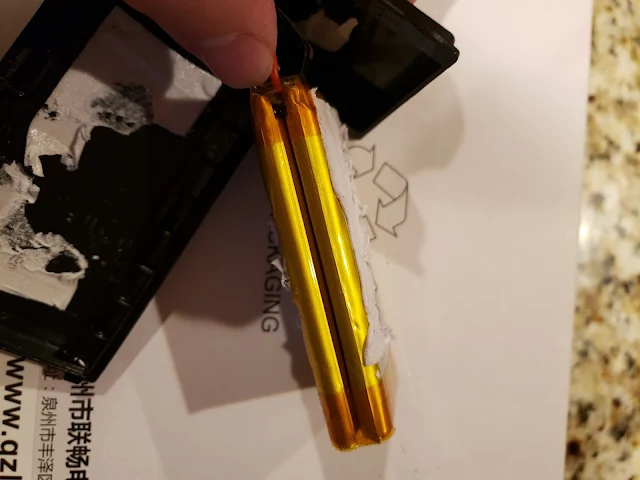
The below photo shows my disassembled battery which inside is a pair of 3.7V 2500 mAh capacity cells held in place by adhesive tape as found in many other battery packs. Only one of the cells seems to have malfunctioned though so I have plans for the remaining good cell.


Two series 3.7 Volt 2500 mAh LiPo cells can be found inside the Lanch HG-UV98 battery (Source: Steve Bossert K2GOG)
Two series 3.7 Volt 2500 mAh LiPo cells can be found inside the Lanch HG-UV98 battery
(Source: Steve Bossert K2GOG)

The insides of the battery also includes a USB micro converter and charge controller so these will likely find use in some other DIY project later on, so DO NOT throw out your old battery when it eventually fails! 


A USB micro charge converter can be found inside the battery along with a charge controller
(Source: Steve Bossert K2GOG)


Talking about the new charge cradle

In mid 2021,  my contact at Venus Information Technology let me know they had developed a charging cradle for the radio and were offering that plus a battery for sale for only $32.60 USD.

On February 22nd I placed the order and on March 6th the package of charger and a few extra LC-01 batteries arrived from China. Lets now look at what arrived!


Blackberry USB micro cable Lanch HG-UV98 APRS radio
Recognize the logo?  A former smartphone vendor must have had a
surplus of USB cables that Lanch has found a second life for!
(Source:  Steve Bossert K2GOG)

Lanch HG-UV98 Battery Cradle Details

Here are three photos of the new cradle, clearly showing it is designed to be charged with USB micro connections.  You can charge the battery without attaching it to the radio if needed.

The cradle only comes with a USB micro wire and no USB charger, but that is ok as I already have left over ones from past or other purchases.

The label on the bottom of the charger helps validate that the battery does the conversion from 5V USB standard up to 8.4V needed to charge the battery.  

But, interestingly the inside of the charge cradle has its own voltage converter. When the battery is charged in the cradle, the internal battery converter is bypassed.


Extra Bonus Details

Electronic devices these days often have shorter life cycles so that vendors can sell new equipment, but that is sometimes wasteful.  

The good news is that the Lanch HG-UV98 will soon be joined by a new radio which combines the APRS and radio programming into one common MCU.  

This means no need for two separate computer  programming applications.  Both radios will use the same battery which is the major extra bonus!

Support these products!

Normally, I do not outwardly endorse a vendor product, but in this case I will.  Based on the behind the scenes support from Venus Information Technology and a lack of other reliable low cost analog AX.25 1200 baud radios, the Lanch HG-UV98 will be a great addition to anyone looking for a first or additional APRS radio.


Wednesday, November 7, 2018

Review: Alinco DJ-MD5T Series DMR Radio

This is the third official article on HVDN about the new Alinco DJ-MD5T series dual band DMR/analog handheld radio, but is the first actual review of this interesting communications tool.

Alinco DMR dual band radio MD-5TGP HVDN
The Alinco DJ-MD5TGP  was released
for sale in the United States in November 2018


Responsibility: Users & Vendors

DMR started life as an open standard digital voice mode for commercial use in 2005 and started to see early amateur radio adoption in 2009 through surplus commercial equipment.

Since 2012, use of DMR in amateur radio has been increasing quickly and starting in 2016 really took off compared to other standards in use by the amateur radio community.


how many DMR repeaters are there?

Adoption of DMR has been largely attributed to low priced Chinese origin radios since DMR is an open standard and expensive intellectual property licenses were not needed, like the offerings from other vendors.
Amateur radio communities around the world generally like to expand the capability of existing equipment and radios such as the TYT MD-380 proved an interesting platform for experimentation.
While DMR equipment to date has offered features more appropriate to commercial users such as wide frequency coverage, amateur radio operators have generally been responsible to only use this equipment within amateur radio spectrum.

IMPACT: Recently in the United States, federal trade restrictions have impacted the ability for certain vendors to sell product legally due to source of geographic origin and frequency capability.

While no one country or vendor is to blame, global demand has created a great opportunity for a responsible vendor looking to sell DMR equipment to the amateur radio community.

Overview:  Alinco DJ-MD5T Series

The DJ-MD5T series radios now offered by Alinco is actually its second DMR offering marketed to the amateur radio community.  Model DJ-MD40 was released as a UHF only option in 2015 but saw little adoption because it was priced much higher than the popular TYT MD-380 or Connect System CS-750.

Alinco is now the first well known Japanese amateur radio vendor to offer a dual band DMR radio with the DJ-MD5 series.

Key Detail: There are two versions of the DJ-MD5.  DJ-MD5TGP includes a built in GPS and the DJ-MD5T does not include GPS capability.

For a price difference of less than $30, the GPS version may be the better option for most users to purchase for future resale value and application expansion. Do yourself a favor and do not cheap out.

Alinco MD-5 Series: Key Specifications 
  • Configurable VHF/UHF Band Coverage
  • Analog FM & Digital DMR Tier I and II
  • Four RF Output Levels (5/2.5/1/0.2 W)
  • 4,000 Channels (Configurable between 250 Zones of up to 250 channels each)
  • 10,000 Talk Groups
  • 160,000 Digital Contacts
  • 2.32 (L) x 4.65 (H) x 1.57" (W/T)
Alinco MD-5 Series:  Key Features
  • 1.7" OLED Color Display
  •  VFO/Memory Mode
  • FM Broadcast Reception (87-108)
  • Repeater Offset Storage
  • Path/Distance to Contact Location
  • Text Messaging
  • Auto Power Off
  • Volume Min/Max Settings
Alinco MD-5TGP Review

With the Alinco DJ-MD5TGP now available for official purchase in early November, lets start off with talking about its configurable band coverage as illustrated below.  The model setting is configured through software and is not keypad programmable. This is a first for DMR radios.  Prior to this, only programmed channels can be "transmit disabled". Alinco allows entire areas of spectrum to be disabled for transmit capability.

There are 13 band configurations and option 11 should be what most amateur radio operators should focus on to remain compliant with amateur licensing and to prevent accidental "out of band" transmission.

Alinco CPS DMR
Alinco DJ-MD5TGP programming software allows
one of thirteen profiles to be used depending on country or
operator specific legal preferences

RF Power Output

Users of the various hot spot devices such as those built on MMDVM and Pi-Star combinations or the latest OpenSpot2 may appreciate the 1/4 watt RF output setting as one of the four possible power options.

Major Benefit: Alinco DJ-MD5 battery life is greatly extended by using low power as to be expected with a hotspot.

Memory Configuration

There is ample storage for DMR specific information and is easy to understand compared to some other DMR radios and appropriate programming software. Common terms:
Digital Contact(s):  Sometimes referred to as the "User Database", this is where up to 160,000 user details with DMR ID, call-sign, name and location are entered.  
Loading the entire database of just parts of it help identify who is speaking just like a caller ID function on telephones.  
A great tool for gaining access to the DMR user database can be found at http://amateurradio.digital/
Talk Groups:  A separate area for the storage of up to 10,000 talk groups allows all the "official 1,170+ Brandmeister talk groups to be stored. 
It is possible to also store the same talk group number with different names to accommodate locally numbers talk groups that are not accessible over networks like Brandmeister, NEDECN, Phoenix, etc 
Channels:   Storage of frequency, repeater shift, analog/digital mode, time slot, talk group, channel name, color code, encode/decode tones, power setting, scan lists, group lists and more are done on a per channel basis.  4,000 channels can be created and stored.
Zones:  Multiple channels can be organized into a zone of up to 250 channels. 
Common examples would be for channels for a specific repeater with different talk groups,  simplex channels and local non-amateur communications such as first responder, rail, and marine communications.  Scan lists can be created much like how a scanning radio such as those made by Uniden and Whistler to not miss communications.
Display Feedback

The color display is easily readable in most lighting conditions and shows all important information.  Navigation for settings shown is done through two soft buttons under the display labeled in green and red.  An up and down arrow key performs further navigation functions along.

DMR display Alinco dual band
Vibrant display as found on the new Alinco DMR handheld radio

The keypad can be used to send DTMF tones or access different functions found in the menu.   Shortcuts or "hotkeys" can also be created to access frequently used functions.

Entry of most parameters of this FCC type accepted radio can be performed by the keypad, including a memory or VFO mode that allows the user to change frequencies to allow for monitoring and tactical changes easily.

The speaker is of a ported design and is above and below the keypad. The microphone is below the green button and above the "1" button. A menu in the radio and software can increase/decrease gain based on user preference.


There is no major need for an instruction manual for this radio as much of the configuration should be enabled in the included software which is easy to follow and understand.
Help and description menus are part of the software to help better understand certain functions. 
Here are few of the more interesting and fun features I think makes this radio a good option for beginner or experienced users.

Alinco MD-5 Series Advanced & Fun Features

A good amateur  radio should be easy to use for access to  information and communication and the Alinco MD-5 is no exception.

Reception in the United States of the National Weather Broadcast system found between 162-163 MHz is possible with the MD-5 and also the FM broadcast band from 87-108 MHz for music, news and more.

Cool Feature: The built in GPS will show location coordinates of the user and also the distance and direction to another DMR user. This function works "radio to radio" and also via Brandmeister based on either the self entered coordinates of a users hotspot or actual location.

A general complaint with many DMR radios with GPS has been no clear way to use it. The Alinco is the first radio aside from the Anytone D868 that has made attempts at this in order to compete with some of the benefits of APRS enabled radios.

Non-Voice Communication

The Alinco DJ-MD5 allows the user to send manually created or preprogrammed text messages while in DMR mode.  This is partially dependent on how each user programs each radio, but it is possible to have voice and text at the same time on the same frequency because of the TDMA based DMR mode time slot functionality.
Cool: How to send text and location data over DMR with TYT MD-380
Text messaging does not work over analog FM, so please consider this when considering the purchase of this or other DMR radios.  Text messaging is part of the ETSI standard that DMR is based on. There is no such standard for analog communications unless one is talking about AX.25 based APRS.

Other Functions

One of the best features of any radio is the ability for it to turn off after a period of in-activity.  Alinco offers this along with a power save function to cycle the receiver on and off to save battery.


The volume setting is unique with Alinco in that the user can create listener profiles to have maximum or minimum volume levels set to avoid ear damage or even by accidentally turning the volume all the way off and missing a potential call.

Alinco DJ-MD5TGP features
The Alinco DJ-MD5T offers interesting features like , but does not
include a "mosquito repellant" function as found on older analog Alinco radios
such as the DJ-195, SJ-S446 and others.


Every few years Alinco offers a radio with some rather interesting features, such as a "mosquito repellent" or "theft protection" feature like "digital monitor".

The MD-5 offers a menu called digital fun that has something very interesting called digital monitor.

Alinco hudson valley digital network programming

This function lets the user in DMR mode allow either one or both time slots to be monitored at the same time.  A function like this can be helpful if the user does not know what time slot certain communications is supposed to take place on

A built in voice recorder allows both digital and analog voice recording for up to 14 hours. Other DMR radios only offer recording on DMR mode.  The Alinco not only allows received audio, but also what is spoken into the microphone.

Super Nice Feature: This may be interesting for those interested in satellite operation and recording of contacts for later playback

As illustrated, there is a lot of functionality this radio is capable of and should become pretty popular.

Any secrets?

The Anytone D868/D878 and BTECH 6X2 are very similar to the Alinco MD-5. Many of the software functions and operation of the radio are roughly about the same.

This will be the topic of a tear down of the MD-5 in the coming weeks, so please look for that on the HVDN Notebook by making use of the tag cloud feature for any content that covers the Alinco MD-5

Overall Verdict


  • Build quality is excellent and the keypad numbering does not seem like it will wear off easily. 
  • Audio quality for signal reception is pretty good and does not seem to struggle at maximum volume.
  • Owners of other DMR radios should be able to learn the Alinco function set pretty easily
  • Code plugs from other manufacturers will either partially or completely work with the Alinco MD-5
  • Battery life is excellent and audio accessories are plentiful 
There will be much more to say about the Alinco MD-5 for sure and it will be interesting if Icom, Yaesu and Kenwood come out with something to compete with Alinco.

Thanks for reading. Ask some questions and share your own comments, if you dare.  

Sunday, October 14, 2018

NEAR-FEST: What is under the tarp?

Since 2006, amateur radio operators, electronics hobbyists and camping enthusiasts have been making the pilgrimage to New England to experience an interesting two day long event known as "NEAR-FEST"


What is under the tarp you ask?  Some interesting electronics with a military
history for sale at the 24th NEAR-FEST in Deerfield, NH on October 12-13th 2018

Held twice annually, every spring and fall at the the Deerfield Fairgrounds has been the home of a unique event called NEAR-FEST.
Part electronic swap meet, educational session, casual gathering, food destination and opportunity to purchase brand new and interesting radio related equipment offers a little of something for everyone in the family.
Over the years, the New England Amateur Radio Festival has attracted those from both far and wide.

The October 2018 edition was no exception with those spotted from Quebec, Ontario, Virginia, Florida, Ohio, Japan, Haiti, Puerto Rico and of course the entirety of the North Eastern United States!
Event attendees can camp on site in a tent, roll up in an RV or camper or stay at any number of area hotels. 
This makes it a very convenient "ham fest" as compared to other amateur radio or even "maker" oriented events.


New England Tech Trek gives another reason to not leave NEAR-FEST too early
if you are not interested in purchasing something which is one of the
top reasons to go to a "fester" like this bi-annual event 

There is no need for every attendee to contend with an early morning drive or risk there getting late out of fear vendors will pack up early.  Once someone is at NEAR-FEST, they are generally there for a while.
Everything from food, ATM machines and restrooms are available to prevent people from leaving 

Helpful NEAR-FEST Tips

It is recommended however, to bring a backpack to hang on to anything acquired at the "fester".  A bottle of water, comfortable shoes, various batteries, rain repellent are recommended to have on hand too.

Need a rain jacket before going to NEAR-FEST?  L.L Bean h
as you covered at its various nearby outlet locations.
Most of these "forgotten" supplies however can be purchased at an L.L Bean Outlet in nearby Concord or Nashua.  This may be especially of interest to those with interests such as QRP kayak portable, SOTA or other converged ham radio/other stuff sort of activities. 
Over the past years, more commercial vendors both at NEAR-FEST and other similar events take credit card payment, so save your cash to support the tail gate community.
Also, if going with friends, agree on what "secret channel" to use and program a few options in advance to your hand held radio of choice.  All of the common "simplex" channels may be in use, but its still good to have those programmed too.

Frequency Suggestions for NEAR-FEST

If you have a DMR radio, the NEDECN has pre-populated code plugs for all area repeaters of interest to NEAR-FEST attendees.

All you need to add are your simplex and "secret" channels along with configuring them in the correct zone, scan list or receive group. Some "amateur radio" suggestions include:
  • Standard FM analog frequencies such as 146.520, 146.535, 146.550, 146.580, 446.000 and 446.500 with no PL tone.
  • Digital voice DMR frequencies such as 145.510, 145.790, 446.075 and 445.925 saved with TG 99, TS1, CC1. 
  • Your own "secret channel" using FM analog, DMR or some other mode like Fusion or D-Star on 433.0125, 433.920, 147.030 or 223.500
Various DMR radios by Anytone, TYT, Vertex, Motorola and a few others can
easily be programmed for NEAR-FEST thanks to NEDECN's informative website


You can also try one of the "unlicensed" channels for FRS and MURS in order to include your not yet licensed amateur radio friends. A great radio for events like this are the Xiaomi Mijia with smart location sharing reviewed in the past on HVDN.


This inexpensive radio not only is a great discussion topic, but also serves dual purpose for both amateur radio and unlicensed operation in one friendly looking design. No internet is needed for this to work, compared to trying to share location with Google Maps or verbally explaining your location over the radio.

Time To Learn & Get Edu-ma-cated... 

An exciting addition to NEAR-FEST recently is the second annual New England Tech Trek or NE(T)².

This mostly hands on educational event engages children as young as 8 years old all the way up to and beyond the age of 80 years old.

For those not familiar with amateur radio and its infinite list of complexities, NE(T)² helps capture some of what amateur radio is all about to prospective "hams", existing hams or those newly licensed thanks to exam sessions also available at NEAR-FEST.
This year, New England Tech Trek showcased a range of well known habits of the amateur radio hobby that have seen modern changes as well as purely new and innovative applications and technologies relevant to any communications focused hobbyist.
NEAR-FEST XXIV Report

Friday October 12th and Saturday October 13th were the planned days for attendees to enjoy the event and rain only impacted part of Saturdays festivities before the event officially came to a close at 3:00 PM Eastern Time.

Inside three buildings were vendors of brand new equipment and small components. Outside and scattered between various food stalls were tail gate and "tent gate" vendors selling everything from surplus "militaria",  antennas, computers, rechargeable batteries, VHF/UHF radios, HF amplifiers, microphones and test equipment.

Some of the commercial vendors or service providers at NEAR-FEST XXIV included:
Not Just "For Sale" Stuff

There also were organizations focused on various parts of amateur radio visibility scattered throughout these rain proof building to help raise awareness of different parts of the amateur radio community that are built upon like minded members.

The Nashua Area Radio Society was just one of the
organizations that made the NE(T)2 event possible at NEAR-FEST XXVI


Was the ARRL there?

Aside from the expected ARRL attendance via a small table, other leadership and influencers were at NEAR-FEST also making a much larger presence known.

One of the non-commercial sellers had a monitor
that said "My wife said to take all reasonable offers" 


Key organizations present included one of the longest operating female oriented amateur radio clubs called YLRL which showcased its bi-monthly newsletter called YL Harmonics.

Niece, KA1ULN  was enthusiastic to engage with those who braved the weather to attend NEAR-FEST XXVI and it was great to meet her in person.

A national women's only amateur radio organization promoting the hobby since 1934


Booths for various geographic focused clubs such as White Mountain Amateur Radio Club, Nashua Area Radio Society, and the New England Digital Emergency Communications Network to name just a few helped make this a great way to decide who else to spend precious "membership" dollars with too.

Many of these organizations use NEAR-FEST as a great way for its membership to see each other in person as well as to raise funds for club activities through the sale of surplus member equipment, spare parts and even member driven projects.

Craig, N1SFT, oversaw some VYL (Very Young Ladies) complete
a small kit that required soldering 

Pictures, please!

The mixed smell of pine needles and grilled pepper & sausage sandwiches permeated the damp fall air across the fair ground which added to the overall great atmosphere by a well run and planned event by those responsible.
Thank you for all your hard work and effort for yet another NEAR-FEST!
Here are some further photos and commentary related to the event.

Most Curious Antenna Award

At the fall NEAR-FEST of 2016, Steve K2GOG (Co-Founder of HVDN) was seen walking around with a high gain 2.4 GHz antenna which attracted a lot of attention.  For the asking price of $5, it was hard to pass that up. This can be found on his QRZ.com profile page

This year, he was on the look out for something else very interesting to add to the antenna collection, but decided to pass on this 900 MHz corner reflector antenna based on its size and price. This could have been easily modified for 440 MHz, 1.2 GHz or maybe even a lawn chair!


Best Convergence Hobby Tailgate Vendor Award

There is much to say about this photo ranging from the precision GPS antenna attached to the roof of the Toyota RAV4 with the license plate of  "Hiker" to the bumper sticker that could relate to the load of vintage test equipment or his other favorite activity that is not ham radio

Hiker Trash:  Certainly, you wont win any feather-lite
pack tips if trying to take any of this gear out on the trail
Most Popular NE(T)² Discussion Topic Award

Anything to do with satellite operation was a big topic of interest inside the NE(T)² as well as outside. The impressive antenna array used for satellite communication demo  that made use of crossed polarization  14 element 435 MHz Yagi, 7 element 145 MHz Yagi and a 20 element 1200 MHz Yagi on a azimuth/elevation rotator. This is one impressive (and expensive) antenna system!

This impressive satellite communications array is capable of receiving
very weak signals as well as for transmitting very high power for
long range line of site communication


On a much more simple and cheaper scale was the Elk Log Periodic antenna found inside the NE(T)² building. T\

This much less expensive but effective antenna can be used to make contact through low earth orbit satellites such as those covered in the popular "Amateur Satellite Basics: Where, When & What to listen for" article from March 2018.

Not to be left out with all the satellite communication focus is a
high altitude balloon presentation at the right of the small crowd.


Digital Mobile Radio Robustness Network Award

The New England Digital Emergency Communications Network connects over 80 different repeater sites over much of the north eastern United States in order to create a very robust communications network.  The KM3T and W1RCF repeaters located on the fun to (mis)pronounce Mount Uncanoonuc  are part of DMR-MARC which is a different network than the popular Brandmeister network.


Both DMR networks are mostly able to talk to one another though due to great interoperability between those responsible for these tremendous contributions to modern amateur radio communities globally.   NEDECN had many radios on display such as the popular Anytone AT-D868UV along with some Motorola equipment for sale by one of NEDECN's members.
NEDECN did a fantastic job or promoting DMR at NEAR-FEST and they even operated a repeater for NEAR-FEST communications.
Reach For The Sky Award

Any time a number of amateur radio enthusiasts gather is the time to see who has the largest antenna on a car.  Here is one example of an HF mobile operator with a 8 foot long vertical antenna on a station wagon. License plates have been blanked out to protect the identity of this super ham-heros!


The Not Just Ham Radio Presentation Award (Tie!)

Computer and Maker enthusiasts were represented by a presentation about what can be done with a Raspberry Pi.


And, for those looking to get out and do something fun with a Raspberry Pi or antenna project can experience hidden transmitter locating or "Fox Hunting".
A very effective directional antenna can be constructed out of PVC pipes, hose clamps and a measuring tape.


The Last Picture Award 

With the weather getting a little more wet on Saturday, even the "hard core" military ham radio crowd started to pack up early.


Mystery Picture Award


Care to take a guess as to what this is? Sound off in the comments...


Friday, October 5, 2018

Review: A Crappy $40 "Smart Watch"

Two months ago while scrolling through recent Facebook activity, one of those embedded advertisements jumped out at me regarding a smart watch.
After careful review of the product description at the time, I figured for $40.79 USD, it was worth the gamble. Low expectations were set from the start....
Here is a product review of the "Radiance Z3" and to possibly save you the read, what a bloody disappointment this purchase was and totally not worth the long shipping time from China!!

Note: This has no "ham radio" or "electronic maker" relevance since that is what most of HVDN's content focuses around, but should be of interest to anyone who loves cheap electronics and making them do something other than intended (maybe)!

What was advertised included:
  • Wireless charging
  • IP67 water resistance
  • Standalone GPS
  • Rotatable bezel for navigation
  • Embedded cellular connectivity
  • Fitness tracking functions
  • Outdoor view-able display
  • 3 different band colors!!!
None of these features were included, save for cellular connectivity.

All is not lost....

However, pairing over Bluetooth works just fine to initiate wrist worn phone calls via the watch's built in speaker. If I put a SIM card in the provided slot, this smart watch could also make calls on its own over a 3G network.

There is also a built in camera to take pictures with the watch, do remote shutter from a smartphone and play music stored on a user supplied SD card.
So, I figured even though this smart watch was not what was advertised, it still may have a sort of  "If it breaks, no big deal" value to it. 
However, the back casing of the watch is the biggest piece of crap imagined and would worry about it falling off - even with it secured on my wrist. It is friction fit to hold it on which means no claimed water or dust resistance.

The 32GB SD card was not included in the purchase of this smart watch, for the record.
So, now it is time to go back to the "Do not buy crap via Facebook, Instagram, etc websites at 12:00 AM!!" strategy I usually employ.  CAVEAT EMPTOUR!!

VGA camera resolution in all its 320x240 glory.

While doing a search for some other info for this review since I did not want to spend much time on this myself, I came across this nice video on YouTube not available when I purchased this item  that pretty much nails everything bad about this product.
Without a deep dive analysis, I am pretty sure this is nothing more than a poorly copied knock off version of the Samsung Gear S3 Frontier smartwatch minus all the more expensive components and better overall user experience.
So give it a view and prepare to be NOT amazed!! This product is now a well documented scam and this review being one of many. 


Tuesday, October 2, 2018

Open Hardware Summit 2018 Recap

This past week in Boston was the Open Hardware Summit on the beautiful campus of the Massachusetts Institute of Technology.

An estimated 340 people attended based on the number of filled seats for the great presentations that were scheduled across the day.

Alex Camilo and Michael Welling helped create this amazing open source design for an attendee name badge.
OSH Park and Screaming Circuits helped bring this into reality for OHS 2018

Beyond the 17 scheduled educational sessions at the MIT Stratton Student Center, there were also two separate areas for event sponsor demonstrations.

Open Hardware Summit 2018 Highlights

Every attendee received a keepsake "hackable" name tag that includes Wi-Fi connectivity for users to customize the E-Ink display, just like the ones found on the popular Amazon Kindle or in shelf edge displays at Kohl's department store.

More badge functionality can be accessed or enabled by built in FTP or serial connection thanks to the embedded MicroPython based programming along with some additional add on boards also provided to attendees of OHS2018. Other features include temperature sensing, different display fonts, color changing LED lights and SD card storage to name just a few.

The design files, firmware and more details are available on GitHub.  

Additionally, a bag full of goodies including a Particle.io Photon board, DigiKey ruler, stickers, notebooks and a number of other open source circuit projects were given to each attendee too.

Since a few members of HVDN were in attendance for the official event, here are our collective thoughts on the overall OHS2018 experience.

MIT Stratton Student Center was home to the 2018 Open Hardware Summit

Wednesday Evening Pre-OSHWA Networking & Attendee Swag Bag Assembly Gathering

Held at the premier "maker" space in Boston - Artisan's Asylum hosted tours of the member space and was also the backdrop for a pizza party to fuel the volunteers assisting with the assembly of swag bags for attendees of the next day official event.

Pictures of the pre-event have been withheld to protect the identities of all involved since adult beverages may have been also consumed along side the unique veggie crust pizza

The Artisan Asylum was not just home to electronic hobbyist "makers", but others interested
in all sorts of other design projects such as this rather interesting creation.
More about Artisan's Asylum can be found here
This casual gathering with a purpose was a great way to meet others involved in open source projects with pure hobby backgrounds or a blend of commercial and hobbyist areas of focus.

Thursday OSH2018  Event Sponsor Demo Highlights

There were two separate areas for event sponsors to setup demonstrations and talk with attendees of the event.  This staggered approach made it possible for all attendees to roam around the entire event rather than just stay put in one space.  Some of the sponsors that the HVDN team met with included:

  • Import larger component databases from semiconductor manufacturers through vendors such as DigiKey, SparkFun and even more module based offerings.
  • Easier ability to create custom components and pin-out labeling
  • Enhanced trace and layout tools known as "FANOUT"
  • New digital and analog testing tools 
A more detailed explanation and description of updates for version 9.2.0 can be found at http://eagle.autodesk.com/eagle/release-notes   
Many hobbyists seem to have adopted the open source KiCad software or the more simplistic virtual bread-boarding Fritzing program recently, but maybe EAGLE should be reevaluated again by some in the hobby community.

EAGLE is one of many CAD (Computer Assisted Design) programs for those
 interested in EDA (Elecronics Design Automation)

HVDN PERSPECTIVE: As a long time EAGLE user myself looking at alternatives in recent months, faith is now further restored in EAGLE (for now!!) as a commercial oriented program with a great freemium offering for hobbyists or students on a limited budget.
  • Tindie.com - Nice discussion about how Tindie can help its sellers reach an audience looking to purchase or experience authentic products rather than foreign copied versions. 
Plus, how Tindie can help individual sellers better manage customer contact and support. Products such as the N5BOC duplex board that HVDN reviewed can be found on Tindie for example directly benefit by value offered by this online store which is part of SupplyFrame.
Ever wonder how much money gets spent by hobbyist "makers"? 
Here is a view into Japan only spending power. Please note this slide was provided by a
charismatic bunny ear wearing attendee of OSH2018 and is not related to Tindie.com
  • Great Scott Gadgets - Fantastic discussion with the founder of this company (Michael Ossmann) behind products such as the HackRF One SDR platform, YardStick One and an exciting new product aimed at those looking for a peripheral expansion solution for I/O over USB called the GreatFET.
Learn more about the GreatFET by having a look
at the Great Scott Gadgets website.

Further discussion about other products such as sensor based products similar to the HVDN remote field strength project currently under redesign to accommodate a different Wi-Fi module. This to me was one of the highlights of the event in meeting Michael and talking "shop" about similar topics of interest.
  • Red Hat - Handing out premium T-Shirts to those interested in Linux and IoT edge, core compute, or other open source related projects that can harness this robust operating system as an alternative to Microsoft Windows, Apple macOS or other Linux distributions such as Debian or Ubuntu.
OHS2018 HVDN open source hardware software design CAD open source
Open Hardware Summit logo combines a few common electronic hobbyist components
to form an interesting design to promote the mission and focus of the open hardware community.
Learn more at https://www.oshwa.org/

  • OSH Park - One of the best and US domestic provider of circuit board production services. Very valuable insight on working better with them for various projects and design tips to maximize hobbyist dollars. OSH Park is also known as the "purple board" guys, so that may give a hint as to whom HVDN is working with for some of its current and future projects.
Production space for the 300 attendee badges was made available at Artisan's Asylum.
Badges were being soldered the night before and programmed up until the last minute to make f
or a great personalized attendee experience.

Other sponsors there included hackster.io,  MIT Department of Mechanical Engineering,  Circuit Maker and Upverter by Altium, OpenBCI, Digilent, ICFOSS, ShopBot, ChibiTronics  and OctoPart but did not have the time to engage in deeper discussion with them.

Of the scheduled presentations, here is a review of  just a few of them:

  • Sara Chipps: C++ API for Kids
Sara provided an excellent overview on how to encourage and inspire children and people of all ages that its never to early (or late) to learn how to code and enable all sorts of projects or dreams. Her company, JewelBots demonstrates the convergence of science, technology, engineering and math also known as STEM.  This is outside of her day job at Stack Overflow.
  • Robin Getz: Open Source Software Defined Radio
Robin works for Analog Devices and provided a great basic understanding of what is software defined radio, its impact on the future of RF design and its ADALM-PLUTO evaluation platform available for purchase through ADI directly or re-sellers such DigiKey. 

ADI SDR AT1621
ADALM-PLUTO SDR development board offered by Analog Devices

  • Neil Gershenfeld: How To Make (almost) Anything
Prof. Gershenfeld is director of MIT's Center for Bits and Atoms and covered the future of manufacturing through the lens of Moores Law limitations, self replicating machines and the third digital revolution. It was a fascinating presentation that generated many questions from the audience and three rounds of applause.
The ubiquity of compute enabled devices highlight the amount of underlying impact
technology has on our expanding global economy
  • Joseph Apuzzo: MicroPython on ESP32 and LoBo
HVDN's own Joe Apuzzo (N1JTA) had the dubious task of following Neil's presentation and covered the convergence of amateur radio, embedded operating systems and low cost STM32 based micro-controller hardware that can offer high relative performance. 

Particle.io comparison. The Photon, Electron and soon to be available Argon, Boron
and Xenon boards all support microPython and area all very low cost.

Various applications such as MMDVM or IoT through the easy to adopt programming language known as microPython and its performance enhanced graphical interface system known as LoBo can take advantage of both open source hardware and software.   
  • Jodi Clark: OpenCosplay, Teaching the Next Generation
Jodi took the audience on a journey through her progression of a hobby interest that turned into a life changing series events that ultimately unlocked a tremendous career opportunity.  CosPlay is the hobby of designing detailed costumes or props found in cartoons, anime, comic books and more that are as realistic as possible.  
While many costumers understand how to create amazing things out of fabric and other materials, many do not know how to integrate electronics to create even better costume experiences.  
Jodi has a popular YouTube channel that teaches some of this and a video of her presentation can be found here
  • Nathan Seidle: Founder of Spark Fun (Secret Surprise Speaker)
Nathan was the surprise speaker of the 2018 Open Hardware Summit and shared some recent projects that leveraged or improved upon open source projects.  Nathan first shared how the SparkFun team was able to 3D print different components that formed part of a "safe cracking" robot. 

He then went on to later share in detail how a community of hobbyists helped improve on a machine used in the rapid production of circuit board assembly.  
sparkfun sale hvdn ham radio
Sparkfun offers a range of kits, boards, modules and project ideas for
the modern electronic hobbyist and education community

The company Nathan founded has proved a valuable contributor to the hobbyist community over the years and his presentation certainly was exciting to be present for.
  • Ted Hayes: How to Put A Neural Network on an Arduino and Why
The topic that Ted covered rivaled the big picture thinking and complexity explored in Neil Gershenfeld's earlier discussion. The Arduino is a capable low cost embedded computing option available today to hobbyists.  
Neural networks partially involve a non-binary state of computing that unlocks amazing potential on low cost hardware, just like what Joe Appuzo covered in his microPython presentation. A more detailed article about neural networks can be found here and a recording of Ted's presentation hopefully will hopefully be made available through OSHWA soon, because I really want to go back and watch it.


  • Closing Remarks: Alicia Gibb, OSHWA Director
Alicia thanked so many people who made this event possible and let the audience know that the 2019 Open Source Hardware Summit will likely be in China next year.  HVDN may be organizing a group rate trip for those potentially interested in attending, so please sign up for updates or inquire if there is interest through our various contact forms.
Why Open Hardware Summit & HVDN relate to each other?

Perhaps it would have made sense to explain about what the open hardware movement is all about first before a review of the event, but now I know I have your attention from all the excitement covered above.

Open source design has proven to disrupt and innovate in the data center.
The amateur radio community may be able to innovate by looking at how the open source
hardware movement has already impacted other communication technologies


Within the amateur radio community, there have been heated debates about copying the design of freely available designs for projects such as the ZUMspot.   This is where the opensource overlay into ham radio comes into focus.

This hotspot device was hard to get at times and priced at a level that not everyone could afford for a niche interest.  

These contributed to a friction full experience that hindered adoption and innovation, but at the same time created a competitive opportunity.


Once a few hobbyists copied the original design for this digital hot spot and offered them for sale at more than a 50% price reduction thanks to cheap off shore manufacturing, an entire new market was created that drove additional interest in MMDVM based hotspot purchases thanks to slightly less purchase friction.

hvdn faraday open source ham radio
Will this new project called "Faraday" be the future of amateur radio?
Learn more here at: 
https://faradayrf.com/


Additional components for the copycat versions of the original ZUMspot were now high in demand such as cases, power supplies, better antennas, displays and even oscillators!

This never would have happened had there not been open source hotspot hardware available alongside its opensource software needed to create an interesting piece of communication equipment.

Copy of the original ZUMspot version that Joe N1JTA offered some tips for in the
"MMDVM JumboSPOT board: Mods you may need" article.


Amateur radio operators that had experimented with low cost DMR radios such as the TYT MD-380 or Radioddity GD-77 that did not have local repeaters to communicated with others through now had something entirely new to experiment with thanks to this open source derived experience.

The ZUMspot sparked additional purchases and areas of interest due to its open source
design and the competitive opportunities it created


Open source projects have created tremendous amounts of spending that would not have otherwise happened without this contribution to the hobby.

There is a huge opportunity for the amateur radio community to look towards other hobbyist communities in order to bring expertise they do not have related to licensed wireless communication capability.

Open Hardware Summit showcased so much synergy potential for the renewed relevancy of amateur radio outside of what some most associate with amateur radio.


HVDN wants to help promote experimentation through open source hardware, so please use the search cloud on the HVDN Notebook to find other articles tagged with Open Source Hardware in the future.

Feel free to share some links to your favorite blogs, project pages, re-sellers, etc related to open source hardware.