Showing posts with label FCC ID POD-DMRUV. Show all posts

Thursday, October 4, 2018

The Official "NOT" Review of the Alinco MD-5 Series

The Alinco MD-5 series of DMR radio first appeared as a "Coming Soon" model in 2017.

Not long ago, official "for sale" release dates were announced by vendors such as GigaParts, Universal Radio and DX Engineering as being late October 2018, early and late November 2018.


Some vendors made a pre-order wait list available to help understand product demand and guess what?
The first Alinco MD-5TGP's have not only started to appear in the United States in late September, but have already sold out!
First is the worst, second is the best?

HVDN has been lucky to secure one of the first batch of radios and will be a source of  a detailed review inside and out as we did with the TYT MD-UV380 Part 1 and Part 2.

However, we will not release this until it is supposed to be officially for sale later this month or possibly early November once market supply of the product is stable and potentially available to everyone.


The now FCC certified the Alinco MD-5 series as covered in our
article "FLASH NEWS!: Alinco MD-5 Series Cleared by FCC" on September 10th 2018.
Tariffs, Certification & Type Acceptance Situation

Lately in the news, there has been an FCC ruling that states:
"Two-Way VHF/UHF radios may not be  imported, advertised, or sold in the United States unless they comply with the commission's rules"
Moreover, this also pertains to the actual users of these radios as well.  The full text of  FCC Public Notice DA-18-980 can be found here.


FCC import rules ham radio


HVDN wants to focus on being purely neutral and objective and takes no political leanings, but this FCC ruling is related to the long list of Chinese imports affected by the 1,333 product categories reduced from a much larger list proposed in Docket Number USTR-2018-0026.  

Where could I NOT get one?

Based on some vendor polling the day this article was posted, at least 350 units of Alinco's MD-5TGP have been sold in the US and were imported directly or through some other means rather than the official distribution channels most vendors usually adhere to.

So, how were these radios imported into the United States and able to be sold to amateur radio operators is the big question.

Give a listen to some of the popular DMR talk groups and chances are that you might just hear someone using one of the 350 or so radios that have supposedly already been sold in the US.

DMR talk groups ham radio burning man
Looking at the "Call Statistics" page on Brandmeister can help users
determine when may be the best time to find activity on interestingly focused
talk groups such as "Burning Man" , "Reddit" or "The Guild"

There have already been a few people in the Ohio, California and Texas areas that have made it known that they have one of these radios "On The Air", but do not seem to really know what they have or do they?

Impacts on the US Amateur Radio Community

Even though Alinco is a Japanese company, there are Chinese origin components and manufacturing  related to the Alinco MD-5 and thus affected not only by impending tariff laws but also by  US law on what equipment is permissible to be operated by an amateur radio operator within the amateur radio spectrum in the United States right now as of October 4th 2018.

Is this one reason for the delay from manufacturer to distribution to re-sellers and finally into the hands of end users?

Third is the one with the hairy chest!

The amateur radio punchline to the rhyme is that right now it is:

100% illegal to use the Alinco MD-5 by amateur radio operators in the United States because even though it has FCC certification, it is not Part 15 type accepted and able to be used under Part 97 rules.
This radio and many others like it are capable of transmission outside the amateur radio spectrum making them "technically" only operable by those with a commercial license.

Users covered under an umbrella license such as those for public safety, schools, businesses or some other organization that has permission to operate on certain licensed frequencies are not amateur radio related, so why are amateur radio vendors selling this radio to those not properly licensed to transmit with it?

Even if you are one of those people who hold a "General Radio Operator License" or "GROL", that will not allow you to use this radio currently on amateur radio frequencies.

FCC Rules

Part 15 certification mostly deals with radios capable of "scanning" or wide frequency operation. Part 95 is focused on certification for little to no interference to other devices. Part 97 pertains to amateur radio governance.

These are just high level summaries of a few FCC rules that often come up in amateur radio discussion.

At some later date, the Alinco MD-5 will likely be properly certified, so maybe there is nothing to worry about, or is there?

Competing single and dual band DMR radios of foreign origin that were previously
reviewed in our "Comparison of Entry Level DMR Radios (2017 Edition)"

Certain vendors such as Retevis, TYT, Radioddity, Baofeng and others seem to already by looking for loop holes to still sell radios in the US and for users to remain in compliance of US law. These loopholes include setting up US address headquarters as noted in relation to the BTECH 6X2 and also that the Radioddity GD-77 was just a re-branded TYT model

Alinco clearly is trying to do the right thing through certification, but will it succeed as it relates to Part 15, 95 and 97? Chances are it will and this could be a reason why Kenwood, Icom and Yaesu have not yet tried to sell a DMR capable radio because they will likely also want to do it 100% the right way also.


The Virtual Green Wire

Up through the mid to late 1990's any radio sold in the United States and marketed towards the amateur radio community could not have any "out of the box" capability to transmit outside the FCC Part 97 spectrum which overs amateur radio.

Some radios also had/have restrictions covered under Part 15, 47, 80, 90, 95 to reduce the ability to receive certain frequencies as well as to transmit on frequencies licensed to other services such as marine VHF, MURS (154MHz), FRS, GMRS, and CB frequencies in the US.

Many vendors had simple modifications that could allow "out of band" transmit capability and were often called the MARS/CAP modification.  Clipping a certain color wire or soldering two or more pads together are all it took to enable this functionality.  

With Military Affiliate Radio Service (MARS) or Civil Air Patrol (CAP) no longer permitting radios not capable of narrow band (N-FM) or tight frequency tolerance (<0.5 PPM) operation for digital modes, most "modified" radios while possible to operate out of the amateur bands could no longer be officially used under MARS/CAP because of how those two service changed how the treat the use of radio equipment.

Have a look at websites such as Mods.dk and other clones of it that share helpful tips on how to modify radios for different manufacturer unintended features.

Has any vendor been in trouble?

Back when Radio Shack was in operation, they got in major trouble for releasing a radio named the HTX-204 that was so easy to modify, it got pulled from stores in less than a week and most of the stock was physically destroyed.

Since that time in 1997, there has not been such an infraction, so how have certain vendors avoided the same issue since?

The HTX_204 is considered a rate collectors item
thanks to its "easy modification" to allow out of band operation


Baofeng was one of the first Chinese radio companies to sell inexpensive analog radios in the US and were capable of "out of band" operation with no modification and there was also no easy way to restrict operation to only the amateur radio bands.

With many of the DMR radios, they come fully capable to operate out of the amateur band, but can be restricted in the software to only amateur radio spectrum.

The very popular TYT MD-380 is one such radio that can be restricted this way through modification of one file that can then be uploaded to the radio. This was partially covered in the past "Radioddity GD-77: Frequency Expansion".

In mid 2018, it has been rumored that a slightly different version of this TYT radio has started to turn up with some sort of "changes" but has not been verified by HVDN. Could this be part of a start to better control radios being sold to the amateur radio community?

The Alinco MD-5TGP right now is being sold by amateur radio vendors and clearly we know who is buying these radios.  

However, this Alinco radio is not being marketed by the sellers to the amateur radio community. One vendor explicitly states:


Other vendors do not have this clause, so what we will likely learn when HVDN does its official review includes:

  • Is the Alinco MD-5 radio able to only transmit between 144-148 MHz and 420-450 MHz in the US and receive on other frequencies such as the rest of the 136-174 MHz and 400-480 MHz range?
  • How easy is it to "front panel program" the Alinco MD-5 or can you only do this in software only?
  • Are there are "green wires" that need be be clipped physically or virtually in the MD-5?
  • Anything magically different inside the Alinco MD-5 compared to other DMR radios?

HVDN will publish the first part of the Alinco MD-5TGP the first week of November and a second part shortly there after.

Register for updates to not miss
                                 this and other HVDN Notebook articles


Monday, August 20, 2018

Firmware Update: TYT MD-UV380/390 Update 17.05


The TYT MD-UV380 and waterproof UV390 has just seen its first firmware update since many people first started taking shipment of this new VHF/UHF dual band dual mode (FM/DMR) hand held radio in April and May 2018.

August 2018 Firmware Version 17.05

Users of the non-GPS enabled MD-UV380 first started to report having the 17.05 firmware loaded back in July, but this update was nowhere to be found on the TYT website until August 20th 2018.

This latest firmware release has multiple versions explained below in this article.


latest md-uv380 firmware
TYT MD-UV380 Firmware Update Version
17.05 Released on August 20th 2018 is now available on the TYT website 


If you were one of the earlier adopters of the MD-UV380, its now worth updating your radio to this latest firmware which supposedly fixes something with the DTMF, channel write faults and contact database related functions, but nothing in 17.05 is a major upgrade.

After updating from FW 16.05 and 16.06, there are no easily visualized changes when moving to FW 17.05.  It is very important to use the right firmware or your radio may not function properly and you will then need to re-install the correct version. TYT website is here:

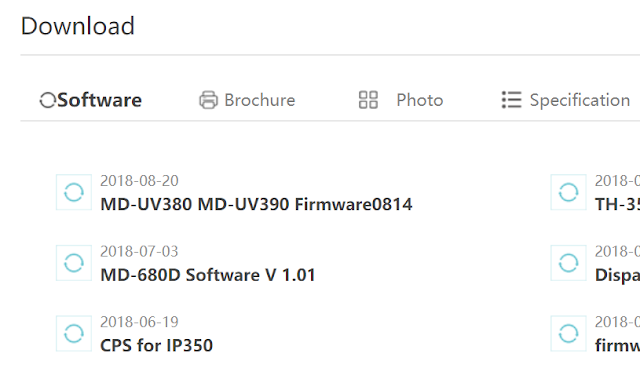
http://www.tyt888.com/?mod=download 


August 2018 Programming Software (CPS)  Version 1.07 & 1.08

CPS version 1.07 and 1.08 are prepackaged with the FW 17.05 on the TYT website and there seems one small change compared to using CPS 1.05.

When trying to import the user database and writing that to the UV380, the software does not seem to crash.

It is still advisable to save any changes you make to a code plug and put it somewhere safe as covered in the "60 Days with the MD-UV380" article posted earlier this month.

Updating MD-UV380 Firmware

If the TYT MD-UV380 is your first TYT DMR radio, you may be puzzled by some of the cryptic instructions and menus on how to update your radios firmware.

The utility called "FirmwareDownloadV3.04_EN"  is what needs to be installed on your computer. This same utility can also be used for all other TYT products so is worth keeping it handy.

Beyond being able to update the radio firmware, it also lets you add a custom "splash screen" to be displayed when the radio powers up.

MD-UV380 splash screen
The size of a replacement image on the TYT MD-UV380 needs to be
 a BMP file no larger than 128 by 160 pixels of 64 by 128 pixels at 8-bit, 256 color.


Once you have decided which is the correct firmware for your radio, navigate to where the update tool installed to.  On Windows 10, mine defaulted to:

 C:\Program Files (x86)\FirmwareDownloadV3.04\DMR Firmware Downloads v3.04_En


Select the "Open File Upgrade button, navigate to the downloaded new firmware and
then press" Download file of upgrade"  AFTER you put the MD-UV380 into DFU mode
 and have the programming cable connected to the radio.


In order to put your radio into "DFU Mode" which is required to get the radio ready for new firmware, plug the USB cable into your computer and radio. Then, hold down both the PTT and button above it while turning the radio on. 


  • The LED on the top of the radio will alternate flashing green/red to let you know the radio is ready for the update.
  • Now open the update tool and proceed to load the correct firmware version for your radio.  A progress indicator will let you know its status and when it is complete.
  • After the update is finished, turn the radio off, unplug the cable from the radio and then turn the radio back on.


Now to make sure it updated, go to "Menu" then "Utilities" followed by "Radio Info" and finally, "Versions" which will show you the current firmware and the last version of the CPS you used to program your radio.


uv380 firmware
TYT MD-UV380 showing a successful update
to FW  17.05 on the GPS enabled version of the radio

Downloading From TYT Website

Sometimes the TYT website can be slow, but not too slow. If you would like a slightly reorganized set of files related to this article, here is a link to download everything you need to upgrade to FW 17.05 along with CPS 1.07 and 1.08 hosted on the HVDN web-server.


Thursday, August 16, 2018

Digital Voice Capable Radio (DMR) Made In South Dakota?

The Federal Communications Commission (FCC) website has all sorts of interesting information.

You can find out where certain frequencies are licensed to be used, look for information on who should be using certain frequencies and also learn about what RF equipment is certified for use in the United States to name just a few.

Over the past few years, not every device that gets sold in the United States seems to be 100% certified under rules such as Part 22, 90, 95, 97 or many other FCC laws that determine things like "acceptable interference", "operation on amateur radio spectrum" and "equipment regulations for specific services".

If you have a device that transmits some form of RF energy in the United States, it should have an FCC ID.  But, as it turns out....not every FCC ID is real or are they?

K66 03770X30
The new Yaesu FT-818 FCC ID is real, but what makes
it real and how can you tell?


There are a number of manufacturers that sell equipment that list an FCC ID, but do not often follow the correct format or procedure that the FCC manages, so this article will cover a few examples of this.

Where is this on the FCC website?

The Office of Engineering & Technology is responsible for the certification of devices at the FCC among other tasks, many amateur radio and electronic hobbyists should be aware of prior to "experimenting" with different devices.

Here is the current link to where all sorts of searches can be run:

https://apps.fcc.gov/oetcf/eas/reports/GenericSearch.cfm

TYT BTECH YAESU KENWOOD ICOM ALINCO FCC ID
Many different searches can be run on the FCC OET website, but you need to
know a few things in order for it to work


Using the FCC OET Search Tool

Every manufacturer is assigned a 3 or 5 digit grantee code. This is the most important part in finding out information about a vendor. Some vendors have multiple grantee codes for different product types, but many only have one.

In the case of Yaesu of Japan, they have been assigned "K66" and doing a search for that will return the following results of 642 devices. You can further filter things by date range, frequency range and also how much information is shown in a table or what you can export as a file.


Yaesu had an FCC Grantee code of K66. There are 642 devices in the FCC database for this
grantee code, but the FCC site will only allow you to see 500 of them until you filter to a smaller date range.

Details For Each Device


If a piece of equipment is capable to operate in different parts of radio spectrum, the FCC must approve everything.

The Yaesu FT-818 radio for example lists four different areas of certification and there are many details that can be found by looking at the files attached to each.

While Yaesu is a company of Japanese origin, they do have a US office in Cypress, California and known as Yaesu USA  and this is widely accepted by most of the amateur radio community in the United States today.


Proper FCC ID process for the FT_818 Yaesu radio

You can usually find operating manuals for most amateur radio equipment, smartphones, Wi-Fi devices and so much more which is a handy thing to have.

You can also find some internal and external photos as well as a number of certification documents. This represents a milestone achievement for the United States government in offering a clear benefit beyond spectrum allocations to the amateur radio community.

The FCC OET database is also a great tool for finding out about near future release products since a manufacturer is supposed to have an FCC ID and all the related testing completed prior to selling an RF emitting device in the United States.

Some Strange Results...

Sometimes there is a small gap where a product is already for sale, but the FCC ID process has been delayed. If doing a search for an FCC ID or even just the grantee code and not coming up with much, what could that mean?  It could mean a lot and here are a few examples of this.

TYT MD-UV380

HVDN has reviewed the new dual band TYT MD-UV380 DMR handheld radio back in May 2018 when it was first released. As of August 16th, the FCC ID still is not listed.

Searching for the grantee code of "POD" does not show this. Much of this radio is based on the MD-2017 released a year prior under the FCC ID of "POD-DMR2" and everything you should find is easily accessible on the FCC OET website.

TYT MD-UV380 released in April 2018 

It is not clear if TYT needed to apply for a new FCC ID for the MD-UV380 or have they just been able to "sort of" use the MD-2017 one to cover the MD-UV380. 

Compared to Yaesu, the FT-818 is an updated version of the FT-817 released over 15 years ago. Both radios are identical, but because of a need to source updated components, some efficiency was gained in the FT-818 allowing 6W of power output instead of the 5W in the FT-817.

It is not clear if this is why the FT-818 has a new FCC ID of K6603770X30 and the older FT-817 has the FCC ID of K66FT817.

Could the RF parts of the MD-2017 and MD-UV380 be so similar to not require public listing in the FCC ID database?

So the question remains about why the TYT MD-UV380 still can not be found as a certified device on the FCC website even though it lists an FCC ID of POD-DMRUV very clearly as shown in the HVDN MD-UV380 teardown.

FCC ID POD DMR2
The TYT MD-2017 under the FCC ID of  POD-DMR2 was easily found when looking up the POD grantee code.  Other products were listed too, but not the MD-UV380

Ailunce HD1

Ailunce is a premium brand assigned to another dual band DMR radio that is manufactured by Retevis.

Retevis offers product that look identical to the TYT or legacy Tytera branded radios prior to being forced to re-brand and re-certify due to patent infringement situations between Hytera and Motorola Solutions.

For example, the earlier mono band VHF and UHF versions of the Tytera or TYT MD-380 also go under the brand of Retevis RT-3 and RT-82.

Looking for the grantee code of 2AAR8 lets you easily find more information about Retevis, who incidentally according to the FCC is really doing business under the name of HENAN ESHOW ELECTRONIC COMMERCE CO., LTD. out of China.


Today, TYT is doing business under the name of  TYT ELECTRONICS CO., LTD  of China but when they sold product under the name of Tytera, they were known as Shenzhen Tianjian Telecom Technology Co.,
The Ailunce HD1 created by Retevis has an FCC ID that is not found in the
 FCC database, but has been on the market for over a year

The FCC ID for the HD1 as printed on the radio is 2AAR8AILUNCEHD1 and was released for sale almost a year prior to the TYT MDUV380, but still does not appear in the FCC ID database and it is not clear why that is the case. There is no other radio similar in design cosmetically or electrically to explain this currently.

Anytone AT-D868UV

Anytone released a dual band DMR handheld radio for sale in the United States and the official business name of Anytone is Qixiang Electron Science& Technology Co., Ltd and lists different  addresses in China, just like Retevis and TYT do as where they are headquartered.

Anytone has the FCC grantee code of T4K. The Anytone AT_D868UV FCC ID of T4KD868UV is listed and it appears that Anytone has gone to great length in certifying this radio for different services covered under FCC Part 90 as well as Part 22.

This company even registered for separate  VHF and UHF only versions which is interesting and who they say it will and will not be marketed to which shows a focus of compliance not found with other Chinese brands.


The Anytone AT-D868UV, TYT MD-UV380 and Ailunce HD1 are the three current dual band DMR/FM radios that seem to be most in demand by the amateur radio community a the time of this article, but there is a new radio offered by BTECH called the 6x2 that has some even more background than many might be aware of.

BTECH 6x2

Every DMR radio mentioned in this article clearly has Chinese origins just by looking at the addresses listed as part of the FCC ID listings. Even the engineers that certify the products are of Chinese origin, so it does show there has been mostly great care in trying to follow US FCC related regulations, but some interesting points to be discovered.

BTECH is sort of the new name for the Chinese company that made most people aware of amateur radio equipment that was low cost named Baofeng.  Baofeng started to release product in the US market as early as 2010 and got many people into the somewhat expensive amateur radio hobby.  Analog dual band radios before Baofeng came to market were mostly over a $200 USD price, but Baofeng was able to offer a fairly capable radio for under $60.

The inexpensive Baofeng UV-5R that has helped
 get more people interested in amateur radio since 2010


Recently, companies like Baofeng have been in the news for manufacturing products that are capable of transmitting on frequencies in use by licensed public safety  and GMRS or other unlicensed services such as PMR, FRS and MURS. Certain re-sellers have gotten in trouble for who they have sold these radios to because the Baofeng radios are not certified to be used on frequencies other than those used by amateur radio.

BTECH is based in Arlington, South Dakota now according to the FCC OET database.
  Here is where they are on Google Maps


It is an interesting discussion to have when talking about who is liable since a manufacturer can not enforce who its sales channel sells its product too, so this gives some companies a bad reputation.

Many well known amateur radio brands such as Kenwood, Icom, Yaesu and Alinco have always had the capability for out of band transmission, but required a modification to do so. Baofeng and other companies like it could have taken this precaution, but have not.

Radios reviewed in the 2017 entry level DMR article on HVDN. 
An updated article for release for 2018 will appear in September or October 2018


All of the DMR radios mentioned all are capable of out of amateur radio band transmission and require no modification, so what makes the BTECH 6x2 different? Its still possible to transmit where you are not supposed to, so that is not it.

For starters, its "identical" to the Anytone AT-D868UV. Most people already figured that out, but there are some "special" functions that help make it different like a store and forward voice recorder also known a a "simplex repeater" and also some more convenient scanning/priority options.

BTECH 6x2, designed in China and certified for the US market.


What many may not be aware of is that BTECH now technically is a company based in South Dakota, United States.  This was learned by looking at the FCC OET database.

The BTECH 6x2 hails from South Dakota, but with permission to rebrand it by Anytone.

Here is a letter found  by clicking for "details" for a change of ID request between BTECH, formerly sort of known as Baofeng Technologies and Qixiang Electron Science& Technology Co., Ltd. who is better known as Anytone.


Now What?

Its clear that there is a lot of confusion on who designed a radio, who really owns the brand and if it is legal to operate certain equipment on certain frequencies in the United States. The FCC website can help determine legality by doing your own research instead of believing what others may say or report on.

If there are any errors in this article, HVDN wants to know about them and hope you enjoyed this article. Please rate this article below so we know we are doing a good job or not.

Tuesday, June 5, 2018

Teardown & Comparison: TYT MD-UV380 Part 2

Last week saw HVDN post a partial tear-down and comparison of the newly released dual band TYT MD-UV380. And, it seems to have gotten a lot of attention too!


The follow up article that you are about to read goes into more detail "under the hood" on the MD-UV380 compared to the MD-380G mono band version.  There is also some further explanation of features found in the user interface along with some other discoveries that may catch your eye in the RF portion.

FCC Type Acceptance

The FCC ID for the MD-UV380 is "POD-DMRUV" and as of June 4th 2018, it does not yet appear in FCC OET records which is interesting.

FCC ID of MD-UV380 that is not listed yet on FCC OET website

While querying the FCC Office of Engineering & Technology website, here are the only ID's associated with TYT.

All recent TYT FCC OET IDs that have been approved

The first three records for "POD-DMR3" are for the TYT MD-9600 mobile radio.  FCC ID's of "POD-DMR1" are for the mono-band UHF version and finally "POD-DMR" is for the VHF version of the MD-380.  Notice the 2017 certification dates for the mono-band radios. These are actually re-certifications for TYT. In the past, the radio was branded as "Tytera" and is no longer able to be used due to brand infringement with Hytera, a totally different radio vendor.

When a vendor lists various documents as part of the filling, its common to include some internal photos, but they are usually not the most interesting. HVDN has decided to go the extra mile in showing whats really going on within the MD-UV380.

Under the under side of the under the hood?

As noted in our part 1 tear-down, the MD-UV380 seems to have moved the base-band portion of the RF unit to the underside of the PCB. What was learned is that the HR C6000 is used in the MD-UV380 instead of the HR C5000.   The TYT MD-9600 for reference also uses the HR 6000 and this provides an overall better platform for digital voice compared to the older, but still capable, HR C5000.  The MD-UV380 will likely have a long shelf life ahead of itself.


HR C6000 base-band as found in the new TYT MD-UV380


With confirmation of the base-band chip and the STM MCU talked about in the part one article last week, perhaps the most exciting thing discovered is the AT1846S software defined radio chip.

This fairly common component and its RDA1846s cousin seems to make the TYT MD-UV380 just a little more interesting. Integrating this in addition to a much better front end offers much better performance compared to lower priced radios and something that also competes with higher priced models that do slightly less in a larger form factor.

The AT1846s SDR chipset as found in the new TYT MD-UV380


I do not know if its possible, but it should be theoretically possibly for someone to rewrite part of the coding and enable FM broadcast reception with reduced performance which is one of the only features the Ailunce HD1 offers.

Here is a close up view of the additional filtering found on the underside of the TYT MD-UV380.  A future project would be to use a vector network analyzer or signal generator and scope to see where the filtering low and high cut range is as well as any notches in between to see if FM broadcast reception would work or possibly add through software, the ability to use the MD-UV380 on the US 1.25, 220 MHz amateur allocation.

The underside of the RF deck of the TYT MD-UV380 front end filtering. The underside of the radio provides better shielding.

Here is a image zoomed out for more idea overall of how different the TYT MD-380G (UHF) and the new TYT MD-UV380 underside of the RF deck looks.

MD-UV380 at right and MD-380G at left from rear side of RF deck

So that does this all mean?

A main reason why HVDN felt a tear down would be important was because of the better than average audio signal reports provided over the air while using this radio. Same thing with the quality of the receive audio.

The microphone elements on both radios are identical. The MD-UV380 receive audio at the minimum volume level is quiet loud and favors the low end of the audio spectrum which provides a much fuller audio experience compared to the MD-380G (UHF) as well as commercial Vertex VXD-720 and the Radioddity GD-77.  On transmit with the MD-UV380 and the mic gain setting at the middle setting of "3"  comments on transmit audio have been quiet good.

This better sounding audio is likely due to the HR C6000 base band and related AMBE translation.

From an RF perspective, receive wise, signals for local analog repeaters, local DMR repeaters and public safety and utility in both analog and DMR also seem to come through more clearly on the MD-UV380 compared to the MD-380G (UHF) and also a MD-380G (VHF).

The signal meter though seems less sensitive compared to the MD-380G radios. Pretty much everything seems to max out at 3 of 4 bars.  There is also a "scanning" effect on the signal meter at times on DMR.

Here is a demo video of receiving an analog NOAA NWS weather transmission with the stock antenna followed by another of receiving a local hotspot with DMR audio.


Additional Review Notes

As mentioned prior, the radio shipped with F/W S15.021. It was soon after upgraded to S16.06, but then I decided to downgrade to S16.05 based on other users experiencing issues relating to compatibility with S16.06 and certain versions of the computer programming software  or "CPS".

There are a number of versions of the CPS available. I started with version 1.03 which works fine.  Version 1.05 also includes 1.04 which can only be found on the Grapevine Radio website download area and not the TYT website.  Version 1.06 available on the TYT website also includes version 1.07.

It is suggested that even though an MD-UV380 with GPS has software available for it, the MD-390 version firmware and CPS are suggested to be used directly by TYT.

There are no issues with any versions of the CPS I can find, aside from one major issue that users on Facebook user groups related to TYT are discussing.  The issue is the inability to upload the user database to the radio while using the appropriate firmware for CSV and GPS compared to the recorder and GPS version noted in the part one article.

Setting up short messages for use with SMS WX and GPS sending with the TYT MD-UV380


I am not sure how I did it, but I did have the user database working under F/W S15.021 but can not get it to work again in later F/W or even after rolling back to what the radio came with. Moreover, after experimenting with the user database in the MD-2017 format, it seems to write the contacts to the radio, but they are somewhat scrambled.

The GPS functionality also works fine and I was able to send location data to aprs.fi as well as receive SMS weather messages with the MD-UV380. If this interests you, please have a look at this article on how to set that up.

The user database feature will need some more time to get the bugs worked out, but otherwise should be an easy fix. I rather have a really good sounding radio compared to a user directory to start out.

Summary

Compared to all other TYT radios at the time of launch, the MD-UV380 seems be much further along than other radios, especially the MD-9600 and MD-2017. It should not take long for the user database issue to get officially sorted out. Right now the workaround is to convert files from an MD-2017 into the MD-UV380 format which is easily done. Its also possible to import MD-380G files into the MD-UV380, but first needing to be saved in the MD-2017 CPS.

What else was learned in the part two of the teardown

  • Uses the upgraded HR C6000 base-band
  • Integrates the AT1846s SDR chipset
  • Has a much better designed RF front end
  • Better audio on receive and transmit compared to MD-380G
  • Has some unique quirks such as flickering signal meter and user database
  • The smallest receive audio level is fairly loud and should be able to be fixed in the CPS
Next areas HVDN will focus on regarding the TYT MD-UV380 include:

  • Making some small "tweaks" in the configuration files for RSSI, squelch and audio
  • Staying up to date on all CPS and user database issues
  • Learning about other hardware potential "tweaks" to further unlock greater value in this radio


Subscribe for HVDN Notebook updates only at top of page