Showing posts with label 900 MHz. Show all posts

Thursday, October 3, 2024

You need to know what is going on within 902 and 928 MHz!

Will keep this brief as a photo is a 1,000 words and a 3 part video combining for 59 Minutes and 13 Seconds is worth I do not know what, but.....

You need to know what is going on within 902 and 928 MHz! 


On September 30th 2024, I was invited to present on what is known as the 33cm spectrum to the Warren County Amateur Radio Club. This plan was hatched by the club president, Adam Koeble KD2YFY and I over the summer while attending the Sussex County Hamfest. I just needed a topic, but knew it would involve MeshTastic and something else interesting.

Thanks to the NextNav news brought to the attention of the amateur radio world by the ARRL, I think I had my plan. With not only the amateur radio community irritated, the commercial world is not happy with what they are attempting to do. Even the Electronic Frontier Foundation has something to see about this possible land grab.

In my video, I explain who are the major users and what they are doing between 902 to 928 MHz.  Amateur radio is not as important here as some may think, as a secondary user for 39 years. But, those who are using unlicensed devices plus those using licensed frequencies with higher power here are pretty irritated should this NextNav plan get approved by the FCC.

My personal opinion is that there is enough spectrum to keep everyone happy, but amateur radio should lose secondary status and be given a few portions as primary users only.  I would offer the following scenario.

  • 927.000 to 927.500 MHz (Repeater Output Block)
  • 902.000 to 904.000 MHz (Weak Signal Users & Repeater Input Block)
  • 910.000 to 912.000 MHz (Amateur Data Experimenters Block)

This reduces from secondary status from 26 MHz of total spectrum down to only to less than 5 MHz of spectrum.  The blocks above were chosen to protect repeater users as well as weak signal activities. It then dedicates a block to be used specific for any other use, such as modified use only for ISM repurposed devices for amateur radio only. These are my summarized comments submitted to the FCC before the deadline period.

A plan like this is more than fair, offers clarity for commercial users and easy to coexist with existing licensed users in almost every area plus provides a great incentive for unlicensed users to consider a path towards amateur radio or just stay as ISM users.

Let the rest of the ecosystem fight over the remaining 21 MHz left. Has the ARRL proposed anything?  I would love to find out! 

Have watch. I broke the video down into three parts and you can play them via a playlist or one by one:

Part 1 - Mostly just focuses on some history of the spectrum and how many devices are sharing the same spectrum across all users, licensed or unlicensed.

Part 2 - Gets into more details of the commercial users and breaks down spectrum used by different types of users, regardless of what they are doing as licensed or unlicensed users plus if they are commercial minded or not.

Part 3 - Focuses 100% on the very basics of MeshTastic, which uses unlicensed devices anywhere across the entire spectrum and by those that are not licensed and thus restricted to what they can do legally compared to the benefits of an amateur radio license holder, but will face other issues too! 


Wednesday, April 8, 2020

Mesh: Upgrade or die!


Remember those Linksys WRT54 series routers?  Please stop using them and stop buying them on E-Bay!

This article will explain why its time to upgrade or die, but just in the context of mesh networking and amateur radio through the use of AREDN and the amateur radio spectrum!


Level Up:  Mesh & AREDN

A few years ago, the only options for experimenting with modern amateur radio mesh networks were some antiquated Linksys routers and a few older Ubiquity Network devices.

Today,  these "entry level" devices are no longer very usable since they lack processor speed, on board memory and capable Wi-Fi chipsets to offer a great user experience.

Currently there are 79 different devices across 4 vendors supported by the latest version of AREDN which is v3.20.3.0.


What device should I buy?


Currently, there is only one dual band device which offers the 2 and 5 GHz spectrum and is the GL iNet GL-AR750 which sells new for under $60 USD.

Additionally, there are a total of 3 Ubiquity Networks devices that support the 900 MHz band and another 3 that offer 3.5 GHz access.

The remaining 72 devices are equally split between the 2.4/2/3 and 5.8/5/9 GHz bands.

Selecting the right antenna and deciding where or how your AREDN mesh device is a very user specific question. 

All devices offer different benefits should you need longer range, higher power, smaller size or remote operation that are far too numerous to list here, but the AREDN Forum is a great place to ask questions.


HASviolet: Here's a Story about a Lovely Project

In the beginning . . .


It all started with a member of HVDN sharing the following idea with Steve, K2GOG and I

"I've been wanting to do a "communicator" for a while. Something that someone could use over relatively short distances to send text messages back and forth. I have been looking for others to work on a project with too!"

After some investigation LoRa was something to consider since it "should play well with the hacker/maker crowd and possibility the IoT/computer science area." From this point we thought it was a good idea to take forward and started developing a concept around it.

Yet another LoRa project?


We sifted through a number of existing published LoRa projects using Raspberry Pi and various microcontrollers. GitHub sites with code, libraries, and recommended hardware but most of them were just "proof of concepts" with no demonstrations of use cases are sharing of lessons learned whether as a "lone eagle" or part of a team.

Since there were going to be a number of skills we were going to develop along the way including building new skillsets our differentiator with this project would be sharing the journey through articles, videos, and (hopefully) good documentation.

Our Story and Hope


There were skill gaps to overcome but we were driven by the same desire.

  • Do an open source RF project that bridges the maker/hacker and Amateur Radio communities
  • Learn new or build existing skills along the way
  • Inspire others to do the same

Inspiring others is not about contributing to this project (though it is welcome) it is about inspiring people to take big steps in making your ideas real and not be intimidated by any skills gap you or your compatriots have. Lot's of discussion and breaking progress down in small steps or sprints is what will keep the learning feel organic.

By emphasizing the project journey through a series of blog posts here, we hope to inspire you to chase your passion and through caution to the wind in developing skills you think are hard to build. You just need to find something you have a passion for and other like minds.

Finally, we would like to thank Joe N1JTA for the initial idea and taking time out of his busy schedule for early testing.

All the best,

- Joe, NE2Z


Monday, April 6, 2020

HASviolet: LoRa RX, TX & Chat Applications

N1JTA worked on some stuff on the UI, but was very minimal


There are four demonstration applications that are built in to HASviolet.  This article will discuss our receive (HASviolet-rx.py), transmit (HASviolet-tx.py) and chat (HASviolet-chat.py) applications plus some helpful tips and tricks to using them.

HASviolet RX & TX Applications

The HASviolet project is focused on providing a basic environment for learning. We are not promoting this as a fully developed application. The reason is so that many use cases can be enabled through HASviolet and its basic demonstration applications.

Our HASviolet-rx.py and HASviolet-tx.py applications are designed for others to integrate with other tools which can be used for specific applications.

An example in using the HASviolet-tx.py application could be as a mechanism to transport some sort of sensor data or status report.

The same would go with the HASviolet-rx.py application, but as a receiver of whatever information is sent to it and then further filtered, actioned or forwarded through add on software that will easily run on the Raspberry Pi Zero.

LoRa tranmit ham radio


When using the HASviolet-rx.py application, you simply run it while in the HASviolet directory by typing:

./HASviolet-rx.py
You can add -s or -r to show either signal strength (RSSI, in dbm),  raw data or both.

The only parameter in the HASviolet.ini file you should be aware of is the frequency.  Our default to promote experimentation is on 911.250 MHz.

There are a number of modem parameters we have already configured that combine  spread, bandwidth and speed.

Our next release of HASviolet will include a fancier interface, that will resemble the one used in raspi-config or what that the unrelated, but nice rpitx project has migrated to.

This new interface will provide easier to understand options to select optimum combinations for receiving and transmitting data to support different use cases.

Our transmit application offers the ability for you to specify where you want to send the message by using the "-d" function.  Then, you can use the "-m" function followed by quotes to type what you wish to send.


how to text message with LoRa


HASviolet Chat Application

The HASviolet-chat.py application as shown in Joe's video will also be able to monitor any transmissions sent from a HASviolet-tx.py user as well as the HASviolet-beacon.py application, but its not the intended purpose.

The "chat" demonstration application does a few things that no other project based around the RFM95/96/97/98 LoRa capable modules when combined with a Raspberry Pi.

There are many LoRa projects that use the ESP32, ESP8266 and Arduino computers since they more easily handle handshakes via the GPIO. 

While there is a benefit in using these lower CPU options such as lower power consumption, our goal in creating a project using the Raspberry Pi Zero is to eventually make use of its faster processor and flexibility in memory storage or configuration.


The HASviolet-chat.py application uses a special interrupt function which is initiated by the "Control Z" key sequence to break the receive or transmit loop which prevents these sort of "chat" based applications from being possible.

Joe NE2Z came up with this idea after gaining some insight from a few people that revolve around our local maker space called "Squidwrench".

He also got some helpful insight from Casey KC7IBT whom HVDN's founder, Steve K2GOG met during one of the Hackaday.io "hack chat" meetings this past December and introduced Casey into HVDN and Squidwrench.

The journey in creating the HASviolet-chat.py application has fulfilled some of the hopes and dreams for the project goals.

We not only met some people along the way, but were able to put that applied learning to good use where others may build upon our work.  This journey also exposed the ability or inability for project team members to either learn new things or to admit the lack of knowledge in certain areas that needed improvement.


HASviolet:  What is chat good for?

Having a basic chat application is not exactly the most exciting thing to have, but was a necessary evolution step for our more advanced applications already in development, such as our quasi secretive "duck-hunt" and "vasili" applications.

Perhaps, as an example use case for both our chat and further described beacon application can be to enable "troposcatter"or other long range communication methods using 911.250 MHz in the United States, or other frequencies in the 868 or 433 MHz spectrum bands.

IoT 900 Mhz Casey Inductive Twig


Watch "HASviolet: Talking about RX and TX and Chat"


Tuesday, March 31, 2020

HASviolet: Open Source Antenna Basics

Steve Bossert K2GOG

This article will focus on the basic features and functions of the HASviolet antenna which is designed for the 900 MHz ISM and 33cm amateur radio band.

The HVDN HASviolet sets itself apart from all other projects involving LoRa as it seems the first to highlight the journey involved in bringing together hardware, antenna and software design and related best practices.

Lets now look at the HASviolet antenna!

HASviolet Antenna V1

This antenna is the original version that almost anyone can make using some easily sourced components.  Our upcoming V2 version is further simplified, but instead of using a common pen as its body, instead will use a printed circuit board and be able to offer the user the ability to complete final assembly for use on both the 900 MHz shared ISM/amateur band plus the amateur radio only 1240 to 1300 MHz band.

More detail about V1 assembly can be found at hvdn.org/violet and the final version of the assembly and technical manual are known as V.05.

900 MHz LoRa antenna IoT

As you can tell by the above dimensions, our antenna is small. It easily can fit inside a folder or slipped into a notebook case.

We have decided to use the standard female SMA connector rather than any of the reverse polarity versions commonly found on some Wi-Fi devices and Baofeng or other Chinese low cost radios plus the newer and more expensive Alinco DJ-MD5TGP DMR radio.

The reason for this is to more easily sourced short jumper cables or barrel connectors to connect the antenna to the HASviolet hardware.

Also, the standard SMA is a better connector option since this promotes this antenna as a tool for licensed radio users that will use more than the power limited to unlicensed users of 900 MHz spectrum.

HVDN HASviolet antenna


Following Instructions

Our step by step assembly manual is pretty detailed and should allow anyone to recreate this antenna with minimal fuss.  There are some challenging issues however to consider if you wish to replicate this antenna:

Challenge #1 - COVID-19:  Our original intent with this antenna was to sell them as pre-assembled kits or fully completed antennae in packages of two for around $20.00 USD.    
These were going to be offered at the WOPR Summit which did not take place in March, but is now rescheduled for September.   
Given the circumstances in the world today, we will instead hold these for later use and will focus on our V2 version which will be offered for sale in both kit and fully assembled versions in a few months or maybe sooner.
Making repeated trips to the post office now for such a small sale amount does not seem worth the health risk no matter what precautions are taken, even though we want to get as many of our HASviolet antenna's in use.
We may offer a mix of both versions for sale at WOPR Summit when it does happen and possibly even at HOPE 2020. It would be great to see you all there once the situation improves!  

                                                    _____

Challenge #2 - Matching Section: One thing to be mindful of is that we stress that proper matching is critical for this antenna to function correctly.   
We used RG-179 miniature coaxial cable which has a 75 ohm impedance compared to the more common RG-174 which has 50 ohm impedance. 
This is clearly noted in our assembly and technical manual.  In the kit form, we decided to already attach the SMA connector to the matching section to save you the cost of buying a dedicated crimping tool. 
                                                     _____

Challenge #3 - Finding your own materials:  HVDN has sourced a huge amount of phosphorous bronze rod from our local maker store, P&T Surplus to be used for product of both antenna versions.  
Most people can purchase this easily online or from most hobby shops. A common pen should be the most easily found component and you probably already have one. 
Beyond those two parts along with the already mentioned matching section, things like heat shrink, glue and scrap wire from an old Cat-5 cable should be easily found at most discount hardware stores.

Making the best of the situation

HVDN is a big fan of all things "open source" and we were looking forward to showing off our antenna at the also cancelled Open Source Hardware Summit prior to our official launch scheduled for WOPR.

What we have decided is to share our original design of the HASviolet V1 antenna and consider it an open source project so that others can improve upon it or ask us as many questions as possible.

All we ask is for credit to be shared back to us for the inspiration and to support us through the purchase of our even better V2 version once COVID-19 disappears.


HVDN open source hardware


Major Features of HASviolet Antennae

The really nice feature with our antenna is that it allows forward gain to increase the range of transmitted or received signals.  It also offers the ability the reject signals behind it.

Having both a frontal "gain" lobe as well as a rear facing "null" lobe can be useful for radio direction finding, limiting interference of increasing range of signals otherwise not possible with a omni-directional antenna.

900 MHz LoRa antenna IoT


If orienting the antenna upwards, there is still some bi-directional capability thanks to the side lobes and there is also a near field omni directional capability too.

The benefits of this antenna are all in the actual placement of the antenna as well as to favor the polarity needed for certain tasks across wide bandwidth.

900 MHz LoRa antenna IoT


We have some videos on our official YouTube channel worth having a look at for more details.

There is also our technical manual for some additional details that are written for any audience to understand.

Thanks

Steve Bossert K2GOG
Founder, HVDN & HASviolet Antenna Person


Sunday, March 29, 2020

HASviolet: What color is your spectrum?

K2GOG NE2Z N1JTA


The entire United States amateur radio community are relative late comers to using or even understanding what LoRa is.

However, the "maker" community in the United States and elsewhere has embraced this weak signal spread spectrum technology much quicker and has been doing some interesting things with it.

This article will highlight where both communities of hobbyists can learn from each other and inspire some really nice projects enabled by LoRa technology thanks to HVDN's HASviolet project.

K2GOG NE2Z N1JTA

Black & White: What is LoRa?

Amateur radio or "ham" radio people usually love to talk about history and sometimes forget to look forward.

LoRa actually has some roots going back to the German radio company Telefunken and the underlying thinking of LoRa as a general concept was even described in part of a 1903 US patent by Nikola Tesla.

During World War II,  both the Axis and Allied powers experimented with "frequency hopping spread spectrum".

The smart minds of the day such as Leonard Danilewicz, Willem Broertjes and actress Hedy Lamarr being just a few to read about to learn the history of spread spectrum communication to help level up when it comes to learning about LoRa and technology like it.

womane in ham radio  limor fried k2gog  n1jta ne2z
While frequency hopping spread spectrum or FCSS can be useful for both data or voice transmissions,  only "chirp spread spectrum" or CSS is useful for sending short bursts of data over multiple frequencies.

This is one reason why the "maker" community has adopted LoRa because they generally care more about actionable use cases versus "talking for the sake of talking", which is what a lot of "ham radio" people enjoy most.

LoRa is not meant for voice transmission and it even requires some fancy manipulation to get it functioning for basic "chat" sort of communication.

The good news is that the HVDN team and our HASviolet project went a few more steps where others gave up when it comes to use case exploration.

The lack of voice communication via LoRa does not matter much for non-amateur radio users as other electronics hobbyists are more interested in using LoRa to relay sensor data or control the status of different devices, like a gate, mailbox or even as a fault indicator for a 3-D printer. But, not all amateur radio people use voice to communicate so this is ok.

The "Continuous Wave" or CW mode for short involves Morse Code and is still highly practiced within the amateur ranks today.

Even much newer modes  like WSPR, JT-65, JS-8CALL and PSK31 are some other choices with different use cases, but all really only focus on chat functions and not anything more use case driven beyond that. This now starts to make some amateur radio and maker people not very different from each other, aside possibly from age.

How to send LoRa:  Straight key optional

CSS also not only helps obscure messages as Hedy Lamarr exploited in her work more than 70 years ago with torpedoes and the US Navy, but also helps increase transmission range and control of torpedoes.

While encryption on amateur radio spectrum is not permitted, LoRa is easily demystified once you know how to look for the signals and decode them.  This makes LoRa and CW not really that far different from one another.

An amateur radio person may known Morse Code and a maker will not. Conversely, a maker may know how to probe packets and reassemble messages where someone who lives only in the ham radio world will not.

Perhaps the shared merit of LoRa and CW as  "DX" or "Long Distance" communication capabilities is worth exploring within amateur radio, but with value added use cases for a change beyond making contact for the sake of it.

This is where both communities can share and learn different skill sets and what HASviolet is all about.


K2GOG NE2Z  N1JTA

LoRa implements CSS mostly in a default configuration which takes up about 250 kHz of spectrum,
but can be easily modified by changing the spread and bandwidth settings, which may be advantageous for certain applications.

This may sound crazy compared to sub 2 kHz wide CW signals, but LoRa can offer so much more.

What makes LoRa unique compared to other "spread spectrum" methods of transmission is that it is focused on relative narrow band use cases and thus better suited for sub-GHz spectrum use.

Comparatively, Bluetooth and Wi-Fi are also spread spectrum based, but use much wider bandwidth and would be troublesome to be used at frequencies such as 433 and 868 MHz as well as 900 to 928 MHz.   Since Bluetooth and Wi-Fi live at 2.4 GHz and above, this is a non issue since the higher you go in frequency, the shorter they travel when not including "Line Of Sight" communications.

The HASviolet project's goal is to utilize LoRa in the 900 to 928 MHz band also known as 33cm and to take advantage of the different characteristics this unique mode offers.

And because how well LoRa works very far into the "noise floor"  the communication distance when thought about as a function of transmit power, range and antenna size becomes pretty interesting.

There are ways to shrink the bandwidth which LoRa uses for single channel communication and will also be explored via the HASviolet project too at a sub 6 kHz levels and possibly even further with correct precision timing.

LoRa: Made better with fruit?

One major challenge with LoRa is that it uses proprietary modulation offered by Semtech and is not considered an "open source" mode like what NB IoT uses, which is a competing wireless standard along with SIGFOX as popular "Internet of Things" type of applications that commercial and maker enthusiasts are using.

A company started in 2005 by Lady Ada (Limor Fried) called Adafruit Industries helps the educational "STEM" and maker communities through open source development of fully functional and semi-complete products which incorporate components made by company like Semtech.

The modern electronic hobbyist or "maker" can easily purchase what Limor and her team creates and use them in any number of projects, just like our HVDN HASviolet project.

ne2z n1jta k2gog
And there is one thing that the "ham radio" community really loves, and it is anything that involves "low cost".   LoRa easily becomes a low cost way to experiment with something very fun.

A side benefit beyond cost is that it makes a perfect platform to start the "ham radio" crowd to essentially start to "level up" on some areas of interest that the maker crowd has already zoomed far ahead on. Some of these include things to do with "Raspberry Pi",  "ESP32", "MicroPython", "IoT"

Full integrated Semtech LoRa chips such as the SX1276, SX1272 and SX1261 can all be generally had on preconfigured breakout boards for under $10 USD, so lets dive into what each community can learn from each other in upcoming articles.

So what is HASviolet?

When the HVDN HASviolet team came up with an idea to make something which the maker and amateur radio community could use together,  they started thinking about how to highlight underused spectrum where licensed and unlicensed users may overlap.

Originally, the amateur 50-54 MHz "6m" band and its nearby unlicensed 49 MHz spectrum was thought to be a good starting point due to the ability to easily design something that could use the popular Raspberry Pi with an add on RF filter board.


https://github.com/hudsonvalleydigitalnetwork/hasviolet


This proved pretty quickly even after discussion with other amateur radio enthusiasts as far away as Arizona and Germany to not be a path to start down first as others have done it, but failed to get a lot of interest.

Instead, it became clear  that going much higher in frequency would still offer what the HVDN team was looking for.

We would like to introduce you to the HVDN backed HASviolet project, our journey and lots of great documentation to inspire others to come along for the ride using violet shared spectrum.

If you want to learn something cool involving hardware, antenna or software, we think you will like what you are about to find.

HASviolet Team

  • Joe Apuzzo N1JTA - General Do'er & HASviolet HW Certification Guy
  • Steve Bossert K2GOG - Antenna & RF Design Lead & UI/UX Hamster
  • Joe Cupano NE2Z - Core Software Developer & Git Hub Jedi Master

HASviolet General Details


Tuesday, May 1, 2018

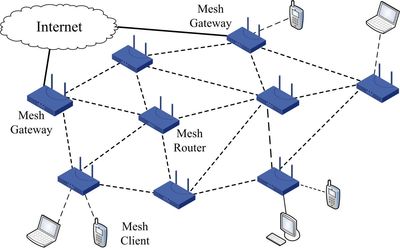
Bringing The Internet To A Mesh Network

A mesh network allows network devices to extend range to end user devices over a greater area and create a better user experience compared to using network bridges or repeaters.

Super old Linksys WRT-54 series wireless routers are well known for being re-purposed as repeaters and bridges and much lower bandwidth mesh networking. Newer Ubiquiti Networks equipment offers additional functions that create even wider area high speed networks that leverage mesh technology plus easier ability to offer advertised services to users. More about that later....

Avoid older Linksys gear and purchase Ubiquiti equipment instead. Used basic "mesh" capable/compatible Linksys routers can be had for as low as $5-10/each but do not offer the features a modern person would prefer. 

The Linksys WRT-54 series of routers were first introduced 15+ years ago and there have been many versions out since.  Alternate firmware to provide more functionality has been around a long time with some of the most popular being Tomato Firmware and DD-WRT Firmware.

Upgrading Linksys to add mesh networking?

Up until a few years ago, it was possible to add mesh networking capability to these older Linksys routers, but struggled to keep up with more modern features. A lack of on-board memory limited more advanced features from being added in the firmware for mesh options such as AREDN.

The other major reason is older Wi-Fi standards such as 802.11b and 802.11g are just not speedy enough and efficient to allow for proper mesh networking to work well.  It is advised for anyone looking to experiment with mesh networking, to ignore older Linksys equipment and instead focus on Ubiquiti branded equipment instead easily sourced from E-Bay or local businesses upgrading to even newer equipment.

Ubiquiti Equipment = Better for Mesh Networking

Ubiquiti branded equipment offers 802.11n standards plus higher power output, which means greater range and speed.   Another benefit based on the chip-set used in Ubiquiti devices such as the AirRouter, Bullet, Nano, etc is the ability to choose additional channels below the standard 2.4 GHz Wi-Fi channels available to consumers.  These two other channels are part of the amateur radio only spectrum from 2.397 to 2.407 GHz. Standard Wi-Fi runs from 2.412 to 2.437 GHz.  The benefit of this spectrum is less users which means less noise/interference and slightly better range and signal quality.

Ubiquiti AirRouter HP model capable of running AREDN
mesh with other enhancements for under $50.


Mesh Networking

There is more background on mesh networking here on HVDN as well as the AREDN site.

An overlooked feature when talking about mesh sometimes is the ability to offer services or "apps" over a mesh network that are not reliant upon having access to the internet.  Having a mesh network to share just internet between different different nodes (mesh routers) and then to end use devices (cell phones) is only useful if there is internet to access information.  Without the internet, you can not do much unless there are services attached to the mesh network.

Services can be things like:

  • Cameras
  • Weather stations
  • Storage Devices (Network hard drive for file hosting)
  • Longer range communication devices (900 MHz radios, amateur repeaters, etc)
  • Informational broadcast receivers (FM, Weather, Satellite, etc)
  • Voice communications (VoIP phone)
  • Chat and file share (Text messaging, IRC and other messaging/"snapchat" sort of applications)

HVDN Mesh Chat

The HVDN offers a few services to members of HVDN, including "mesh chat" which is a messaging platform that lets users create channels and communicate across the mesh network wirelessly.

The application or "advertised service" also ties in for internet users to communicate across the mesh network as well from anywhere.


In providing a gateway from the internet into the mesh chat application will help show how useful this will be and allow HVDN to build out a wider area "wireless" component of the mesh network.

This will then to allow both internet in/out communication plus wide range communication capability should the internet not be available in the Hudson Valley.

The Major Challenge

Since mesh chat does transmit wirelessly on amateur radio spectrum, any text sent is considered a transmission and only licensed amateur radio operators can use this system.   If there was sufficient interest, a non-amateur mesh network can be set up the same way and use standard Wi-Fi channels.

Mesh chat user interface available over the internet as well as local "wireless" connection.

There are multiple security mechanisms in place to ensure that only licensed amateur radio operators use this current system, including password protection and self-identification using your amateur radio call sign.

If you would like the password to use the system, please consider joining HVDN.  Membership is free for the first year for all licensed amateur radio operators.