Showing posts with label mesh networking. Show all posts

Tuesday, March 9, 2021

USMA Spotlight: How and why about NVIS communications


The June 12th "Hudson River Radio Relay Featuring Bannerman's Island" is getting much closer and our event website is nearing completion with all the details.  

While the event and its impressive list of local amateur radio club sponsors will be covered in different ARRL media in the months to come,  here is a glimpse of a form of communication that will be used during the event.

Fellow Hudson Valley resident, member of the Orange County Amateur Radio Club and Professor at the prestigious United States Army Cyber Institute located at West Point is COL Stephen Hamilton KG5HY.

Here is his recent presentation on using near vertical incident skywave (NVIS) for short range and reliable HF communications plus some really exciting details on cave based communications using rudimentary mesh communications technologies. 


Wednesday, April 8, 2020

Mesh: Upgrade or die!


Remember those Linksys WRT54 series routers?  Please stop using them and stop buying them on E-Bay!

This article will explain why its time to upgrade or die, but just in the context of mesh networking and amateur radio through the use of AREDN and the amateur radio spectrum!


Level Up:  Mesh & AREDN

A few years ago, the only options for experimenting with modern amateur radio mesh networks were some antiquated Linksys routers and a few older Ubiquity Network devices.

Today,  these "entry level" devices are no longer very usable since they lack processor speed, on board memory and capable Wi-Fi chipsets to offer a great user experience.

Currently there are 79 different devices across 4 vendors supported by the latest version of AREDN which is v3.20.3.0.


What device should I buy?


Currently, there is only one dual band device which offers the 2 and 5 GHz spectrum and is the GL iNet GL-AR750 which sells new for under $60 USD.

Additionally, there are a total of 3 Ubiquity Networks devices that support the 900 MHz band and another 3 that offer 3.5 GHz access.

The remaining 72 devices are equally split between the 2.4/2/3 and 5.8/5/9 GHz bands.

Selecting the right antenna and deciding where or how your AREDN mesh device is a very user specific question. 

All devices offer different benefits should you need longer range, higher power, smaller size or remote operation that are far too numerous to list here, but the AREDN Forum is a great place to ask questions.


Tuesday, January 14, 2020

Tiny Mesh Networking: AREDN & GL-iNet AR150


These cool little travel routers have been around for a few years made by a company named GL-iNet.

Higher speed models have come to market like the GL-AR750S which won the Innovation Honoree Award in the Cybersecurity and Personal Privacy product category at CES in 2019.

But what about the older AR-150 product?  Leave it to amateur radio enthusiasts to breathe some new life into older but very useful equipment.  It is now possible to run the alternative AREDN Mesh firmware on this great little 2.4 GHz only Wi-Fi device!

Why do this?

Different versions of mesh networking have been around under names such as HSMM, BBHN and now AREDN. A mesh network ensures that if any one node is removed from the network, the rest of the nodes can still talk to each other. This is called being fault tolerant and promotes network reliability.

Anyone who has been around Wi-Fi experimentation will likely remember the Linksye WRT54 series of routers that were easily enhanced with new firmware such as OpenWRT, Tomato and DD-WRT. Even with everything these other firmware add, they do not allow for mesh networking.

Amateur radio operators built on top of OpenWRT and introduced mesh networking features to these blue and gray Linksys beasts, but they all suffered from too little memory and not enough bandwidth to make them useful for modern mesh networking.


The costs of equipment by vendors like Ubuitity and Mikrotik have come down and found new homes in the amateur radio community along with the AREDN firmware. These offer faster speed, more on board memory and much higher transmit power for increased range.

Different applications such as VoIP phones, software defined radio, web cameras, chat programs and more were much more easily deployed now.

Most people experimenting with mesh networking today have retired those old Linksys devices as evidenced by the different frequency bands in use across the AREDN Mesh Network that are permitted thanks to your amateur radio license. Many are now using Ubiquity, Mikrotik,  TP-Link and now GL-iNet gear. The goal of this article is to make you more aware of GL-iNet.


So what about that little travel router?

The ARDEN Mesh project is pretty well documented and upgrading your firmware on older GL-iNet AR150 or more current devices could not be easier.  Have you since tired of MMDVM digital voice and no longer have a need for that cheap hotspot since you bought the OpenSpot2 or 3?

Here is your reason to do something with that old travel router!

The below video shows K2GOG and N2HVD's local mesh network in the Hudson Valley running a mix of 2.4 GHz and 900 MHz equipment plus a "virtual tunnel" connected into the WU2S mesh network down in New Jersey along with many others around the world.


Getting AREDN mesh on your travel router

If you are interested in this, head over to the links below for more information and see how easy it is to set up a portable mesh node now with nothing more than a GL iNet AR150 and laptop.


Oh, and if you are local to the Hudson Valley and would like to learn more about what you can do with a mesh network, perhaps a pancake breakfast at a local restaurant would be a good idea?

Check our event calendar for upcoming in person meet ups and other area technology happenings. HVDN has some big plans for 2020, so be sure to follow us.


Tuesday, December 4, 2018

64 Satellites: Can I get a ride too?

T- Minus     10...9...8...7...6...5...4...3...2...1...LIFTOFF!!!

SpaceX was able to put 64 various size satellites into orbit with only one Falcon 9 rocket. The total payload weighed in at 8,800 pounds (4,000 kilograms).

learn about satellites class students
Jerry Buxton, N0JY of AMSAT pictured at the SpaceX launch facility.
AMSAT was responsible for the Fox1Cliff (OSCAR-95) communications
satellite available to amateur radio operators world wide

Payload Details

Of the 64 objects launched on December 3rd,  the amateur radio Fox-1Cliff which is now known as OSCAR 95 is just one of many satellites, so here is the full list of publicly known 60 satellites and basic details, so let's get going.....


amsat satellite amateur radio student space


Lists: We love lists!

Not every satellite was a "CubeSat" which are normally 10cm cube weighing less than 4 kilograms.The largest satellite part of this launch was potentially the 231-pound (105-kilogram) KazSTSAT Earth-imaging satellite.  

There was also the Elysium Star 2 which carries the remains of Robert Lawrence, an African American astronaut was selected for the U.S. Air Force’s Manned Orbiting Laboratory program.

64 satellites launched  AMSAT OSCAR 9


#1 - AISTECHSAT 2: The second in the AISTECHSAT series and is a 6U CubeSat developed by Aistech to provide thermal images of the Earth. It will also help with maritime and aeronautical tracking as a prototype for a larger constellation.

Thermal imaging system is on board that is used in forest management, fire detection, gathering data for agriculture like identifying the health of the plant, analysing land for expansion. It can also detect energy consumption and loss of buildings.

The satellite also provides airborne and maritime vessel tracking via AIS and ADS-B receivers. The AISTECHSAT can also use a bidirectional communication system on board to send and receive automatic information from the vessel or remote asset worldwide.

For aircraft tracking an ADS-B receiver is on board. HVDN has its own ADS-B receiver that tracks aircraft in the Hudson Valley and is available to its membership. More information can be found here

----

#2 - Astrocast 0.1: Astrocast is a planned network of Nanosatellites providing global L-band machine-to-machine (M2M) services. The satellites are orbiting in a low earth polar orbit. This allows the creation of a global network covering the entire globe, including the poles. 

After integration of the NanoLink terminal, the ground based assets can reliably and securely send any kind of sensor data to the constellation of nanosatellites that will acknowledge the reception. Astrocast enables transmission of 1KB/day from any region on the earth.

A geographically distributed network of ground stations collects the data gathered by the satellites. The data are then uploaded to a cloud storage for access by the customer.

----

#3 - Audacy:   Audacy is building a space-based data relay network via a constellation of medium Earth orbit relay satellites along with our ground facilities. These satellites will maintain constant connectivity for our customers’ spacecraft from any point on Earth to lunar orbit


Details on 59 more satellites

Fantastic research has already been done by Gunter Krebs on all the other satellites that were part of this historic launch.  Have a look at all his hard work at  https://space.skyrocket.de/index.html 


https://space.skyrocket.de/index.html
Add caption
Talk about stuff like this?

Care to talk with others interested in satellite communications and technology plus the experiments conducted up above?   Here are some spots to check out related to amateur radio:
  • AMSAT DMR Talk Group:  98006 (Listen in here)

Tuesday, May 1, 2018

Bringing The Internet To A Mesh Network

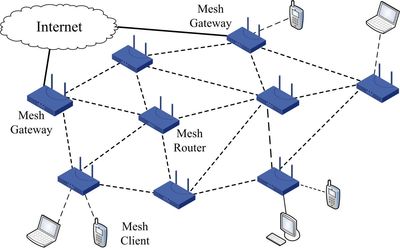
A mesh network allows network devices to extend range to end user devices over a greater area and create a better user experience compared to using network bridges or repeaters.

Super old Linksys WRT-54 series wireless routers are well known for being re-purposed as repeaters and bridges and much lower bandwidth mesh networking. Newer Ubiquiti Networks equipment offers additional functions that create even wider area high speed networks that leverage mesh technology plus easier ability to offer advertised services to users. More about that later....

Avoid older Linksys gear and purchase Ubiquiti equipment instead. Used basic "mesh" capable/compatible Linksys routers can be had for as low as $5-10/each but do not offer the features a modern person would prefer. 

The Linksys WRT-54 series of routers were first introduced 15+ years ago and there have been many versions out since.  Alternate firmware to provide more functionality has been around a long time with some of the most popular being Tomato Firmware and DD-WRT Firmware.

Upgrading Linksys to add mesh networking?

Up until a few years ago, it was possible to add mesh networking capability to these older Linksys routers, but struggled to keep up with more modern features. A lack of on-board memory limited more advanced features from being added in the firmware for mesh options such as AREDN.

The other major reason is older Wi-Fi standards such as 802.11b and 802.11g are just not speedy enough and efficient to allow for proper mesh networking to work well.  It is advised for anyone looking to experiment with mesh networking, to ignore older Linksys equipment and instead focus on Ubiquiti branded equipment instead easily sourced from E-Bay or local businesses upgrading to even newer equipment.

Ubiquiti Equipment = Better for Mesh Networking

Ubiquiti branded equipment offers 802.11n standards plus higher power output, which means greater range and speed.   Another benefit based on the chip-set used in Ubiquiti devices such as the AirRouter, Bullet, Nano, etc is the ability to choose additional channels below the standard 2.4 GHz Wi-Fi channels available to consumers.  These two other channels are part of the amateur radio only spectrum from 2.397 to 2.407 GHz. Standard Wi-Fi runs from 2.412 to 2.437 GHz.  The benefit of this spectrum is less users which means less noise/interference and slightly better range and signal quality.

Ubiquiti AirRouter HP model capable of running AREDN
mesh with other enhancements for under $50.


Mesh Networking

There is more background on mesh networking here on HVDN as well as the AREDN site.

An overlooked feature when talking about mesh sometimes is the ability to offer services or "apps" over a mesh network that are not reliant upon having access to the internet.  Having a mesh network to share just internet between different different nodes (mesh routers) and then to end use devices (cell phones) is only useful if there is internet to access information.  Without the internet, you can not do much unless there are services attached to the mesh network.

Services can be things like:

  • Cameras
  • Weather stations
  • Storage Devices (Network hard drive for file hosting)
  • Longer range communication devices (900 MHz radios, amateur repeaters, etc)
  • Informational broadcast receivers (FM, Weather, Satellite, etc)
  • Voice communications (VoIP phone)
  • Chat and file share (Text messaging, IRC and other messaging/"snapchat" sort of applications)

HVDN Mesh Chat

The HVDN offers a few services to members of HVDN, including "mesh chat" which is a messaging platform that lets users create channels and communicate across the mesh network wirelessly.

The application or "advertised service" also ties in for internet users to communicate across the mesh network as well from anywhere.


In providing a gateway from the internet into the mesh chat application will help show how useful this will be and allow HVDN to build out a wider area "wireless" component of the mesh network.

This will then to allow both internet in/out communication plus wide range communication capability should the internet not be available in the Hudson Valley.

The Major Challenge

Since mesh chat does transmit wirelessly on amateur radio spectrum, any text sent is considered a transmission and only licensed amateur radio operators can use this system.   If there was sufficient interest, a non-amateur mesh network can be set up the same way and use standard Wi-Fi channels.

Mesh chat user interface available over the internet as well as local "wireless" connection.

There are multiple security mechanisms in place to ensure that only licensed amateur radio operators use this current system, including password protection and self-identification using your amateur radio call sign.

If you would like the password to use the system, please consider joining HVDN.  Membership is free for the first year for all licensed amateur radio operators.