Showing posts with label HVDN Events. Show all posts

Thursday, November 7, 2019

Presentation: Sensing The World Around You


IoT, SDR, amateur radio, hudson valley iot, hudson valley ham club test, linux, MHVLUG, HVopen, Sean Dague,


HV Open is the premier open source software group of the Hudson Valley, formerly known as the Mid-Hudson Valley Linux Users Group (MHVLUG) that Sean Dague and others founded in 2003.

MHVLUG made the shift to fully embrace open source beyond just Linux a few years ago and created the reason to change names. Current leadership anchored by Matthias Johnson, Joe Apuzzo  and Jack Chastain have done a fantastic job along with Sean by seeking additional presenters of related topics to illustrate how much more widespread open source software has become with languages like Python being one of the most popular for those looking at SDR or IoT applications.

SDR & IoT: Sensing the world around you with open source software

HV Open was interested for HVDN to give a presentation on software defined radio at its monthly meeting held on the grounds at Vassar College in Poughkeepsie, New York. The slides can be found in our presentation repository. The presentation was given by Steve Bossert.


Steve Bossert K2GOG HVDN


Why open source matters when talking about SDR and IoT?

Amateur radio as a hobby is under immense change due to technology advancements, relevance, use cases and public perception.

The goal of this presentation was to highlight beyond amateur radio where there is innovation and opportunity to converge with other hobby groups and exchange knowledge, inspiration and expertise.


ARRL ham club new york 12603 poughkeepsie rhinebeck


Presentation Highlights

HVDN members create high impact and engaging presentations and this one was no exception.  For the 20 or so HV Open supporters present, they were treated to a video based on the often imitated Star Wars opening movie sequence to help set the stage for a great overview followed by a Q&A session.


Beyond what was captured in the presentation, there was a good bit of hardware demonstrated alongside Steve's presentation to help illustrate that an entry into SDR can be done at low cost by way of the popular RTL-SDR V3 USB receiver and the even more "covert" NooElec Nano 3 USB receiver.

For those interested in obtaining an amateur radio license and the ability to transmit with an SDR the Lime SDR Mini or the ADALM Pluto are two popular options.

All four SDR will work with the software Steve covered in his presentation and certain applications can be run not only on a regular computer or laptop, but also a Raspberry Pi or even a small Wi-Fi travel router such as those sold by GL.iNet that run OpenWRT.


From rear left to right - Zopsc wireless vibration sensor, GL iNet MT-300, AcuRite 02097M
From front left to right - Lime SDR Mini in custom 3D printed case, NooElec Nano, RTL-SDR V3


With any SDR device, different transmission sources such as common temperature sensors like those sold by AcuRite which mostly transmit in the ISM spectrum around 433 MHz. A different type of sensor presented was by a more obscure vendor named Zopsc and can be used for a variety of security applications.

Using a common USB power bank and external antenna such as a small 433 MHz magnet mount are all that is needed aside from an SDR and travel router to create a very flexible and light weight portable monitoring station for IoT devices.

remote SDR box how to


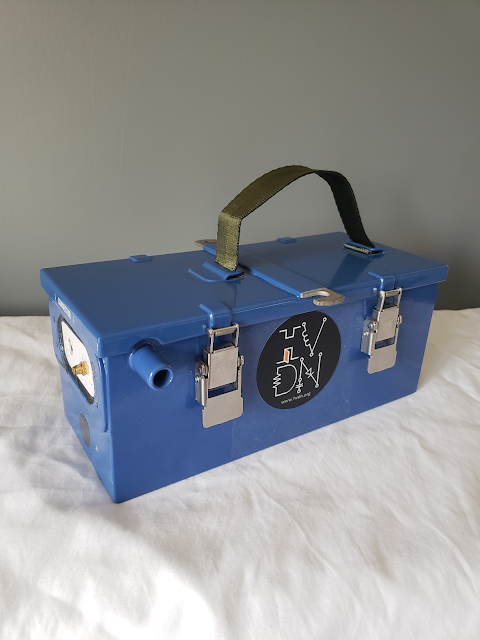
For those interested in a more complete and "professional looking" implementation of a remotely accessible SDR, Steve showed off his slightly over engineered and re-purposed example of such a device. Inside the blue commercial battery enclosure he sourced from the "maker's crown jewel for parts" of the Hudson Valley called P&T Surplus. Here is a basic block diagram inside this rugged enclosure.


mesh network aredn OSHWA Rolly Seth, Sophi Kravitz


The 12 V to 24 V DC converter is not needed for this all to work nor is the external Ethernet port or PoE splitter but were added for flexibility to use the remote SDR setup to provide power and connectivity for longer range Wi-Fi with a Ubiquiti Bullet M2 for mesh networking applications.

Power from the high capacity battery can run the basic implementation of the travel router and SDR for over seven days continually or for a few days less when using the "power over ethernet" mesh device.

All the cabling is interchangeable for easy application changes ranging from standard spade clips for DC power connections to the Ethernet and SMA antenna ports.


Using a remote SDR for IoT sensing

It is very easy to install rtl_tcp or rtl_433 onto the OpenWRT enabled router to share what is received by the SDR with any computing device that has Wi-Fi access.  

A benefit of a remote SDR is no loss of signal or more convenient placement of your IoT sensing antenna and then be able to capture, analyze and use the signals from the comfort of your kitchen table or office with no wires hanging around to trip over.

Open Source Software & SDR

The many options explored in the presentation for software are tough to capture in detail via this article summarizing the presentation, but should act as inspiration to explore Git in more depth as well as other open source software repositories as well as future articles on HVDN or presentations.

There is much to experiment with from both the hardware and software perspectives involving software defined radio and the internet of things and this presentation merely scratched the surface.

Terms like machine learning and artificial intelligence are already catching on within the SDR community as well as in IoT or open source as touched on in Steve's presentation. 


Interested in customized presentations for your group?

Since the inception of HVDN in 2017, we have supported the the Mid Hudson Valley Astronomical Society, the Squidwrench maker community,  Trenton Computer Festival and HV Open with engaging presentations to spread the word about the convergence of amateur radio with other hobby groups.

If you are interested in inviting in HVDN to give a presentation in the general Hudson Valley region of New York or slightly outside our beautiful borders, HVDN leadership can be contacted through the HVDN Notebook blog as well as via our contact page on the HVDN.org website.

SDR & IoT: Sensing the world around you with open source software presentation


Tuesday, September 3, 2019

Special Event: K1A Live From The 53rd Annual Mid-Hudson R/C Jamboree & History of Flight Air Show


amateur radio remotecontrol plane

The Mid-Hudson Radio-Control Society will host the 53rd Annual R/C Jamboree September 6, 7 and 8. See well over 100 giant-scale radio control models of vintage aircraft flying all weekend from 8:00 AM to 2:00 PM. 

The event is taking place at the Old Rhinebeck Aerodrome which is home to many vintage aircraft, including a flying reproduction of the Spirit of St. Louis.

The Aerodrome’s full-scale airshows will take place as usual on Saturday and Sunday from 2:00 PM to 4:00 PM, but the morning will host a special event amateur radio station operating under call sign K1A thanks to our friends over at the Overlook Mountain Amateur Radio Club.

cq  cq

The K1A station will be making contact via the HF bands as well as via internet assisted digital voice. Details are as follows:

HF Voice (USB mode)

  • 21.300
  • 14.230 
  • 7.220 

DMR

  • Brandmeister Talk Group 31630,

Echolink

  • N2HVD-R

All-Star 

  • Node 48878
Local Repeater
  • 146.805 (-0.6 shift, 103.5 Hz PL)

There will also be demonstrations involving digital text modes such as PSK31 on the 20m band.

Aviation enthusiasts from around the world may be on hand via DMR to talk with too thanks to the STEM talk group and the excellent convergence opportunity between the various hobbies involved it creates.

A generous $5 dollar discount is available to anyone holding an amateur radio license who would like to attend the event.  The address for the event is at 9 Norton Rd Rhinebeck, New York


Saturday, March 23, 2019

Presentation: Satellite Spectrum & Amateur Radio

Steve K2GOG presented on "Satellite Spectrum & Amateur Radio" at the Trenton Computer Festival on March 23rd alongside another 50+ technology and innovation focused topics.

The goal of the presentation was to cover the valuable radio spectrum available through amateur radio and promote its use through innovative communication applications on earth and in space thanks to underlying computer technology


How much spectrum do we have?

For those that are already licensed amateur radio operators, you may have a printed version of the below spectrum chart that the ARRL publishes or at least have seen it somewhere before.

In the United States and most other countries, there are different license classes of amateur radio operators. Some countries restrict the transmit power or operating modes as well as what frequencies can be used depending on your license restrictions.


Steve decided to add up all the spectrum that is accessible to the three current United States amateur radio licenses and further highlight just how much of the total 1.4 GHz of total discontinuous spectrum can be used for satellite related communications. The results are pretty interesting.

What really separates the Extra from General or Technician?

Sometimes it is good to be simple. Get the highest license possible and ensure you never have to worry about operating on the wrong frequency. Currently, the only thing that separates the highest from the lowest license class in terms of spectrum access is 3.9321 MHz of operating capability.

The difference in spectrum for the different license classes is mostly found in the HF bands ranging from as low as 135.7 kHz and up to 29.7 MHz. The only other spectrum not accessible to the technician class license is the 219 to 220 MHz portion of the under utilized 1.25m which many consider as being only from 222 to 225 MHz.

The remaining spectrum is all available to the Technician class license holder!

What if your not interested in long range "HF" communication?

With advances in radio receiver sensitivity and advanced low signal to noise ratio transmission modes, large antennas often associated with HF operation are not always needed.

However, even with specialized magnetic loop antennas and FT-8 digital text modes -nothing beats a full sized dipole for global communications on the 14 MHz or 7 MHz bands often referred to as 20m and 40m respectively and not everyone has the space or interest in such an antenna.


Radio propagation theory does not always guarantee communications are possible at all times of the day which may frustrate some people who only have limited times to "play radio" with HF spectrum.

RF HF propagation is just like the weather

A forecast is still just a forecast and is generally correct, but the difference between satellite communications and HF is the predictability.  For those with limited time to gain "radio communications" gratification, satellite communications may be worth a look.

You can easily calculate when a satellite will pass over head in the case of the "Low Earth Orbit" satellites covered in Steve's presentation for example. It certainly would be great if the weather was like that, wouldn't it?


Depending on satellites

One shortcoming of most satellite communications is that you are reliant upon a man made piece of technology flying over your location in order to make long range contact.

The other shortcoming is you can only make contact with other stations in the footprint of the satellite, which is different than HF since technically you can talk around the world and sometimes even hear your own echo under the right conditions.

Benefits of satellite communication is that you can get a lot of "ham radio" done in a very short amount of time given the brevity of low earth orbit satellites for those not fortunate to live in the foot print of the only current geosynchronous satellite that covers all of Europe, Middle East, Africa, India and a few other countries across Asia.


Fight:  Innovation in amateur radio

The first amateur satellite put into orbit was OSCAR-1 in 1961, just 4 years after Sputnik was put into orbit as the first ever satellite. 

Now almost 60 years later, there has been a total of over 100 satellites put into orbit and most of them being fully operational, with a few example success stories being AO-7, SO-50, AO-92 and QO-100.

In total and thanks to international regulatory efforts, all this satellite success requires spectrum to be set aside since managing who or what can use certain frequencies is more challenging compared to how a specific country can manage its finite spectrum resources.

Its pretty clear that there has been a lot of innovation within the amateur radio satellite spectrum, but much of it has yet to be fully realized.

One example of how technology originally meant for meteor scatter or earth-moon-earth communications which involves bouncing signals off of these non-man made satellites is known as low signal to noise ratio modes, mostly invented by Joe Taylor, K1JT.  The modes can now be found in use on the HF bands rather than for space related contacts. Here is how computers and amateur radio together create innovation.

Technology Improvements: We all benefit 

OSCAR 100 which was put into functional orbit by the Qatar Amateur Radio Society along with technical guidance from the German branch of the Amateur Satellite Corporation known as AMSAT pushes the boundaries of technology and spectrum management.

In 2018, various digital voice modes such as those enabled and made more accessible due to Multi Mode Digital Voice Modem (MMDVM) hot spot devices created an issue for certain satellites operating in the congested 435 to 438 MHz band.   A LEO satellite such as AO-92 speeds overhead at an average altitude of 220 miles and can easily be interfered with by 20mW hot spots and the lower power radios people use to access them. OSCAR 100 is the only satellite that does not have this issue.


Price has driven the adoption of MMDVM hot spots and radios such as the Anytone D868, TYT MD-380 and others. 

Today, thanks to the QO-100 satellite, there is a lot of rapid innovation taking place which shows that cost and user benefits generate lots of excitement that highlights the growth of the radio arts as specified in FCC Part 97.1.

The only unfortunate thing for North American amateur radio operators is that its not possible to utilize this innovative satellite and its great use of spectrum because it is in geosynchronous orbit. However, the AMSAT project GOLF is coming near which is exciting!

Looking beyond, satellite is just one way to show innovation through the use of spectrum. The future of amateur radio is dependent on finding other innovative applications for spectrum, so why not look at what else may be possible outside of the HF bands, even going as high as the mmW bands -
GigaHertz.... not MegaHertz!!!

Full Presentation & Added Bonus

The complete, but non-animated version of the presentation can be found at the link below in addition to the amateur spectrum database compiled to help develop some of the content Steve K2GOG presented both at the HVDN Quarterly meeting this past March 11th as well as TCF on March 23rd.


Thursday, February 21, 2019

How was it? February HVDN Meeting

Even with all the snow, ice, sub-zero temperatures and sporadic unseasonably warm winter weather, it was possible for just over 20 people to venture out on March 11th and take part in the first Hudson Valley Digital Network meeting of 2019.

What was on the agenda?

Our meeting inspired both the local maker community and national level of amateur radio leadership to have representation that illustrated first hand what amateur radio is all about as created by the Federal Communications Commission almost 100 years ago!


Because amateur radio is a federally licensed service, we have our own unique set of rules to follow. Part 97.1 of the FCC rules found in many places such as government, lobbyist and even legal academic websites such as New York's own Cornell Law School.  

From the over 21,000 MHz of discontinuous wireless spectrum we are provided to the equipment, power levels and information we are allowed to transmit - there is so much that amateur radio can offer a wide range of hobbyists that goes unnoticed at times today.

The major draw of the evening in Rhinebeck New York at the ultra modern co-working space aptly named CO. were our two presenters. Sean Swehla of the Squidwrench maker group and rarest of rare contacts to ever make through "on the air" methods, talked about the upcoming (and nearly sold out!)  Build It: Oscilloscope & Signal Source event taking place on March 9th.

This upcoming event focuses on education about soldering and how many hobbyist groups can benefit through education of practical use of basic or advanced test equipment.

STEM & Amateur Radio Together?

In comparison, our other presenter was Ria Jairam spends much more time making use of the wireless amateur radio spectrum compared to Sean who also holds an amateur radio license but they both have different yet similar hobby interests which is one thing that makes amateur radio great!

Ria holds the distinction of being the newly elected Hudson Division Director of the Amateur Radio Relay League provided a great presentation and insight as to the priorities of the ARRL at the highest levels including renewed focus around Science, Technology, Engineering & Math.

She also highlighted the new executive leadership of the ARRL and experiences that will help ensure that amateur radio principles are made more visible to wider audiences. Ria also highlighted the newly improved and expanded Hudson Division website and its activity calendar.


The Future Of Amateur Radio

The organizers and presenters of the meeting all agreed that the future of amateur radio is under attack if we as a community do not promote modern and relevant aspects of the hobby in an overly connected world we have come to know today. 


The attending audience seemed to be in agreement and following the presentations during refreshments were many discussions covering topics including some of the following:


The next HVDN meeting will be on March 11th at 6:00 PM in Rhinebeck with location details at https://hvdn.org/meeting . Featured March discussions will likely include:

  • Sneak preview of Steve K2GOG's satellite spectrum presentation and live demonstration of SATCOM
  • Oscilloscope use cases based on the DSO150 scope and signal source constructed at Build It two days prior.
  • Special guest speaker and topic 

Anyone interested in suggesting future presentation topics or contributing in some other way (snacks, prizes, etc) for the future meetings, please contact HVDN at info <at> hvdn <dot> org

Thursday, February 14, 2019

March 23rd: TCF19 Computer Festival


This event has a little something for everyone interested in modern technology and applications, not just related to amateur radio or even computers.

The featured keynote this year will be led by Tony Sager of the Center For Internet Security which is headquartered just outside Albany, New York.  Tony will talk about the importance of cyber-security and how it affects almost every aspect of our connected lives today.

Other featured presentations include:
  • The State of Cyber Crime in New Jersey by NJ Department of Homeland Security Cyber Team!
  • Maintaining the Integrity of Elections in a Digital World – Rebecca Mercuri
  • Quantum Computing – Barry Burd 
  • Amateur Radio Satellite Spectrum - Steve Bossert 
  • WordPress Bootcamp – Lou Judice
  • Cybercrime and Theremin Zen – Kip Rosser 
  • MMDVM Hotspot Construction - Joe Apuzzo  
  • Hands-on Arduino Workshop for Beginners – Katalin Frolio
  • All Day Robotics Pavilion – Seung-yun Kim
What about amateur radio? 

HVDN's very own Joe Apuzzo N1JTA and Steve Bossert K2GOG will be among the 50+ presentations and workshops also taking place during this fantastic event.

In N1JTA's 30 minute presentation he will talk about how radio and computers has converged through the popularity of digital modes in Amateur radio and how it has grown exponentially over the last few years due to the affordability of VHF/UHF digital handheld radios and other equipment.

is full duplex capable and the same size as a Raspberry Pi Zero. 

A large part of this growth can also be attributed to the impact of hot spot devices and the unique learning capability they create. A hot spot is a small access point type device that uses amateur radio spectrum and a decentralized network of servers to enable global or local  digital communication.

Joe will cover at a high level, what is needed to construct your own "micro repeater" or hot spot device and how it works, along with how to create secure connections and utilize a decentralized network maintained by a group of amateur radio operators around the world.

Brandmeister is unique in that it can route all types of digital voice traffic through its decentralized network of servers to end node devices such as hotspots and repeaters

Since the hot spot device is nothing more than a Raspberry Pi single board computer and a multi mode digital voice modem hat plus some open source software called Pi-Star it is relatively inexpensive but very complex to understand how it works.

Steve will be cover in varying detail more than 21,000 MHz of spectrum available to amateur radio operators looking to experiment with satellite communications today. While much of this spectrum is above 1.2 GHz, this still leaves over 60 MHz of varied spectrum that can be used by those holding the easiest to get Technician class amateur radio license and with minimal expense.

Your DMR radio can also be used for satellite communications
via analog FM mode you might have forgot exists.

Steve's discussion will cover the most common spectrum used today for amateur radio operators interested in satellite communications, additional spectrum users to be mindful of and a review of the most active satellites that can be used with less than $100 of invested equipment.  He will also give a "sneak peak" on this topic to attendees of the March 11th HVDN meeting in Rhinebeck, NY.

More about TCF19, the full agenda and when is Joe's presentation can be found at https://tcf-nj.org/

Interested in other interesting events? Check out the HVDN activity calendar


Wednesday, January 30, 2019

February 11th: Would you like to meet a super hero or two?

Hudson Valley Digital Network (HVDN) is proud to offer an exciting event open to any current or aspiring amateur radio or electronic hobbyist regardless of any other memberships on February 11th 2019.

Join us in welcoming newly elected ARRL Hudson Division Director, Ria Jairam N2RJ and Sean Swehla KD2HGY of the Squidwrench maker group for an evening of education and fun in Rhinebeck, New York starting at 6:00 PM.

Event Details:

Doors to the community space at CO. located at 6571 Spring Brook Ave in Rhinebeck New York officially open at 5:30 PM with the presentations starting a little after 6:00 PM. Light refreshments and hot/cold beverages will be served. The event concludes at 7:30 although the space is available for discussion after and up until about 8:30 PM.


HVDN Presenters: Ria Jairam N2RJ & Sean Swehla  KD2HGY

Ria will share details on where she thinks ham radio is headed, how to be part of it and how to make the hobby interesting to a wider audience.

Sean will talk about the upcoming oscilloscope build project event that Squidwrench and HVDN have collaborated on. Details on this pre-registration only event can be found at:
https://www.eventbrite.com/e/build-it-oscilloscope-signal-source-tickets-53349617141 


Where Do I Go?

Rhinebeck is home to many unique attractions ranging from the home of the 200+ year old Dutchess County Fair  and Beekman Arms which is the oldest Inn in the United States.

There are many more modern attractions, one of which is the very sleek CO. co-working office and community space just across from the fairgrounds. It should be easy to find.

Anyone who is a professional "work from home, with a laptop" sort of person may also be provided a complimentary pass to use the facility for the later part of the afternoon prior to the start of the HVDN meeting.  Please contact Steve Bossert K2GOG and co-founder of HVDN at steve.bossert@gmail.com or at 1.914.573.1799 for details.


Wednesday, January 23, 2019

March 30th: DMR University

The Hudson Valley of New York has recently become a hot bed for modern physical and digital destinations of interest to the amateur radio community.


DMR has permanently changed the way amateur radio operators approach local communication through repeaters, hotspots and direct communications.


As the highest growth digital voice technology today, please join Lenny N2LEN along with other local "DMR Experts" on Saturday March 30th at Greene County Emergency Services located
at 25 Volunteer Drive, Cairo NY 12413.

DMR University will be taking place in the main conference room downstairs.

The agenda is as follows:

9:00 AM - Morning Session
  • Introductions and brief history of DMR
  • Overview of current Digital Voice Modes
  • How DMR is Unique: C-bridge, Brandmeister, TGIF networks
  • Hotspots/MMDVM: Shark RF Openspot2, Zumspot, Jumbospot, etc...
  • Overview of Current DMR Radios
  • Anatomy of a DMR Repeater
  • Introduction to Talkgroups
  • Understanding Zones, Contact Lists, & RX Groups
  • Scan Lists
  • DMR Etiquette: How to act on the DMR network


12:00 PM - Lunch Break
  • Bring your own food or visit a nearby restaurant


Afternoon Session
  • How to Build a Codeplug
  • Hand's On Programming Exercises

Len kindly asks that those interested in attending to reserve a seat in advance and to bring a laptop for programming, your radio, any programming cable you may have, and have a copy of the Programming Software you use installed on the laptop. 

However, do not worry if you do not have a DMR radio or laptop, there will be some radios for you to experiment with. 

Important: To reserve a seat, please email Len at n2len@aol.com

If you haven't already done so, please go to Register here for your DMR ID# and obtain a DMR ID number. (https://www.radioid.net/register#!)


Thursday, December 27, 2018

March 9th 2019: Upcoming Kit Build Event

HVDN and Squidwrench have teamed up to sponsor an event right here in the heart of the Hudson Valley aimed at those wanting to hone soldering skills and build something very useful for electronic circuit building, troubleshooting and experimentation.

maker space poughkeepsie

Build It: Oscilloscope & Signal Source Kit

The oscilloscope kit that will form the centerpoint of the March 9th 2019 event is well documented across the internet and we will make it even more fun to build in a social atmosphere and ensure everyone leaves with a functioning multi purpose piece of test equipment or two....

Tickets are limited so, so be sure to sign up early if there is interest.

There will be a few more articles related to test equipment and the DSO150 oscilloscope found on HVDN along with info about our own signal source that can be used with this piece of equipment to form the basic additions to a set of inexpensive test equipment every hobbyist or professional should own.

mount beacon mt. beacon hamfest  DSO150 ham radio university LIMARC MBARC OMARC PEARL


Event registration and details can be found at the below link:

https://www.eventbrite.com/e/build-it-oscilloscope-signal-source-tickets-53349617141