Showing posts with label SSTV. Show all posts

Tuesday, April 19, 2022

UNDR Group Experiments with KG-STV


There is a great reason for sharing an image like that and no, those black boxes are not censorship but bad pixels when receiving a KG-STV image over amateur radio.

Why send images?

The Ulster and Northern Dutchess Readiness Group is a new organization founded in 2021 to promote ways for the casual radio amateur to learn about preparedness.  

ARES and RACES programs are excellent, but not everyone has the time to dedicate to those or the missions that sometimes prevent a higher level  of local community awareness regarding amateur radio.

Sharing photos for reasons such as training for public works damage assessment or other "grid down" information sharing reasons is an important skill to learn as part of the amateur radio hobby.

Sending photos over a repeater

To help differentiate UNDR Group, the leadership team led by Steve K2GOG has focused on practicing the use of slow scan television (SSTV) images which can be relayed through analog repeaters in the Hudson Valley.

Since October 2021, the UNDR group has found that the PD90 mode is a good trade off between resolution and time needed to send an image with excellent clarity.  A 320 x 240 pixel image sing PD90 takes about 90 seconds from start to finish.

In April 2022, the UNDR Group did an experiment simulating the need to send, receive and re-broadcast an image pretending there was a UFO sighting over the Hudson Valley.


Poughkeepsie UFO,  Highland UFO, Pine Bush UFO
Captured and then rebroadcast SSTV
PD90 image of a pretend UFO over the Hudson Valley
(Courtesy: K2GOG, W2NDG and KD2SQO)

Evolving to digital SSTV

Now that enough members of the UNDR Group have perfected the ability to send and receive images from home or the field using analog SSTV, they have just moved over to learning how to send digital versions of imagery using the KG-STV application.

With normal analog SSTV, one line of the image is sent at a time, scanning from left to right.  As the images is transmitted, those receiving it slowly start to see the image come into view. There are many modes of analog SSTV such as ROBOT36, PD90, SCOTTIE and others. 

KG-STV is different since it is sent digitally in a group of pixels at a time. The sender can choose to send these blocks of pixels in vertical or horizontal rows plus in a randomized sequence.

Sending in a randomized sequence is interesting since it prevents some types of interference or missing large pieces of an image.

Here are two examples of decoding the MARS logo which Steve K2GOG sent as part of an awareness exercise of the Military Auxiliary Radio System.  

This volunteer group managed by U.S Department of Defense via the Army and Air Force has taken a renews interest in collaborating with amateur radio operators for joint readiness exercises.

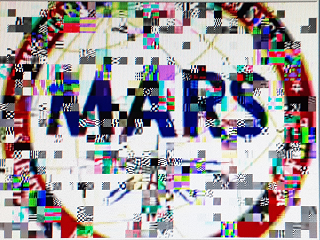


The image above decoded by Tom N2FZC shows only slight pixilation and the image below from Lou KD2TVS shows a bit more given he is much further away from the repeater compared to Tom which relayed the signal 


For a first time test of KG-STV, this was still a great start as it took on average of 6 times using analog for UNDR Group members to get near perfect copy. 

The reason to experiment with KG-STV is that the application can also send text communications which makes it a valuable tool for when audio communications may not be appropriate. 

When does UNDR Group meet?

Every Monday evening at 8:00 PM Eastern Time is the UNDR Net via the WA2MJM 146.805 analog repeater.  The UNDR Net typically shared a list of announcements including upcoming events at the start and the follows a short thematic discussion. 

At around 8:30 PM, the focus shifts to a form of digital communications which can be shared via the analog repeater.  Different forms of SSTV are the current focus, so please check it out as no other organizations are doing anything else like this in the Hudson Valley and possibly in a larger part of the New York Metro area.

More information about UNDR Group can be found at www.undr-group.com 

Tuesday, February 22, 2022

Fishing In the Woods: Looking for Radio Signals


This was the first Winter Field Day that justified a reason to purchase an ice fishing tent.

The tent manufacturer claims you can set this up in under a few minutes and pack it up even quicker.  Lets see what the breakdown looks like.


Inside the Tent:  Gear needed

We all like lists right?  Here is what was in use in the photo below.

(Photo Courtesy:  Ken Campbell AD2T)


Excluding the table, chair and propane heater, this was a minimal operation which proved pretty comfortable even in the low temperatures during Winter Field Day.

The goal was to operate 10m or 15m  PSK31, JS8CALL or SSTV but most of the time it seemed that FT8 was more popular, so that would not count for Winter Field Day. Too bad!!   The 15m band was wide open which was really nice.  A few contacts were made on 40m SSB, hence the need for the headset.

Antenna Questions

A 40m Off Center Fed home made dipole was used with good success.  This design allows for 40m, 15m and 10m operation without really needing the tuner..  One leg of the dipole is 44 feet and the other is 22ft.  At the center point is a 4:1 DIY balun.  The antenna center was mounting with velcro ties on the 20ft orange Jackite fiberglass mast.   

The mast was secured to the ground with a ground stake and length of PVC pipe which the mast simply slides over.  The longer end of the dipole was attached to a nearby tree with a length of paracord.  The shorter end was attached to an artificial tree known as a tripod.

Even with heavy winds, the antenna system as expected maintained upright for the 24 hour event in the frigid cold!

This antenna system works great and easily stows in a bag designed for audio equipment.  Many other accessories for additional HF and VHF antenna also fit in this bag along with a few 25 and 50 foot RG-8X feedlines. 

I would estimate that my entire antenna kit which includes the storage bag, surplus tripod (RIP KE2EJ), feedlines, support stake, full wave 2m loop, Arrow II antenna, 40m OCF, 10m-17m-20m-30m linked dipole,  End Fed 40m/80 and a few other odds and ends cost less than $200.  This is a lot of antenna gear for different applications mostly meant for POTA operations and not SOTA activity which is much smaller scale.

(Photo Courtesy:  Ken Campbell AD2T)


An article like this can get really long if I wanted to detail how to set up Wi-Fi on the Icom IC-705 to talk to the laptop with virtual com ports and audio cables, but there are great tutorials on YouTube which cover that already.  

The only issue I really ran into which continues to be a level of annoyance is that the "705" has such a broad front end that semi decent antennae can easily overload things, so backing the RF gain down is a good idea.  

Nearby strong out of band signals also are problematic and an external band pass filter will be needed for the 705 to perform better during group special events like Hudson River Radio Relay coming up in June..

Last year during that event, the 705 on the 6m band was useless when nearby 20m or 40m CW and SSB activity was taking place.

Not really sure if this article answered any questions for anyone, but it was fun setting this up for Winter Field Day and spending some time playing radio plus teaching others about how to set up a minimal self contained field station.

Monday, November 29, 2021

Doing "data stuff" over VHF/UHF FM?

First, let me set up a user scenario so this makes sense as to what problem is being solved.  

Imagine you are somewhere where you have a fully charged smartphone, but no network access of any kind along with a dual band handheld amateur radio.  

Aside from the above, you happen to have some type of HF radio with you, but you forgot a few important things at home like a Morse code keyer and some important thing that prevents you from powering your HF radio, like a power cord, fuse, etc. 

Your only method of outside field communications is with your handheld radio now! 

Luckily, you have a few extra things  with you such as an Easy Digi Interface and a USB-C to 3.5mm adapter with you. How can you communicate using non-voice modes?

Sending certain data signals over FM provides some benefit. Lets explore a few of these where you will be connecting your smartphone to your handheld radio.

Smartphone Headset Adapter

If you have a smartphone with a headphone jack, that is great but is feature becoming less common.

The latest Android or Apple devices have done away with the standard 3.5mm headphone jack and is why you need an adapter that goes from USB-C (Or Lightning) to a 3.5mm jack.

For $9.99, this USB to 3.55mm TRRS headphone adapter gadget can be yours and will find many other uses you can think about.  Support fellow Hudson Valley club OMARC by using Amazon Smile.


Easy Digi Interface

This simple box allows you to connect your smartphone to your handheld radio.  You may or may not need the smartphone headset adapter, but lets pretend you do.  

It is now simple for you to connect your radio and smartphone together thanks to KF5INZ and the appropriate version of his adapter for your radio. Below is pictured the version appropriate for the Alinco DJ-MD5XTG DMR radio along with the USB-C to 3.5mm TRRS adapter.

An alternative option, but still using a different form of the Easy Digi Interface was even written up by HVDN's Joe NE2Z back in 2019.

Do Not Leave Home Without Software

Since you do not have network access to download applications on your smartphone in this described scenario, install a few before you get stuck somewhere.  

The first application to focus on is one that you can send pictures with.  SSTV and its different modes offer different benefits and this ability might come in handy to increase situational capabilities.

The second application to focus on is something that can send text data in a conversational format.  Modes like RTTY and PSK31 are great for this as they work just fine being sent over FM.  Small or large amounts of text can be shared with these modes. VARA FM is not a focal point in this article since we are focusing on basic implementation for basic users.

A third application is something where you can share your location and short embedded messages.  APRS.  APRSdroid is a great way to start related to APRS without a dedicated APRS radio. 

Here is the list of essential communications applications you should have on an Android device relative only to the use case described in this article.

Please note that similar versions exist for Apple devices, but HVDN can not provide comment/support on those, but we welcome your Apple favorites. 

Robot36 - Highly Recommended as SSTV reception application because of modes supported like PD50.

SSTV Encoder - Recommended for SSTV transmission via supported modes like PD50

APRSdroid - Highly recommended for sound card based APRS with appropriate interface cable.

droidRTTY - Recommended for RTTY over FM or other modes.

droidPSK - Highly recommended for send/receive of PSK using appropriate interface cable.

droidSSTV - Another SSTV option, but better options exist. 

AndFlmsg - Many supported modes but experience may vary based on your smartphone/tablet.

Wednesday, October 6, 2021

Ulster & Northern Dutchess Readiness Net


I would like to thank everyone who has supported what is now going to be officially called the Ulster & Northern Dutchess Readiness Net moving forward following our October 5th 2021 over the air session.

We still get to keep the UNDR acronym and the reason for changing the word "radio" out for "readiness" helps us provide a more flexible resource and mission. 

As we continue to determine if what we are doing will be a benefit to ARES, RACES or CERT capacities at some point in the future as covered in past articles and live discussion every Tuesday at 8:00 PM local Hudson Valley Time (0000 UTC)

One note sent in a few days after our last UNDR Net is the image that solved a problem for Brad KC2VVJ. Thank you Bob K2LD for sharing your below image via our webform and helping Brad out. Details on the issue can be read here. 

Bob K2LD decoded this image with ROBOT36
using PD50 mode while stopped in his car.
Read more details here 

October: Hudson Valley Fox Hunt Season

Fall is the perfect season for walking around with antennae and radio equipment to find cleverly hidden transmitters, which are some times referred to as "foxes". 

There are many practical applications for radio direction finding and members of the UNDR Net team have put together a curriculum to help teach related skills that are useful to this sort of activity detailed below. From a CERT perspective, understanding land navigation and direction finding are important things to know.


Week 1 Highlights & SSTV Summary

With a total of 12 participants, now spanning across 3 state borders across no fewer than 6 different counties, the UNDR Net continues to show that great content attracts more interest compared to how many standard ARES/RACES net serve those specific purposes.

Continuing on with perfecting SSTVM over FM via the WA2MJM 146.805 MHz wide area repeater, we have increased our ability to decode fantastic images using the PD50 mode.   This slow scan television mode only takes less than one minute to send an image with 320x256 pixel resolution.

Past articles show some practical applications for SSTV to communicate or inform on situational awareness and this week we have a little more free form fun.


Ken KD2TQS started off by sharing a photo of this rather nice butterfly, with photo accreditation going to some Ken is friends with.  

The species of butterfly is battus philenor and is more commonly known as the blue swallowtail.  Sharing an image like this, or a type of snake, could be interesting in a no-cellular network access scenario where sharing a photo of wildlife could be very important.


The next image by Brad KC2VVJ, while it appears a little choppy was part due to interference on the repeater, but the commemorative patch is clearly legible for most of the image which proves resilience in sending an image in less than optimal conditions.


The last official image of the evening sent by Steve K2GOG was used as a quiz to identify someone who might "already be your friend" or perhaps "was your friend" on an early form of social media known as MySpace.  Sharing a photo for perhaps some type of lost persons scenario is important.  

No fewer than six participants decoded the image just fine with perfect clarity and all would have been able to pick this person out in a crowd, had this been a current photo of Tom Andersen. 


Discussion during a directed net goes by quick and the UNDR Net for October 5th concluded at 2122 local time.  An "unofficial" round of images followed which included Tom N2FZC sharing his first sending results using EncoderSSTV and the image quality was reported well across multiple people.


Joining us for the first time from Winchester, CT was Dan KC1RRK who decoded most all the attached images and then shared a simple "QSL" image shown above with no photo in the middle of the text.  Brad KC2VVJ responded back with the below image to acknowledge receipt of Dan's image.

Radio Direction Finding Plans

Here are the plans for the jointly organized RDF day planned for October 30th along with the Overlook Mountain Amateur Radio Club, who will handling hospitality via a nice lunch to thanks its members and for those that are pre-registered for the event.


More details will be shared each week and as part of our curriculum. If you are interested in attending our October event at Ferncliff Forest, please take the below survey.  

PRELIMINARY RDF EVENT SURVEY

Thursday, September 30, 2021

Practical use for SSTV with UNDR Net


Our 4th and final UNDR Net of September ended with a unique plot twist. Our weekly theme followed the Federal Emergency Management Agency (FEMA) National Preparedness Month guide via a quick mention of helping youths to be prepared for disasters.

As we have learned in past weeks, the star of the show has been our testing of SSTV over FM with this week being the first time we had three different licensed amateur radio operators broadcasting images through the Overlook Mountain Amateur Radio Club repeater in the Hudson Valley. 

The reason why we are experimenting with this mode of communications is to raise awareness that there is more to just voice capability which a VHF analog repeater can be used for. It is also proving to be another great opportunity to get more familiar with what can be done with equipment you already have at minimal expense.

Should the need arise, using just your existing handheld amateur radio and a smartphone, you can send and receive images with little prior knowledge. This capability may come in handy in a time when you may not have cellular network access, but have a perfectly charged smartphone.

Round Number One

Ken KD2TQS in Rhinebeck led us off with the following image sent in order to spur discussion on about an upcoming special event focused on radio direction finding.

It was nice to welcome Brad KC2VVJ back on the air and to the UNDR Net. The above image was received by him in Washingtonville while parked stationary in his car.  Some of the blurring is mainly due to noise picked up by the microphone in his smartphone, but is otherwise clearly legible.

This image took about 50 seconds to send using the PD50 mode of slow scan television, which is also used by the International Space Station but they often send with PD120 which is twice as long but better resolution like some of the examples here shared by Steve K2GOG. 

Round Number Two

The next image was sent by Steve K2GOG in Poughkeepsie and was also received by Brad KC2VVJ in his car with a noticeable amount of extra noise. 

This week the UNDR Net had a total of eleven participants, including the following who were able to also decode the image and its details were discussed.

Thank you to Paul N3EYQ in Rosendale, Tom N2ZFC in Fishkill, Jim KD2VAH in Poughkeepsie, Guy KD2TLF in Xena, Lou KD2TVS in West Milford (NJ), Ken KD2TQS in Rhinebeck, John K9JPT in Hopewell Junction who all were able to receive the image and share details.

Fellow HVDN and Overlook Mountain Amateur Radio Club member Bob KD2QAK will be giving a presentation on orienteering in October as a virtual video to help provide some useful tips which may be used during the upcoming "Fox Hunt" scheduled for October 30th 2021 at Ferncliff Forest in Rhinebeck.

The weekly theme of the UNDR Net in October will focus on radio direction finding, so be sure to listen in for that plus continued testing of SSTV over FM. 

During the upcoming hidden transmitter hunt which is sometimes called a "Fox Hunt" the signals that will be sent may include SSTV, so its going to be a lot of fun for those who can find the transmitter as well as decode its secret images.

Round Number Three

This time Brad KC2VVJ took a turn sending images and we also were later joined by Brian KD2SQO, Bob K2LD and Mike KC2UVP as late UNDR Net arrivals.

For those that frequent the WA2MJM wide area 146.805 MHz repeater, the below image will make sense as Brad's profession involves the sharpening of knives.

The above image is the original which Brad sent and many got a good laugh out of it, but no one sent in a reception report so we can give them credit for receiving the image.   We have a website set up should anyone wish to share results using the form at hvdn.org/undr.

Round Number Four (And a twist!)

The final image of the night was going to be the most simple one and Brian KD2SQO was first to report he received it. However, soon after additional signal reports it was discovered that Brad KC2VVJ had curious visitors which included a neighbor and a local first responder who heard "strange things" coming from Brad's vehicle.

Neither of them believed he was sending and receiving images with nothing more than a radio which did not include any internet connectivity.   Thinking quickly, Brad quickly made an image of "2+4=6" and sent it out asking our participants to read back what he sent.

Almost all at the same time, Bob K2LD, Tom N2ZFC and a few others all started shouting back the above numerical equation to the astonishment of the curious audience Brad had.

Practical Uses for SSTV

The most common use today for SSTV is mainly on the lower frequency band known as 20m on a frequency of 14.230 MHz but often only includes images sharing postcard type images and callsign of the sender or receiver.  While fun, this has little practical use but does showcase long range communications capability.

Local communications in the 50 to 100 mile range or even closer can greatly benefit by more use of SSTV as being demonstrated over the past few weeks.

Much better image quality can result by connected a wire between the smartphone and handheld radio.  This will certainly happen in October now that many have seen it is possible to send decent quality photos without that extra accessory.


The Easy Digi™ Digital Sound Card Interface by KF5INZ is low cost and allows most radios to be connected to a smartphone.  The great news is that you can send or receive much more than just SSTV, but also text using modes such as RTTY or PSK as well as forms used in emergency communications like NBEMS. 

Adding this interface to your personal emergency kit along with a handheld radio is a great low cost way to further show interesting things with amateur radio. 

UNDR Net October Schedule

With both a virtual and in person event planned in October, our weekly radio discussion will also shift responsibility to a group of net controllers.  Right now this includes Steve K2GOG, Ken KD2TQS and Brad KC2VVJ.  All of them are working closely together to provide curriculum and assistance to those interested in what we are doing on and off the air.

If you would like some personalized help with SSTV, Ken KD2TQS is making himself available and you can reach him using the form on the hvdn.org/undr webpage.

Steve K2GOG is going to be focused on organizing the RDF event on October 30th and Brad KC2VVJ will be working with Bob KD2QAK regarding the online presentation on using a map and compass.

Lots of fun is ahead for UNDR Net and we would like to continue to thank our area partner clubs such as the Overlook Mountain Amateur Radio Club and also the West Point Cadet Amateur Radio Club for finding ways we can all work together to promote the modern evolution and convergence of amateur radio with other interests.

Wednesday, September 22, 2021

Putting the HV on the map with SSTV?


For our third SSTV over FM test as part of the Ulster & Northern Dutchess Radio Net on Tuesday September 22nd, we had a lower turnout than past weeks but had the most success in participants decoding images and playing along.

The month of September is National Preparedness Month as sponsored by the Federal Emergency Management Agency (FEMA).  This weeks casual round table theme was "low cost, no cost preparedness".

Natural disasters do not wait for a convenient time. Preparing for them shouldn't wait either. Start today by having a look at various alert tools, gather and safe-guard important documents and take other low cost/no cost actions like ensuring your amateur radio gear is functional, programmed with appropriate frequencies and know how to use it without the aid of a manual or computer programming.  

Doing all of this in advance helps lessen the impact of disasters and emergencies for you and your family.

Local Hudson Valley Weather Status

The WXL37 National Weather Service transmitter which serves the area is currently offline.  It is unknown when this will be again online, so should there be a situation where there is internet or mobile service disruptions, a reliable and timely source of weather information excluding broadcast media is not available for our area. 

Hopefully this is restored soon, especially since any weather alert radio receivers will not function until this is turned back on.


UNDR Net Participants on 9/22/21

Acting as alternate net control this week was Guy KD2TLF and our total participation this week was six and spread across the core of the Hudson Valley.  Special thanks to:

  • KD2TQS - Ken - Rhinebeck - Dutchess County
  • WA2RKN - Jerry - Hyde Park - Dutchess County
  • K9JPT - John - Hopewell Junction - Dutchess County
  • KD2VAH - Jim - Poughkeepsie - Dutchess County
  • KD2TLF - Guy - Xena - Ulster County  (ANC)
  • K2GOG - Steve - Poughkeepsie - Dutchess County (NC)

After a brief discussion about no cost planning, we moved to the SSTV over FM test using the Overlook Mountain Amateur Radio Club's amazing WA2MJM 146.805 MHz repeater located high atop Overlook Mountain. 

As a reminder,  UNDR Net is not currently affiliated with ARES, RACES, CERT or MRC but would love to be if it shows we can add value. 

Finding people without giving away details 

This week we started off making the audience think we were going to play a game of tic-tac-toe by sending images using the very fast PD50 mode compared to last week's PD120 and prior PD90.  

Each mode takes approximately the number of seconds represented in the numbers of the mode, so thusly PD50 is nearly twice as fast compared PD120 with the only sacrifice being resolution and image size.

A picture is worth a thousand words, so a video is worth more than that, right?  

Here is a nice video from John K9JPT showing how he used his smartphone to listen to the SSTV audio signal coming from his radio as sent by Steve K2GOG and is then converted in real time to the image.


For the next image, which Ken KD2TQS sent, included the "O" in grid B2 on the tic-tac-toe board.

Here is where we then changed things up from a simple children's game to something of more importance. This was the third image sent:


Using the details sent in the first two images, it was simple for our end users to then overlay the "X" in A1 and the "O" in C2 to help provide travel directions in the least amount of moves so that a meeting near the barrels located in B3 code happen.

If this were a real life scenario and people on the ground had a printed map with grid lines, it would be easy for a control operator to share locations of key assets with those in the field without giving away detail over the airwaves. 

Instead, ground users would simply marry up the points of interest, obstructions and team members from a simple image and draw them in locally to a map.  This would give HUGE situational awareness while maintaining some level of mission privacy.

Here is the fourth image sent in the evening to give more ideas on that. If the goal of "SB" was to move to the smiley face in the shortest number of grid moves, it would be easy to do so.  Overlaying a grid like this against a real map would be valuable and secure.


What is next for SSTV over FM and UNDR Net?

Bob KD2QAK has been talking about giving a presentation on map reading and orienteering with a compass at an upcoming Overlook Mountain Amateur Radio Club presentation night.  

If this is possible to get scheduled before an upcoming Radio Direction Finding event on October 30th at Ferncliff Forest, its possible we can blend all three topics together to make a really fun event.

If we think back to how Nolan N2WU was able to use APRStt as a way to identify key locations as part of the West Point Triathlon or how Bob Bruninga WB4APR did a case study using grid overlay at a hamfest to help find people, maybe using SSTV is not too crazy after all!! 

Hopefully this is all coming into picture now that amateur radio has some very unique ways to share photos, locations data and valuable information using nothing more than the most inexpensive handheld amateur radio like a Baofeng UV-5R and a smartphone, that may not have internet service but should already have useful applications on it such as ROBOT36, SSTV Encoder and many more which will also be covered in the future on UNDR Net.

Participating in UNDR Net & Activities

If you would like to register to be part of the upcoming RDF & BBQ which the OMARC club is sponsoring on October 30th 2021 at Ferncliff Forest and would like more information about what you may wish to prepare for,  please use the contact form at hvdn.org/undr 

Other Suggested Reading

Wednesday, September 15, 2021

What's in your kit? + SSTV Enabled Missions


We continue onward with UNDR Net by embracing the National Preparedness Month (NPM) weekly themes by looking at "Build A Kit" as part of this  past Tuesday 8:00 PM EST session.

Following discussion summarized below, another slow scan television (SSTV) over FM test took place.

A total of 10 participants made it to the September 14th UNDR Net and was led by Steve K2GOG, net control and backed up by Jim KD2VAH as alternate net control.

The next UNDR Net taking place on September 21st will focus on "Low-Cost, No-Cost Preparedness" along with another SSTV test, so be sure to tune in to 146.805 MHz repeater WA2MJM thanks to the Overlook Mountain Amateur Radio Club next week.  

Quick Notice:  On September 28th, we will move to testing SSTV over DMR using the Brandmeister Talk Group 31368 which is reserved for Mid-Hudson Valley.   Moving forward, UNDR Net will move one week per month to DMR, so stay tuned for details on that.


be prepared FEME ready.gov  UNDR Net


Summary of "Build A Kit" Discussion

To spur the discussion beyond essentials, here is a great article about "Buy or die:  27 prepper items you need to survive the apocalypse" thanks to Inverse.com. 

Jumping off of this, our participants shared the top items they think would be useful to have on hand after having the shelter, food, water, fire and security aspects taken care of.

  • KD2GGF - Matt - Kerhonkson - Ulster County (NY) -  Vice grip plyers or pair of forceps
  • KD2TQS - Ken - Rhinebeck - Dutchess County (NY) - Sturdy knife, approximately 4 inch length
  • KD2TLF - Guy - Xena - Ulster County (NY) - Water filtering device
  • KD2QAK - Bob - Red Hook - Dutchess County (NY) - Swiss Army knife or multi-tool
  • WA2RKN - Jerry - Hyde Park - Dutchess County (NY) - Solar battery & E-Reader w/ books
  • KD2TVS - Lou - Hewitt - Passaic County (NJ) - Knowledge on surroundings
  • KD2VAH - Jim - Poughkeepsie - Dutchess County (NY) - Proficiency with a "pew pew" device
  • N2ZFC - Tom - Fishkill - Dutchess County (NY) - A bicycle
  • KD2IWC - Paul - New Paltz - Ulster County (NY) -  Joined later
  • K2GOG - Steve - Poughkeepsie - Dutchess County (NY) - Plastic bags (Net Control)

Lots of great ideas and we hope to release an Amazon.com Smile product list of specific recommendations with the purchase proceeds going direct to OMARC to help support its VHF repeater costs.

SSTV Test #2:  A Real Life Scenario

Our second week of SSTV over FM took on a different approach compared to our first week. This week we created a fictitious scenario involving a MEDEVAC flight looking to understand field landing conditions including obstructions and possible threat actors which may be in the area.


First image sent using PD120 mode this week was of the Old Rhinebeck Aerodrome air field.  The large cluster of buildings in lower left are smaller hangers, gift shops, food stalls and support buildings.  Across the field in lower right are larger hangers and support buildings.  

North of the larger hangers are a cluster of smaller buildings used for entertainment purposes part of the famous air shows conducted at the site.

Sharing an image like this helps provide situational awareness in real time from an aircraft to be shared with users on the ground.  Another option could be using a tethered balloon to continue to provide imagery to ground users who may only have very basic reception equipment such as a handheld two way radio and a smartphone, but with no internet access.

Here is a fun image from the air show story line which you would only understand if you visit this wonderful living history museum in person, but in the case of our example scenario, sharing an image like this with a rescue team could be important to help with some planning needs.

How to use SSTV?

The focus of promoting SSTV over FM is through the lens of a basic user who only has a hand held radio and a smartphone available.  The goal is to not promote the use of this aged technology to users in a fixed home position with more advanced equipment.

Having the most inexpensive FM analog dual band amateur radio which is only capable of voice communications still permits other ways to share narrow band information that can be visual.

Two common applications to explore are the ROBOT36 application for Android or the SSTV Slow Scan TV application for Apple devices.

It is very easy to hold your radio speaker near your microphone on your smartphone to receive an image or to hold your radio microphone while transmitting the sounds of SSTV coming from the speaker of your smartphone to send an image.

Please download the above images and use the great simple conversion tool from https://www.vr2woa.com/sstv/ to experiment with different modes.  

You can simply play the files back over your computer speakers and hold your smartphone nearby to decode them while running the application of choice.

What is next?

Next week we will attempt to play some type of game using images.  it may be simple tic-tac-toe or possibly something more complicated like chess, connect 4 or battleship.

If you did decode images, please share them to get posted in future articles.   Visit hvdn.org/undr for details.

Hope to hear from you all next week

-Steve K2GOG


Wednesday, September 8, 2021

SSTV with the UNDR Net?


Tuesday September 7th 2021 was my second week being official net control for the Ulster & Northern Dutchess Radio Net and my alternate net control was fellow Poughkeepsie resident, Jim KD2VAH.

Since the name of this net is a bit of a mouthful, perhaps the abbreviation of UNDR NET may catch on, or may not.  What do you think? (Share comments below if you dare!) 

The month of September in the United States is National Preparedness Month as sponsored by the Federal Emergency Management Agency (FEMA) and more details can be found at READY.GOV

Every week has a different theme, with the first week being focused on how to make a plan.

With the hurricane season in full effect, most places between Louisiana all the way up the Hudson Valley of New York have had massive impacts from this latest storm and good advance planning is useful should you expect to ever be impacted by natural or other disasters.

Amateur radio and its different ways of providing redundant auxiliary communications are good to be aware of as a way to add comfort to certain situations. 

Some helpful tips from our participants

This week's on air discussion enabled by the wide area Overlook Mountain Amateur Radio Club and its repeater high above Woodstock, NY on 146.805 MHz had two features this session.

The first feature was some high level thoughts about planning. Here are some top snippets from the 8:00 PM discussion on what to prioritize.

#1 -  Shelter & Clothing - Listen to what Ken KD2TQS has to say here.

#2 - Water, Food, Fuel & Cash/Barter Items - Listen to Bob KD2QAK's thoughts.

#3 - Security & Realistic Capabilities - Bob KD2RFI in Catskill shares some great information

A picture is worth a thousand words - Feature Numbah Two!

Within amateur radio, we have access to privately funded and club managed VHF and UHF repeaters which are great tools that extend communications capability to those with lower powered stations, such as a hand held radio. The end result is wider communications capability with minimal effort and antenna requirements.  

There were 10 total participants during the September 7th UNDR Net and while the focus of the net is to serve the Ulster and Northern Dutchess  Counties of  New York,  because the reach of the 146.805 MHz repeater is so great, this week we had the following local and further away participants:

  1. Steve K2GOG (Net Control, Dutchess County New York, Poughkeepsie)
  2. Jim KD2VAH (Alternate Net Control, Dutchess County New York, Poughkeepsie)
  3. Ken KD2TQS (Dutchess County New York, Rhinebeck)
  4. Bob KD2QAK (Dutchess County New York, Red Hook)
  5. Bob KD2RFI (Greene County New York, Catskill)
  6. Erich KD2VBA (Columbia County New York, Elizaville)
  7. Matt KD2GGF (Ulster County New York, Kerhonkson)
  8. Lou KD2TVS (Passaic County New Jersey, Hewitt)
  9. Bob K2LD (Greene County New York, Tannersville)
  10. Jerry WA2RKN (Dutchess Co New York, Hyde Park)
While this repeater is normally only used for analog voice communications, it is also possible to send other narrow band non-data signals in an emergency or at a time which will not interfere with other communications.  

This week we experimented with sending small 640x480 resolution photos using slow scan amateur television mode known as PD90.

To send an image in a narrow channel such as the 20 kHz bandwidth that the OMARC repeater uses, roughly about 90 seconds is needed.

Steve K2GOG as net control transmitted three different images he created before the net and sent them using a program called MMSSTV using an Icom IC-705 radio.   Most any radio can be used to send or receive images though.  

In an emergency setting when a base radio and computer are not available, its possible to use an inexpensive handheld radio and your smartphone using an application like Robot36.

Here are the audio files that were sent which translate to pictures, after you  scroll down to click on the links:


The signal level was set to high on Steve's radio so that those receiving the signal would need to adjust reception audio correctly to receive the signals and convert them in real time to pictures.  Future tests will have reduced signal levels to aid in reception by some participants.

Here are some results from a few who participated on the net plus one person who was listening only and sent a reception report to me via email. Thank you Larry (A) , Jim (B) and Ken (C) ! 


Something(s) to think about (Scroll down!)

Based on the discussion and experiment, here are some interesting participant feedbacks to give a listen to which may inspire curiosity.


Hope you enjoyed this article and can join us next week at 8:00 PM on  September 14th for the theme of  "Build a Kit" as part of a preparedness plan.  

Following loose discussion on that topic, we will attempt another SSTV experiment before closing the net.

Also a quick mention that this weekend is the special K2A event at Olde Rhinebeck Aerodrome with details available on the locations website. Feel free to stop by between 11:00 AM and 4:00 PM to chat about amateur radio, SSTV,  remote control aircraft or to just have a good time.  

And a final thought,  Winter Field Day is 143 days away and will be again taking place at Ferncliff Forrest in Rhinebeck, so start making plans for that also!!

Until next time....

Steve K2GOG


Monday, May 3, 2021

UPCOMING 5/17/2021 HVDN:LIVE - Putting balloons into the sky with USMA


On April 27th 2021, the United States Military Academy at West Point put its 11th Astronomy Club and Amateur Radio Club balloon up into the atmosphere of the Hudson Valley and reached 80,000 ft.

Cadets Raymond Triggs '24, Rathin Shah '24, Jacob Willis '23 and Nolan Pearce '22 KE8JCT led a team of fourteen cadets, four of which also have amateur radio licenses.  A total of seven USMA faculty members, including  MAJ Robert Perezamemany and COL. Stephen Hamilton KJ5HY, MAJ Ben Popko N2IAV and Dr. Kate Duncan KB2ZOO helped make this years mission a success.

CDT Nolan Pearce '22 KE8JCT

Please join HVDN: LIVE on May 17th at 8:00 PM EST for a detailed overview of this project

CIC(Cadet In Charge) Pearce will cover the design, build process, launch and recovery of the 6 lb.  STEM focused payload which  included:

  • VHF APRS
  • GPS
  • SSTV
  • GoPro camera
  • Space beer? (Wet yeast!)
  • More....
Cadet Pearce will share details from this years launch over a 30 minute presentation with audience questions saved until the end.

Nolan is active within the USMA radio club W2KGY which will also be participating as N2D during Hudson River Radio Relay this year and he also has a rather excellent blog covering many topics of interest to the amateur radio community.

How to attend?

This presentation is free for anyone to attend via the free open source Jit.si application and will also be live streamed on the HVDN YouTube Channel.

First 50 guests can join via https://meet.jit.si/hvdn/livemay2021 and use password = helium

Additional "human" attendees can follow live or during the replay on the HVDN Video Channel. 

Sunday, June 16, 2019

Upcoming Balloon Launch: SSTV & APRS from "near-space"


The Binghamton, New York headquartered, Triple Cities Makerspace intends to launch a balloon with amateur radio payloads on June 29th in order to promote the convergence of various hobbies.


The Triple Cities Makerspace, Inc., a 501(c)3 not-for-profit workspace and education center is launching a high altitude balloon to near space (100,000 feet) and transmitting photos of the atmosphere during the flight.  The most recent New York based amateur radio technology assisted balloon launch was completed by the West Point Amateur Radio Club on April 6th 2019 where it reached a transmitted elevation of 98,087 feet.


The Triple Cities Makerspace launch will take place on June 29th around 10:30 AM, tentatively depending on weather. The balloon will be tracked by amateur radio and also live photos during the flight will be transmitted back to the ground via amateur radio.

The group hopes that many radio operators will participate by listening in and uploading photos they receive to the project’s website: https://reachfornearspace.com 

The flight is expected to last around 2.5 hours and the coverage area of reception within 500 miles.
Gary Dewey, an amateur radio operator (callsign KD2PYB) and member of the Triple Cities Makerspace, is leading the project. “I’ve always dreamt of going to space, but this could be the next best thing – building something that goes to (near) space. I hope this project inspires others to experiment and reach for their dreams.”

Listen Up!

Gary further shares that they are using the MicroTrak-2001 from Byonics for APRS and will be transmitting on 144.390 MHz with the call sign KD2PYB-11.

For SSTV, they are using a raspberry pi zero with the pi camera, a pHAT dac for a sound card interface and inexpensive Baofeng brand radio for the transmitter. They will be transmitting on 145.600 MHz.

The pi runs a shell script set up as a linux service (just in case it reboots midflight) that takes a picture and formats it, then converts it to Martin2, then plays it out the sound card where it will be transmitted over the handheld.

Please look at https://reachfornearspace.com/ for the most up to date information about Gary's balloon launch.

Decoding APRS & SSTV

For those looking to monitor this fascinating experiment, here are some inexpensive options for hardware and software on June 29th.

Any smartphone running the free Droid SSTV app simply held up to the speaker of any VHF receiver is capable to decode the image signals. This "technique" is known as passive coupling. For better signal decoding, a wired approach can be employed with the appropriate cable using the same software and interface to a smartphone or tablet.  There are too many desktop/laptop options to consider, but should be easy to configure.

For real time APRS tracking, the same passive method can be used with APRSdroid software or with an appropriate cable to interface the radio to a smartphone. Mode advanced options could include a Mobilinkd TNC2, combined with any 2m capable hand held radio.

A simple "whip" type antenna would be capable of receiving the signals, but a directional antenna such as a 3 element VHF 2m Yagi would be better.

This should be an exciting event.

Sunday, October 28, 2018

SSTV: Images from the ISS

Zipping around planet Earth at 220 miles above on October 27th to 29th 2018 was the International Space Station and its special series of image transmissions using amateur radio slow scan television (SSTV)


What is SSTV?

Slow Scan Television or SSTV for short is a method of sending images over very narrow wireless bandwidth with fairly good color resolution in a short amount of time.

There are many different types of SSTV signals or modes and the one currently in use by the International Space Station is known as Robot36 or PD120

145.800 MHz is the "down-link" frequency for amateur radio operation from the ISS.  Sometimes it is used for voice communication and other times it is used for experiments such as SSTV.   On 145.825 MHz is data "packet" APRS operation for two way "text message" like contact with or through the ISS>

How To Receive SSTV Images?

There are two inexpensive ways to receive and decode an ISS SSTV transmission that can be done with less than $50 of equipment, not including the cost of your computer or smartphone.

Method #1:  USB SDR Dongle & Computer Setup 
Wide band software defined radio (SDR) receivers such as the RTL-SDR v3 can be used for many things, including the reception of signals orbiting above you and around you.  
Other things you can use this 24 MHz to 1.7 GHz  "SDR" receiver for include finding your lost car key remote, monitoring smart home devices, listening to weather, music and so much more.
With free software such as SDR#, its possible to record a "visualization" of the signal for later playback and decoding of SSTV signals. The same signal can also be sent from SDR# to MMSSTV software in real time for decoding of the SSTV transmission.


Method #2:  Inexpensive VHF/UHF Hand Held Radio & Smartphone Setup 
A basic dual band hand held radio can be purchased for about the same price or less as the receive only SDR but will also offer the ability to transmit on a narrow range of amateur frequencies also used by the ISS as well as by over 2,500,000 amateur radio operators globally. 
A very simple way of decoding a SSTV transmission is to simply hold the radio next to your smartphone while running the Robot36 application found on in your favorite mobile app store. By turning the radio volume up, the microphone on your smartphone will hear the SSTV signal and decode it. Sample signals to listen to are found later in this article.
The application will decode the received audio with no physical connection to the radio which makes this very easy to demonstrate for those not very computer savvy.  

Antenna Stuff:   Very important!

While any combination of radio receiver and computing device can be used beyond the examples provided, antennas are just as critical if not more so for receiving the best signal possible.

Having what is called a good "Signal To Noise Ratio" or SNR is needed to help differentiate white noise and static from the actual SSTV signal.  Any interference to the SSTV signal will just look like static like on a television screen, so a good antenna helps increase the SNR and produce a better picture

The good new is that the ISS SSTV signal is often very strong and easy to pick up with basic antennas, but a high power directive antenna is a good idea for optimal reception since it will focus the maximum signal strength from the ISS into your radio.

The reverse polarity SMA-J connector is common on Chinese origin radios such
as those for sale by Baofeng, Wouxon and a few others. 


While good reception results will often be had with the including telescoping dipole antenna with the RTL-SDR V3 or the longer "whip" antenna included with many of the inexpensive hand held analog radios such as the UV-8, a directional antenna is a good idea to consider.

Some options that can be purchased separately made by companies such as Nagoya, Comet and Diamond are easily sourced for VHF only of VHF/UHF operation.

It is best to pay close attention to what type of connector on an antenna like this can be used with your radio as they are not all the same.

The SMA antenna connector version of this same antenna is more common for radios
\made by Alinco, Kenwood, Icom, Yaesu, TYT and Retevis.


An alternate and higher gain antenna called the tape measure yagi beam can be constructed with simple hand tools and materials for less than $20.

There is also a ready made antenna available for purchase from the Arrow Antenna Company as well as the Elk Periodic from vendors such as Ham Radio Outlet.


The beam antenna is a great club project or one for a few like minded hobbyists. Many can be constructed quickly at one time if people work together in cutting and preparing different parts of the antenna for final construction..

What does a SSTV signal sound like and how do I find it? 

In order to know what to listen for, below are three very good signals and the resultant decoded image.

Feel free to try decoding these files with the MMSSTV or Robot36 applications to get familiar with the software since you do not want to miss the fast traveling ISS the next time they are transmitting SSTV images.

The "ISS Detector" app for Android is a great way to find out when the ISS will pass over your location next.
You an also track other satellites and even planets too with this program


To find out when the ISS will be over your location next, please visit AMSAT.org for more information about tracking the ISS, satellites and other interesting space related amateur radio topics.

SSTV space station file
Play MP3 Recording:  10:28AM 10/28/2018 ISS SSTV


slow scan television amateur radio space station
Play MP3 Recording:  10:31 AM 10/28/2018 ISS SSTV

space station contact amsat SSTV ISS
Play MP3 Recording: 12:00 PM 10/28/2018 ISS SSTV

How about SSTV with an SDR?

A nice feature with the SDR# software is you can play back a recording of spectrum at any point in time.

This is also called a base-band IQ file and was discussed in prior articles about receiving voice transmissions from the International Space Station.

This file is a base-band IQ file for the "Atlantis and Mir" SSTV image to help with your own testing.


Select the  IQ file option  in SDR#
and play back the 225 MB recording 

Share your success stories, questions and comments below.  Thanks for reading!